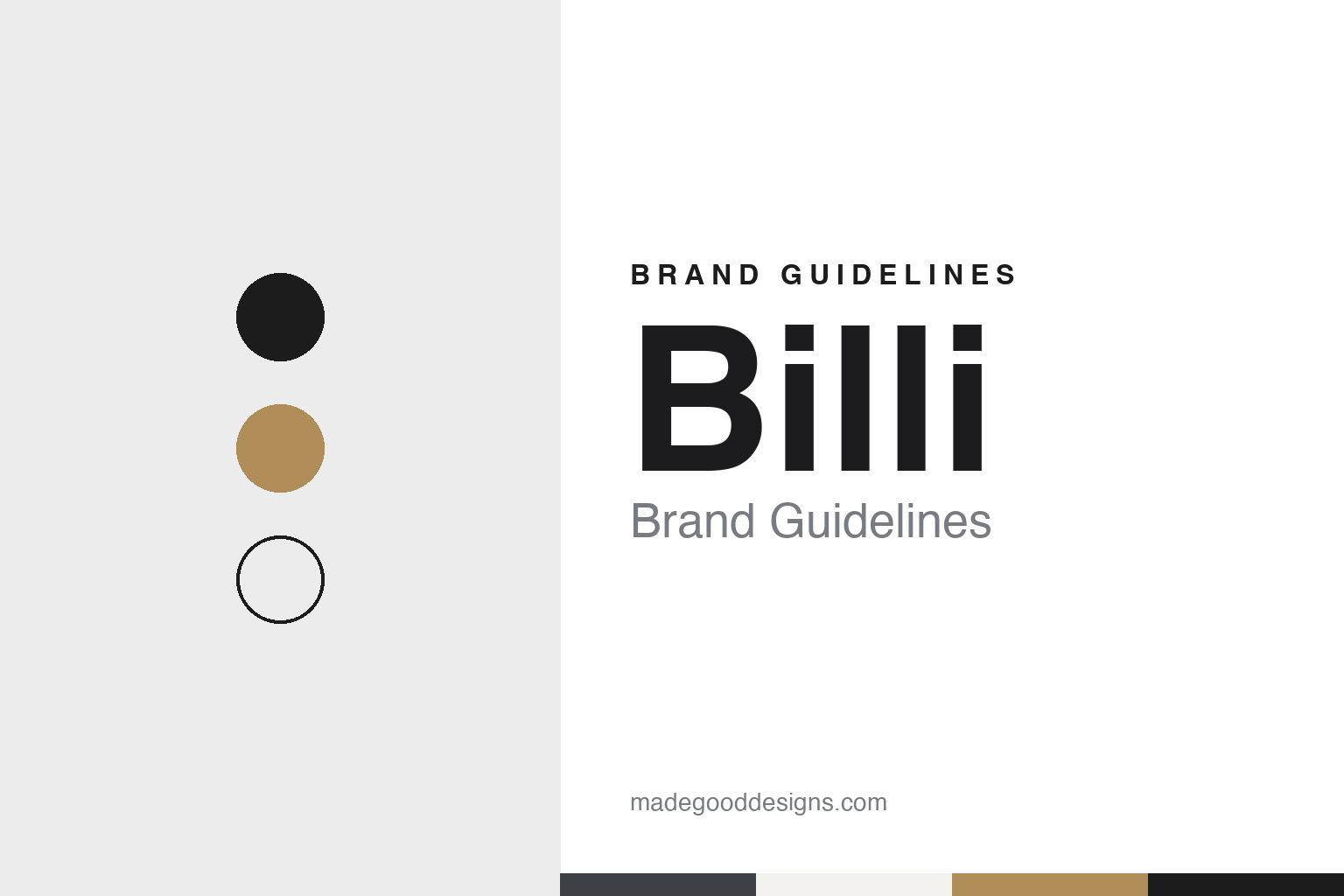
Billi Brand Guidelines
The Melbourne tap maker that hid the boiler under the bench.
Aa
Two constants: a Billi gunmetal, brass and steam white palette and a slim geometric sans register. Abstract homage — not a Billi product or mark; no tap, logo or nameplate is reproduced.
Under the bench
A boiler out of sight and a tap on show.
Billi was founded in Melbourne in 1989, the company says. Its own account is that it launched, the following year, what it calls the world’s first under-bench boiling filtered water system: a single slim unit hidden beneath the benchtop that delivered instant filtered hot water through one neat tap. When Strix announced its purchase of the business in 2022, it described Billi as having a thirty-year history of designing and producing its products.
That arrangement still defines the brand. The working parts, the boiler, the chiller and the filters, sit in the cabinet, and the only thing on the bench is the tap. Billi says the main changes over the decades have been a smaller under-bench footprint, better energy efficiency and tapware that people are happy to put on display.
The range is now sorted by the kind of water it pours. Billi’s site groups its systems as boiling, chilled and sparkling; boiling and chilled; chilled and sparkling; boiling and ambient; and chilled or ambient alone, sold for homes and for workplaces. Its flagship under-bench unit is the Quadra, which the company says marks its twentieth anniversary in 2026. Billi says its multi-stage filtration was developed with the water specialist BWT, and that sparkling water is made with food-grade carbon dioxide.
Billi presents itself as an Australian manufacturer. It says its systems are designed and made locally in Melbourne, in a plant it is expanding to support international demand, and its 2022 statement on the Strix deal carried a Thomastown, Victoria, dateline. The company says it sells in around 25 countries, with regional sites for New Zealand and the United Kingdom.
Colour
Finishes, awards and labels.
Because the tap is the only visible part, Billi talks about it in the language of kitchen design. The company says that in 2016 it became the first maker in its category to offer matte and metallic finishes, and its finishes now run from brushed chrome to brass, bronze, gunmetal, matte black and stainless steel. Profiles are slim, and the company says architects, designers and homeowners specify Billi for the look.
Several tap designs anchor the range. Billi says the XL tap has been on the market for almost fifteen years, and that its Multifunction Mixer Tap, which combines filtered water with ordinary hot and cold, won a Good Design Award for industrial design in 2024. Other lines on its site include the X Series and Slimline.
The company also lists environmental labels and memberships. Billi says it received its first Gold Global GreenTag certification in 2014, that the Quadra has an Environmental Product Declaration, that it joined the International WELL Building Institute as a Cornerstone member in 2019, and that its Melbourne plant moved to the natural refrigerant R290 in 2022. These are the terms in which the brand addresses specifiers and building owners, alongside its service plans and technical documents.
Its own pages lead with the phrase “Made in Australia” and describe the company as Australian-owned and Australian-run, with engineering and production kept under one roof in Melbourne.
Typography
Water in the workplace.
Water dispenser makers sell into rooms that most people pass through without noticing: the office kitchen, the staff room, the school corridor, the gym lobby and the hotel back-of-house. Their brands have to work for two audiences at once. One is the person who fills a glass or a bottle several times a day; the other is the facilities manager, architect or procurement team who chooses the equipment, signs a rental or service contract and answers for it afterwards.
The product types shape how these companies present themselves. A freestanding or countertop cooler fed from the mains is usually shown as a tidy appliance in a bright workspace, often next to a choice of still, sparkling, hot or chilled water. An under-sink system is a different kind of sell: the boiler, chiller and filter sit out of sight in the cabinet, so the visible part of the brand is a slim tap on the bench, and the photographs tend to concentrate on its finish and profile.
Bottle-filling stations and drinking fountains bring the category into schools, universities, gyms and public spaces, where the language turns to refills, durability and easy cleaning. Here the brand appears on a sturdy wall unit rather than a kitchen fitting, and the messaging is aimed as much at the people who maintain it as at the people who use it.
Much of the selling still happens in person, at facility-management, building and hospitality trade fairs, in showrooms and through dealer and distributor networks. Many of the names in this field have also changed hands through mergers and acquisitions, so a brand’s history often runs through several owners, and its identity has to stay recognisable across catalogues, service vans and installer manuals in many countries.
Aa
A slim geometric sans for a brand whose product is a slim tap. (Specimen set in Jost, a sans STAND-IN; NOT the Billi logo.)
Billi
Waterlogic, Strix and an Australian buyer.
Billi has changed hands three times since 2018. That year it was bought by Waterlogic, the British-founded maker of mains-fed water dispensers; Architecture & Design reported the acquisition on 7 May 2018. The Australian Competition and Consumer Commission later noted that Waterlogic operated in Australia through the Waterlogic Australia and Billi brands.
When Waterlogic agreed to combine with Culligan in 2022, Billi became the sticking point. Culligan already owned Zip, whose taps competed with Billi’s in Australia. On 19 May 2022 the ACCC said it would not oppose the deal after accepting an undertaking to sell Billi, saying that “without the divestment of Billi, Culligan’s acquisition was likely to substantially lessen competition in the supply of multi-functional taps.” Regulators in the United Kingdom and New Zealand also looked at the overlap between Billi and Zip.
In October 2022 Culligan agreed to sell Billi to Strix Group, the Isle of Man company founded in 1982 that makes kettle controls and water filtration products, and Isle of Man Today reported the agreement on 11 October 2022. Billi says the deal was completed on 1 December 2022; Strix said it covered Billi Australia, Billi New Zealand and Billi UK. Under Strix, according to a December 2025 report in BusinessCloud, the business expanded its production capacity in Australia and opened a flagship showroom in London.
Strix did not keep it for long. On 19 December 2025 it agreed to sell Billi to Birmingham Bidco Pty Ltd, a newly formed Australian company backed by Crescent Capital Partners VII, a private equity fund managed by Sydney-based Crescent Capital Partners, BusinessCloud reported. Strix announced on 30 January 2026 that the sale had been completed, and the two companies agreed to explore a future manufacturing and development partnership.
For a design guide, Billi shows how a brand can live almost entirely in one small visible object, with the machinery hidden in the cupboard below. Compare Zip Water, the tap brand whose overlap with Billi shaped the 2022 sale, and Waterlogic, its owner from 2018 to 2022. For this guide we use gunmetal, a brushed brass and a warm white with a sans, an unofficial interpretation; no product or logo is reproduced.
Explore & save
Keep Billi’s identity on hand — save it to a board in the Made Good inspiration library.
Billi identity set
Pin the Billi gunmetal, brass and steam white palette and the slim geometric sans register to your own board.