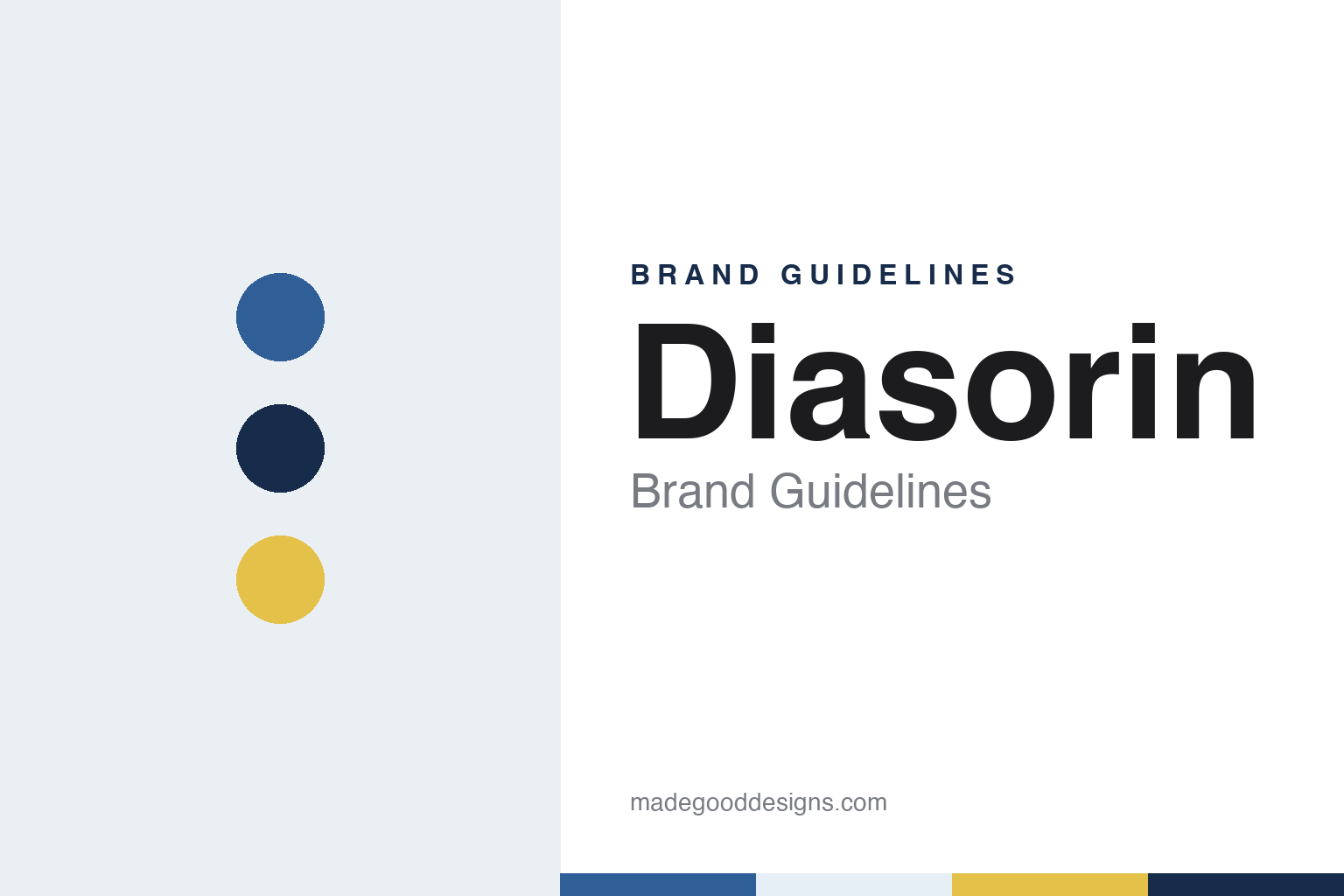
Diasorin Brand Guidelines
The Saluggia diagnostics group built around a drop drawn from a D.
Aa
Two constants: a blue, navy and yellow palette and a rounded lab sans register. Abstract homage — not a Diasorin product or mark; no analyser, logo or symbol is reproduced.
Sorin Biomedica
Nuclear research, Saluggia and a diagnostics division.
Diasorin is an Italian diagnostics group headquartered in Saluggia, in the province of Vercelli in Piedmont. Its name joins “Dia,” for diagnostics, to Sorin, the acronym of the Società Ricerche Impianti Nucleari, a nuclear research company, Italian Wikipedia says. The company dates its own story to 1968: its history page describes the founding that year of SORIN at Saluggia as a joint venture between Fiat and Montecatini, and calls it the first European in vitro diagnostic centre. Italian Wikipedia puts it a little differently, saying that in 1968 Sorin set up Sorin Biomedica, where Italian technicians trained in the United States specialised in equipment for in vitro diagnostics.
The diagnostics business changed hands in 1997, when American Standard International bought it together with Incstar, a diagnostics company based in Stillwater, Minnesota, according to Italian Wikipedia; by then the business carried the Diasorin name. In 2000 a management buyout led by Carlo Rosa, backed by the entrepreneur Gustavo Denegri, took it out of the American Standard group — “Diasorin returns to Italian hands,” as the company’s timeline puts it. English Wikipedia therefore gives 2000 as the founding year of the present group, while the company speaks of more than 50 years of work in diagnostics.
Shares in Diasorin began trading on the Italian Stock Exchange on 19 July 2007, the company says. On 4 December 2018 it joined the FTSE MIB, the index of the 40 most liquid and highly capitalised Italian shares, taking the place of Luxottica, Teleborsa reported that day.
Colour
LIAISON, CLIA and a move into molecular testing.
Diasorin’s products are reagent kits and the analysers that run them, sold to hospital and private laboratories. English Wikipedia describes its “core business” as the design and development of test kits that run on automated platforms, which partner companies build to Diasorin’s specifications. The company splits the work between immunodiagnostics, which detects antibodies and antigens in a sample, and molecular diagnostics, which looks for the DNA or RNA sequences of pathogens.
The turning point came soon after the buyout. Diasorin acquired BYK-Sangtec and with it the rights to the LIAISON platform, based on chemiluminescence immunoassay, or CLIA — in 2001 according to Italian Wikipedia, in 2002 according to English Wikipedia — and began converting older ELISA tests, which were not fully automated, to the newer technology. The company says that in the decade to 2010 it concentrated on specialty and niche tests, building what it calls the widest CLIA specialty menu on the market. The family now includes the LIAISON XL laboratory analyser and the smaller LIAISON XS, which English Wikipedia says was designed for laboratories with low to medium throughput.
Acquisitions widened the range. Italian Wikipedia lists Biotrin and a licence for Eiken Chemical’s LAMP technology in 2008, Murex and an ELISA product line from Abbott in 2010, and NorDiag in 2011. In 2016 Diasorin bought the immunodiagnostics and molecular business of Focus Diagnostics from Quest Diagnostics, with a research centre and plant at Cypress, California; the company says this is how it entered molecular diagnostics, and the unit became Diasorin Molecular, home of the Simplexa molecular assays. Diasorin also bought the ELISA business of Siemens Healthineers — in September 2017 according to Italian Wikipedia, in 2018 in the company’s timeline — and signed a partnership with Qiagen on testing for latent tuberculosis.
In 2020 the company turned much of its effort to COVID-19 and launched four tests for the disease, followed by a fifth in January 2021, its timeline says. In 2021 it launched the LIAISON IQ, a point-of-care immunoassay platform developed with Lumos Diagnostics.
Typography
How diagnostics companies present themselves.
In vitro diagnostics is a business most people meet only at second hand, through a blood sample sent away or a result read back by a doctor. The companies behind those results make analysers, the reagents that run on them and the software that ties them together, and they sell mainly to hospital laboratories, independent labs and clinics rather than to the public.
That shapes how they look. The typical product photograph shows a white or pale grey bench analyser in a clean laboratory, sometimes linked to others in a line of automation, with sample tubes standing in racks and a touchscreen at the front. Smaller formats appear too: single-use cartridges for point-of-care machines, test strips and cassettes for rapid tests, pipettes and reagent packs. Blue and white palettes are common across the sector, along with plain sans serif type and diagrams of the laboratory workflow, and some makers have had their instruments judged on design: Sysmex’s clinical laboratory system was among the Good Design Gold Award winners in Japan in 2011.
The trade meets at a few large events. MEDICA in Düsseldorf gathers medical technology makers, and the annual meeting of ADLM, the Association for Diagnostics & Laboratory Medicine, formerly the American Association for Clinical Chemistry, brings laboratory companies together in the United States. Some of these groups grew by acquisition, so a single corporate name often sits above product names that began with other companies.
This guide sets out what can be checked about each brand: who founded it, who owns it, where its products are made and what it says about its own identity, and it marks clearly what rests only on the company’s own word. No diagnostic or clinical claims are made for any product.
Aa
A rounded lab sans — a lower-case wordmark beside a drop. (Specimen set in Lexend, a sans STAND-IN; NOT the Diasorin logo.)
Diasorin
A drop drawn from the letter D.
The largest step came in 2021. On 14 July Diasorin completed its acquisition of Luminex Corporation, the American maker of multiplexing technology, La Stampa reported, carrying a Teleborsa story; the deal gave Diasorin access to Luminex’s multiplex portfolio, widened its presence in the United States and took it into the life-science market. English Wikipedia lists the Luminex production sites that came with the deal in Austin, Madison, the Chicago area and Toronto, alongside Diasorin’s own plants at Saluggia and Gerenzano in Italy, Dietzenbach in Germany, Stillwater in Minnesota and Dartford in England. The company’s website now speaks of ten factories and nine research centres, and of a presence in more than 100 countries.
Two years later the group changed its look. On 24 October 2023 Diasorin unveiled a new corporate identity together with a new group website, its press release says. At the centre is a “drop” formed from the letter “D” of the logo, which the company says stands for the starting point of research and diagnosis: the sample to be analysed. In the release the drop appears in blue beside a dark navy wordmark, “Diasorin,” written with a capital D and the rest in lower case, above the line “The Diagnostic Specialist.” The release’s own boilerplate still used the older form, “DiaSorin.”
The release explains that the in vitro diagnostics businesses — immunodiagnostics and molecular diagnostics — now sit under the single Diasorin name, while the Licensed Technologies business keeps a revamped Luminex brand. Chief executive Carlo Rosa, who led the 2000 buyout, called the result “a unified and contemporary identity spanning all business lines.” The company presents the change as a step in integrating Luminex, which began after the 2021 acquisition.
For a design guide, Diasorin shows how a laboratory group can gather several businesses under one symbol — a drop that stands for the sample. Compare Qiagen, its partner on latent-tuberculosis testing, and Siemens Healthineers, whose ELISA business it bought. For this guide we use a clear blue and a deep navy with a warm yellow, set in a rounded sans, an unofficial interpretation; no product or logo is reproduced.
Explore & save
Keep Diasorin’s identity on hand — save it to a board in the Made Good inspiration library.
Diasorin identity set
Pin the Diasorin blue, navy and yellow palette and the rounded lab sans register to your own board.