Arab Potash Company Brand Guidelines
Dead Sea brine, solar ponds and a pan-Arab venture from 1956.
Aa
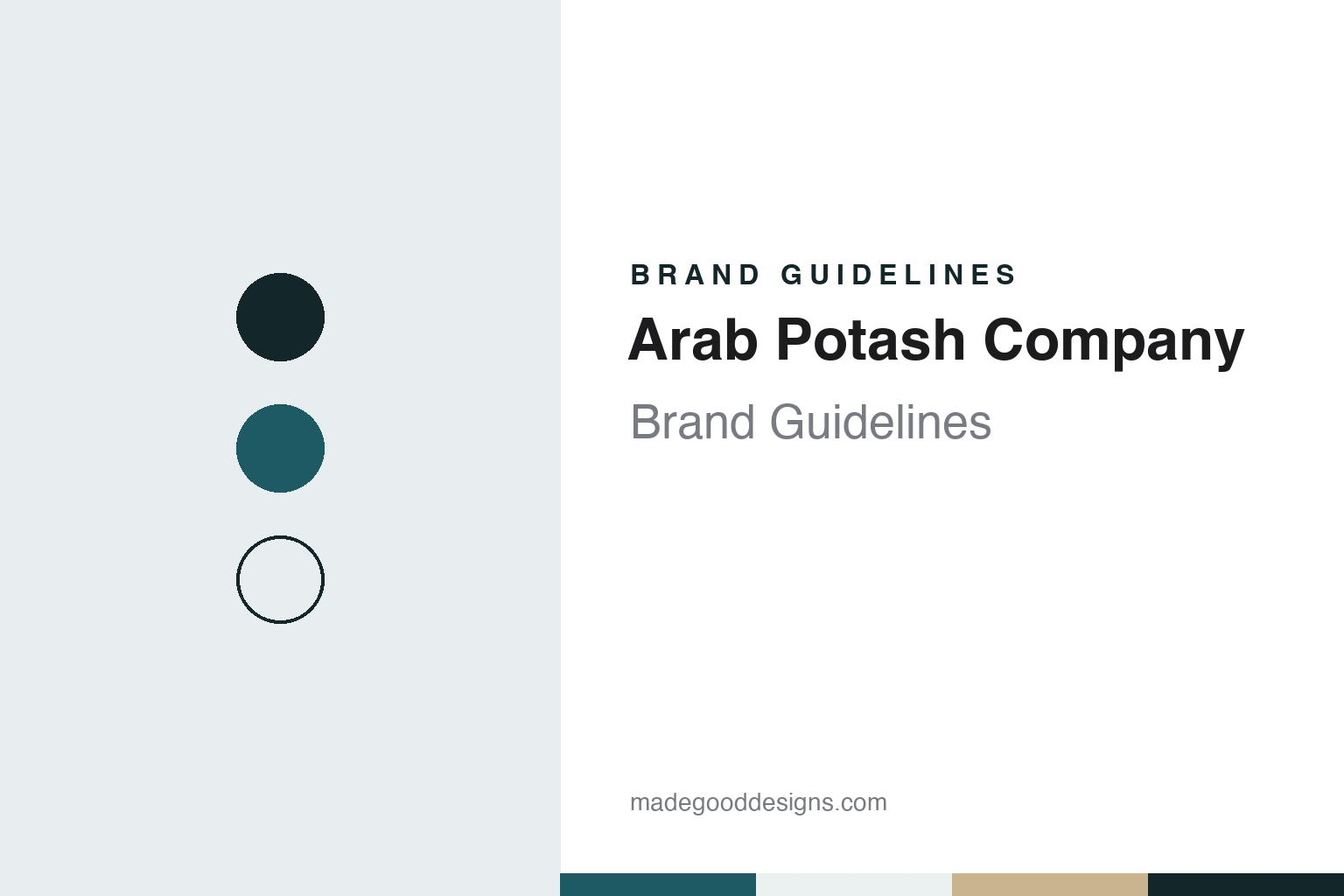
Two constants: a teal, sand and salt white palette and a plain sans register. Abstract homage — not an Arab Potash Company product or mark; no sack, logo or packaging is reproduced.
A Pan-Arab Venture
A company formed for the minerals of the Dead Sea.
The Arab Potash Company, usually shortened to APC, was formed in 1956 in Jordan as a pan-Arab venture, the company says. English Wikipedia says the government of Jordan set it up with several other Arab states, among them Saudi Arabia, Kuwait, Iraq and Libya, to extract potash and other minerals from the Dead Sea, and that Jordan kept the majority stake.
The idea was older than the company. English Wikipedia traces the first attempts to produce potash from the Dead Sea to the 1920s, when the engineer Moshe Novomeysky built a potash and bromine works there and later added a second site; the first was destroyed in the 1948 Arab–Israeli War and production at the other stopped, which ended that project.
A year after its founding, APC received the right that still defines it. Wikipedia says the Jordanian government granted it a 100-year concession, from 1958 to 2058, with exclusive rights to extract, manufacture and market minerals from the Dead Sea, and the company describes the concession in the same terms. Building the works took far longer than the paperwork: APC shipped its first commercial potash in 1983, more than two decades after the concession began, according to Wikipedia.
Colour
Solar ponds at Ghor Al Safi.
The company’s works stand at Ghor Al Safi, near the southern end of the Dead Sea, with its head office in Amman. The method is evaporation by the sun. Wikipedia says the water is drawn in at a brine intake pumping station on the Lisan peninsula, where four intake pumps feed a large system of evaporation ponds. The company says Dead Sea brine is pumped into solar ponds, where common salt settles out first; the brine then moves to carnallite ponds, where the carnallite that forms is harvested as a slurry and pumped to three refineries, the Hot Leach Plant and two Cold Crystallization Plants. The finished potash is stored by grade in the plant’s warehouses, then trucked to the company’s warehouses at the port of Aqaba before shipping. Wikipedia says the second cold crystallization plant came into operation in September 2010, together with a compaction plant for granular potash.
APC makes four grades of potash, standard, fine, granular and industrial, according to Wikipedia; the industrial grade is a high-purity potassium chloride made for buyers outside the fertiliser sector. Wikipedia names India, China and Malaysia as its main export markets. In 2019 it produced red potash for the first time and sent its first shipment to Brazil. The company says it has capacity for about 2.5 million tonnes of potash a year and employs more than 2,200 people in Amman, Aqaba and Ghor Al Safi. It describes itself as the eighth largest potash producer in the world by volume and the only potash producer in the Arab world, a description English Wikipedia repeats.
Around the potash sit several related businesses, which the company lists as subsidiaries and affiliates. KEMAPCO, a wholly owned company founded in 1998, makes potassium nitrate, dicalcium phosphate and nitric acid for markets in Europe and Asia; the Jordan Bromine Company, set up in 1999, is a venture with the American chemical group Albemarle; Numeira supplies mixed salts and Dead Sea mud to the cosmetics industry; and the Nippon Jordan Fertilizer Company, founded in 1992 with the Jordan Phosphate Mines Company and Japanese partners, makes NPK and DAP fertilisers mainly for Japan, according to Wikipedia. A ports company formed with the Jordan Phosphate Mines Company in 2009 works on the industrial jetty at Aqaba.
Typography
How fertiliser makers present themselves.
Fertiliser companies sell something most people never see up close: granules, prills and crystals that leave a mine or a chemical plant in bulk and end up spread across fields. Their visual language tries to bridge that distance. A familiar image is a handful of granules held in open palms, which turns a commodity into something a farmer can weigh and judge, and links the product to the people who use it.
The second register is the field. Corporate reports and websites in this sector lean on green crops, wide horizons and drone shots looking straight down on rows of maize, rice or vines. These images speak to growers and investors at once: they show the end use of the product, and they suggest scale without showing a single factory.
The third register is industrial. Open-pit mines, conveyor belts, evaporation ponds, acid plants and port terminals with ships at the quay appear alongside the fields, because extraction and logistics are the business. Packaging carries the brand into the farmyard: printed sacks and big bags, often with a crop icon, a nutrient formula and a product-range name on the front. Trade events such as the International Fertilizer Association’s Annual Conference add another stage, with stands, lanyards and presentation decks.
This guide sets out what can be checked about each company — when and where it was founded, who owns it, where it mines and makes its products, and how its name has changed — and marks clearly what rests only on the company’s own word. The palettes and typefaces shown here are our own unofficial interpretations, not official brand assets.
Aa
A plain sans for a company named after its region and its mineral. (Specimen set in Libre Franklin, a sans STAND-IN; NOT the Arab Potash Company logo.)
Arab Potash Company
A state stake, a Canadian partner and a Chinese buyer.
APC’s shareholders have changed with the wider fertiliser industry. English Wikipedia says that in 2001 the Jordanian government announced it would sell its 52.9% stake, drawing offers from the German potash producer K+S, the Japanese trading house Mitsubishi and the Canadian producer PotashCorp; by the end of 2003 PotashCorp had bought 28% of the company from the government. The company’s shares trade on the Amman Stock Exchange.
That Canadian holding passed to Nutrien, formed by the merger of PotashCorp and Agrium. On 23 July 2018 CBC News reported that Nutrien had agreed to sell its 23.3 million Arab Potash shares to SDIC Mining Investment, a Chinese state-owned company, because China and India had required it to sell the stake as a condition of approving the merger. English Wikipedia records that SDIC Mining bought the 28% stake in 2018. At board level, Wikipedia says the chairman who had served since June 2012 stepped down in December 2020 and was succeeded by Shehadah Abu Hdaib.
For a design guide, Arab Potash Company shows how a name can state its whole case: a region, a mineral and a company, with a single shoreline behind it. Compare ICL, which works the minerals of the same sea from the other shore, and Nutrien, a former shareholder. For this guide we use a deep teal, a desert sand and a salt white with a sans, an unofficial interpretation; no product or logo is reproduced.
Explore & save
Keep Arab Potash Company’s identity on hand — save it to a board in the Made Good inspiration library.
Arab Potash Company identity set
Pin the Arab Potash Company teal and sand palette and the plain sans register to your own board.