Bluelift Brand Guidelines
The Marti family’s tracked spider lifts from Montescudo.
Aa
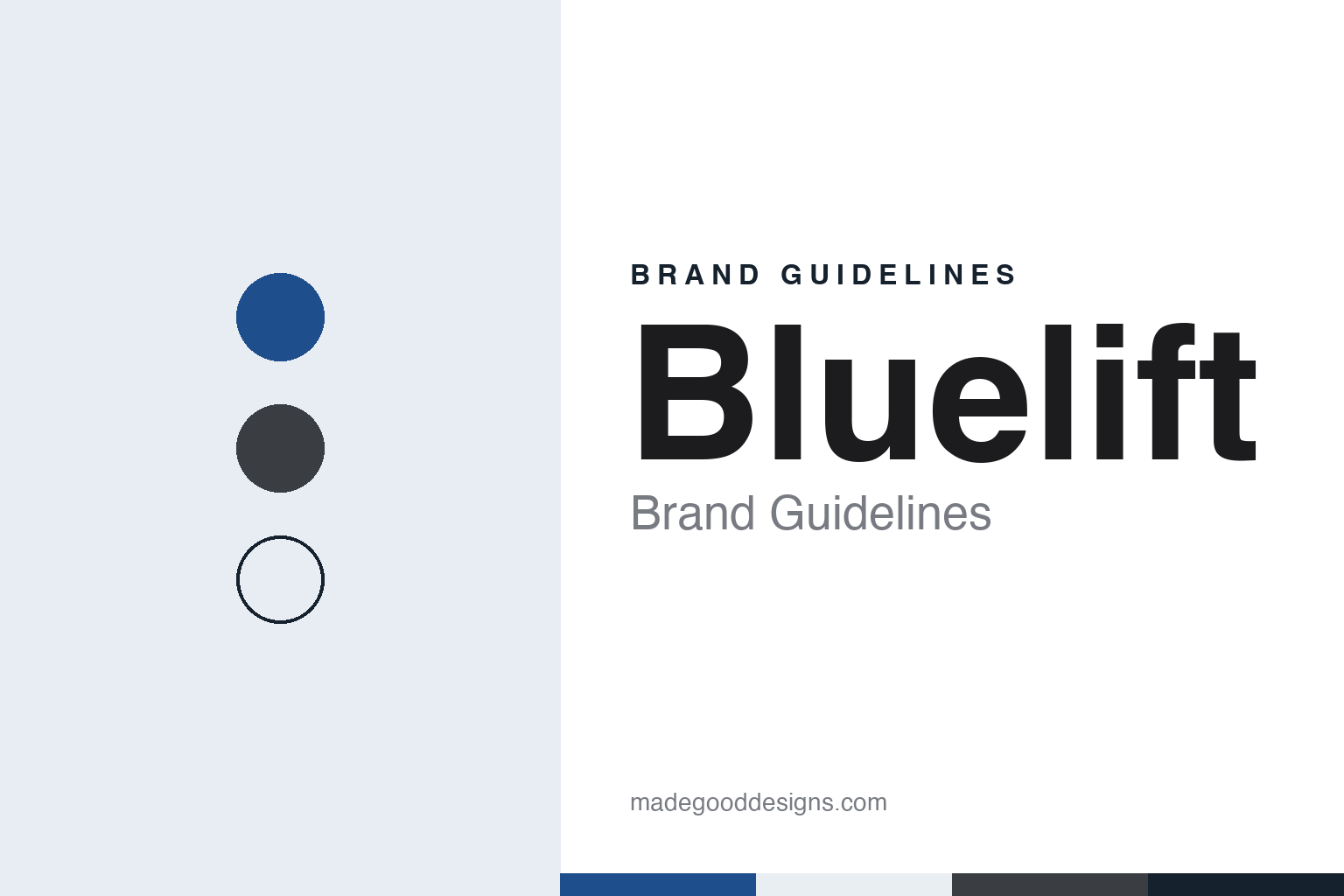
Two constants: a cobalt and warm graphite palette and a grotesque sans register. Abstract homage — not a Bluelift product or mark; no machine, logo or nameplate is reproduced.
The Marti family
An engineering subcontractor builds its own lift.
Bluelift is an Italian brand of tracked aerial work platforms, the machines the trade calls spider lifts. It grew out of a family engineering business. According to Access International, which interviewed the family in 2011, the company sprang from M&M, a subcontract engineering firm set up by the elder Marti in 1989 whose work included building arms for aerial work platforms; Vertikal.net, reporting in 2016, named Paolo Marti as the group’s founder.
His sons Gianni and Gianpiero Marti saw the chance to build complete machines of their own. They built their first prototype in 2003, a 12-metre tracked platform, choosing tracks because they had identified a niche that they believed would grow, the 2011 article said. Rather than sell it straight away, they lent the machine free of charge to local rental companies and end users for around a year, and used what they heard to refine their first commercial model. Even that prototype had a control on a cable that let the operator drive the machine from the ground as well as from the basket. A later report in Access International, from 2018, gives 2004 as the year the Marti family founded Bluelift, so the two dates sit a year apart: the first for the prototype, the second for the company.
The family’s aim for the first range was a set of machines with working heights from 12 to 22 metres, and by 2011 they had built it. Gianni Marti told the magazine that year that the company wanted to go higher, to 25 metres or more, and to keep updating its existing models to meet European standards and legislation. He said the company had invested time and money to bring its machines in line with planned changes to the EN280 standard covering electronic safety devices, and was disappointed when those changes were delayed. The family also told the magazine that it had kept all of its employees through difficult times.
Colour
From Bluelift to Ruthmann Bluelift.
By 2011 the line included models such as the C14 and C22, both offered with a radio remote control. The C22, first shown at the bauma fair, accounted for half of production, the family told Access International, and Bluelift had shown a new stabilising system at the SAIE building fair in 2006 on a 16-metre model. The company was then planning a new building on land next to its plant, so that welding could be separated from assembly and offices.
In April 2016 the German truck-mounted platform maker Ruthmann took a 60 percent stake in the Marti Group, the owner of Bluelift and of the Ram truck-mount brand, Vertikal.net reported. The spiders became Ruthmann Bluelift, the Ram 3.5-tonne truck mounts were renamed Ruthmann Ecoline and the Ram name was dropped, and the spider range then ran from 12 to 26 metres. The KLM loader cranes stayed with the Marti Group, outside the deal. Ruthmann took over the sales and service of Bluelift machines in Germany and Austria straight away, while distributors elsewhere were likely to stay the same, and the deal included plans to expand production capacity, which had held back the Bluelift range in particular, Vertikal.net added.
Later that month the Marti Group was renamed Ruthmann Italia S.r.l., with the family staying in the business: Paolo Marti in charge of manufacturing and purchasing, Roberto Marti managing production, Gianpiero Marti leading sales and marketing, and Gianni Marti on the supervisory board. Production stayed at the Marti plant in Montescudo, near Rimini. In October 2019 Ruthmann Italia opened a second production hall there for the Ecoline truck mounts, leaving the original building to the spider lifts, with 43 staff at the plant, Vertikal.net reported.
Typography
Design and documentation.
Aerial work platform makers present themselves through the machines first. Scissor lifts, articulated booms, telescopic booms, truck-mounted platforms and tracked spider lifts are usually painted in a single strong colour, such as an orange, a blue, a red or a yellow, with the maker’s name and the model code set large on the chassis or the boom. Seen across a site, the colour does much of the work a logo would do elsewhere.
Much of the industry sells to rental companies rather than to the people who use the machines, and its pictures often show that. Brochures and websites favour long rows of identical scissors and folded booms in a rental yard, machines lined up on a delivery truck, and close views of control boxes, battery packs and parts that a fleet workshop would care about. Product names tend to be strings of letters and numbers that encode working height, width or drive type.
The other stock image is the machine at work: a platform raised against a steel frame, a warehouse ceiling or a building facade, with operators in hard hats and harnesses at height. Electric and hybrid drive, lithium batteries and low-noise indoor use have become common themes in recent launches, described in the makers’ own words.
Trade fairs and awards fill the rest of the calendar. New models are often unveiled at The ARA Show in the United States, at bauma in Munich and at APEX, the access-equipment show in the Netherlands, while the industry press runs its own prizes, such as the International Awards for Powered Access. This guide sets out what can be checked about each brand — who founded it, who owns it and where it says its machines are made — and marks clearly what rests on the company’s own word.
Aa
A plain grotesque sans for a family engineering brand. (Specimen set in Archivo, a sans STAND-IN; NOT the Bluelift logo.)
Bluelift
Part of Time Manufacturing since 2021.
Ownership changed again in 2021. In January Vertikal.net reported that Time Manufacturing, the Waco, Texas maker of Versalift vehicle-mounted lifts, would buy the whole Ruthmann business, including the Bluelift plant in Italy and Ruthmann Reachmaster, its distributor in the United States. The two companies already knew each other: Time had distributed Ruthmann products in the US since 2013, and Time’s European arm, Versalift International, sold Ruthmann machines in the Nordic countries. Time’s owner, the private equity firm The Sterling Group, announced on 15 February 2021 that the deal was complete, naming Ruthmann, Steiger, Ecoline and Bluelift among the brands it brought in, with Ruthmann’s head office in Gescher-Hochmoor, Germany.
The new ownership changed how the spiders are sold. In the UK and Ireland, Versalift UK took over sales and service of Ruthmann Bluelift spiders from Snorkel UK and Ahern Ireland on 1 January 2023, as part of its integration into the Time group, Access International reported. In Australia, Ahern Australia was appointed exclusive distributor in 2018, when the magazine noted the lithium and hybrid machines in the range, among them the SA16 hybrid. Ruthmann’s own site today lists Bluelift models including the SA 20, Sat 22, Sat 26 and ST 31.
For a design guide, Bluelift shows a family brand that kept its name through two changes of owner, from Bluelift to Ruthmann Bluelift, inside a group that also includes Versalift. Compare Versalift, its sister brand under Time Manufacturing, and Platform Basket, another Italian maker of spider lifts. For this guide we use a cobalt and a warm graphite with a grotesque sans, an unofficial interpretation; no product or logo is reproduced.
Explore & save
Keep Bluelift’s identity on hand — save it to a board in the Made Good inspiration library.
Bluelift identity set
Pin the Bluelift cobalt and warm graphite palette and the grotesque sans register to your own board.