Dynamic Brand Guidelines
The French workshop that built a brand around the professional stick blender.
Aa
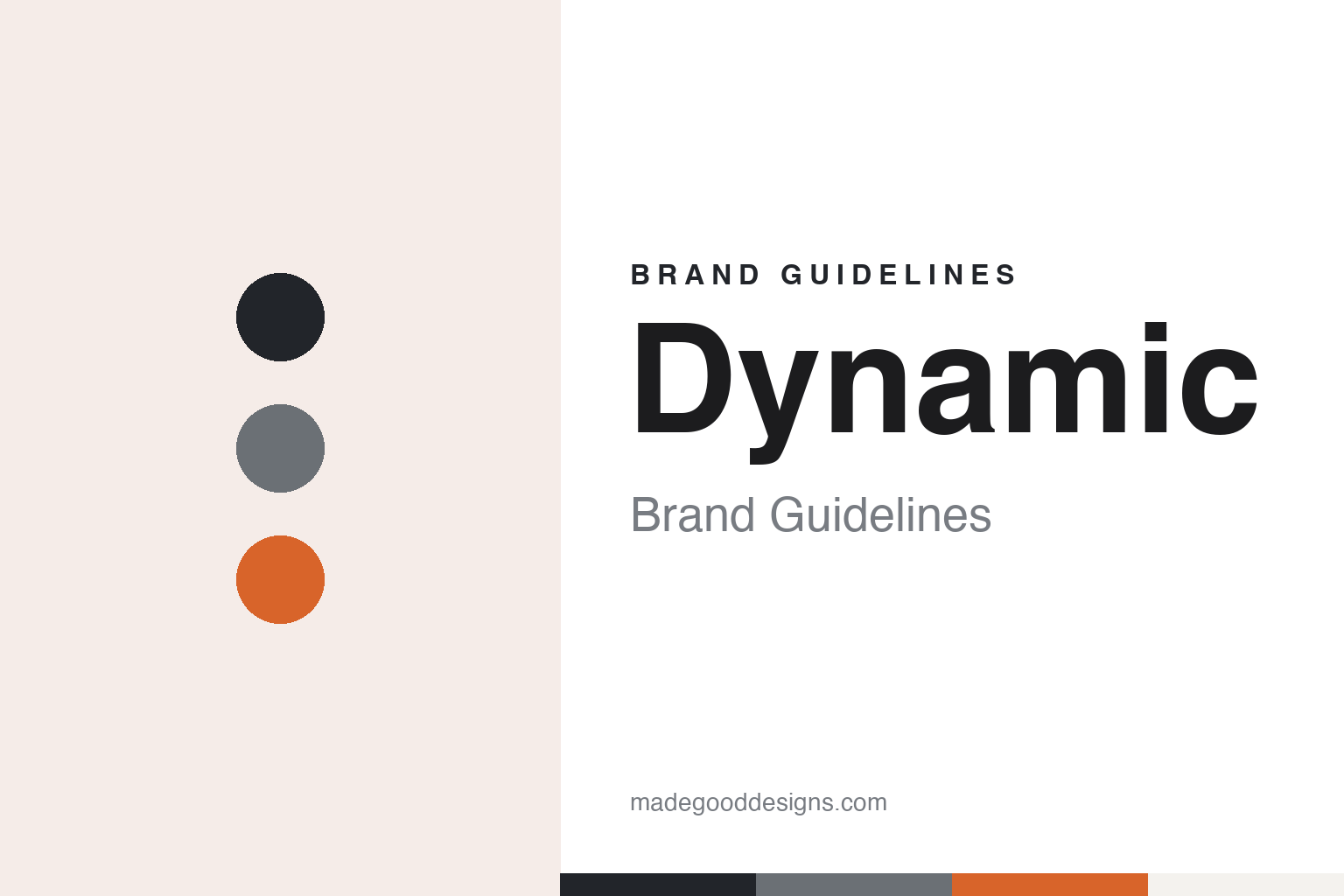
Two constants: a steel, charcoal and warm orange palette and an industrial sans register. Abstract homage — not a Dynamic product or mark; no machine, logo or nameplate is reproduced.
A Vendée maker
A mixer business inside a Cholet industrial group.
Dynamic, written in capitals as DYNAMIC across its own material, is a French maker of professional kitchen machines, and above all of the hand-held stick blenders that cooks plunge straight into the pot. The company dates itself to 1964, and the French business register agrees: the legal company behind the brand, the Société d’Études Réalisations Mécaniques, was created that year and trades under the sign Dynamic from its head office in Mortagne-sur-Sèvre, a small town in the Vendée, in western France.
From the start Dynamic has been tied to an industrial group based in nearby Cholet. The company’s own history says that in 1964 Dynamic “appears on the French market” as a subsidiary of the Nadia group, and that the small firm soon made a name in a field that had been little worked until then: high-end stick blenders made for professionals. The register today lists Nadia Industries as president of the company, which is organised as a French simplified joint-stock company.
Groupe Nadia describes itself as a diversified industrial group with four branches: made-to-measure aluminium gates, shutters and pergolas; road signage; automation and electronics for farming and industry; and what it calls industrial kitchen machines, the branch that Dynamic represents. Its website presents that diversity as a strength, a way of spreading the group’s business across several markets rather than relying on one.
Independent records give a sense of scale. French Wikipedia’s article on Mortagne-sur-Sèvre lists Dynamic among the town’s businesses as a maker of kitchen mixers with 51 staff in 2020, part of the Nadia group. The French business register places the company in the 50-to-99-employee band in 2024 and classes it as a maker of machinery for the food industry.
Colour
One tool, many attachments.
The stick blender is the centre of the range. Dynamic says it designs and makes the motors for its mixers itself, including winding their coils, and that it builds both fixed and detachable mixers with a long list of attachments: whisks, a ricer foot for mashed potato, a small cutter and a blender foot. Its current line-up runs from the MD95+, which the company now offers with a built-in temperature probe, and the smaller MD95+ Junior, to the large Gigamix turbo liquidizers, and the EasyMix system, which holds a mixer on a wall bracket, a fixed stand or a rolling stand.
The range grew outward from there. According to the company, a large-capacity salad spinner arrived in 1990 and became a flagship of the brand; a cordless mixer followed in 2016, presented as an answer to more mobile ways of cooking. The catalogue now also takes in a manual food dicer, a ricer, a juicer and the DMX 225, a blender and homogeniser that Dynamic offers to ice-cream makers.
The newest large machine is a combined vegetable slicer and food processor. A Dynamic press release says it took four years to develop and was launched at the Host show in Milan; it describes a soft, rounded orange base meant to look at home in an open kitchen, a choice of stainless-steel cutting discs, parts that come apart by hand, and a body made mostly of stainless steel and aluminium, two materials the company calls fully recyclable. Dynamic says some of the machine’s details are patented, and that it has kept plastic to a minimum.
Dynamic sorts its customers by trade rather than by product. Bakeries and pastry shops, brasseries and traditional restaurants, delicatessens and caterers, chocolate makers, ice-cream makers, pizzerias, institutional catering and food trucks each get their own page on its website, and a short questionnaire asks visitors what they want to slice, mix, mash or whip before it suggests a machine.
Typography
How the category presents itself.
Makers of commercial food-preparation equipment sell to a practical audience: chefs, bar owners, butchers, bakers and the dealers who fit out their kitchens. Their brands are built less on advertising than on catalogues, spec sheets and demonstrations, and the machines themselves, slicers, mixers, stick blenders, juicers and vegetable cutters, do most of the talking.
The imagery of the category is consistent. Machines are shown as cut-outs on white for the catalogue, or set on stainless-steel counters in a working prep kitchen, often with a chef’s hands at the controls. Close-ups of blades, discs, bowls and whisks stand in for the engineering inside, and a colour on a base or a housing can become part of a machine’s identity.
Trade fairs carry much of the brand work. Host in Milan, Internorga in Hamburg and the National Restaurant Association Show in Chicago are among the shows where makers set up working stands, run live demonstrations and launch new models to importers and dealers; Dynamic says it launched its combined vegetable slicer at Host, and Santos says it chose a limited colour for its #11 juicer after a visitor vote there in 2019.
Some of these makers are independent companies and some sit within larger industrial groups, and several make the place where their machines are built part of their identity. This guide sets out what can be checked about each brand, who founded it, who owns it and what it says about where its products are made, and marks clearly what rests only on the company’s own word.
Aa
An industrial sans for a machine maker. (Specimen set in Archivo, a sans STAND-IN; NOT the Dynamic logo.)
Dynamic
Made in the Vendée, sold abroad.
Dynamic makes much of being French-made. The company says it has two production sites, at Mortagne-sur-Sèvre and at Vence, in the Alpes-Maritimes behind Nice, which it says let it keep design and manufacture almost entirely in its own hands; it describes its range as commercial kitchen appliances “made in France.” It calls itself the inventor of the commercial stick blender, and says it sells around the world through importers and distributors and through its own subsidiaries in Germany and in North America, in the United States and Canada. Those are the company’s own statements.
The brand also leans on durability. Dynamic says that all its spare parts are available, that its products are built to be repaired and taken apart, and that its machines fall under the European rules on the end-of-life collection of electrical equipment. It shows new machines to dealers at trade fairs; in 2026 its website announced a stand at the FIPAN show in Brazil in July.
For a design guide, Dynamic shows how one tool, the professional stick blender, can carry a whole brand, with whisks, spinners and slicers added around that first machine over six decades. Compare Robot-Coupe, another French maker of professional food-preparation machines, and Santos, the Lyon maker of juicers and bar blenders. For this guide we use steel grey and charcoal with a warm orange and a sans, an unofficial interpretation; no product or logo is reproduced.
Explore & save
Keep Dynamic’s identity on hand — save it to a board in the Made Good inspiration library.
Dynamic identity set
Pin the Dynamic steel, charcoal and warm orange palette and the industrial sans register to your own board.