Glenair Brand Guidelines
The Glendale backshell maker behind the Mighty Mouse connector.
Aa
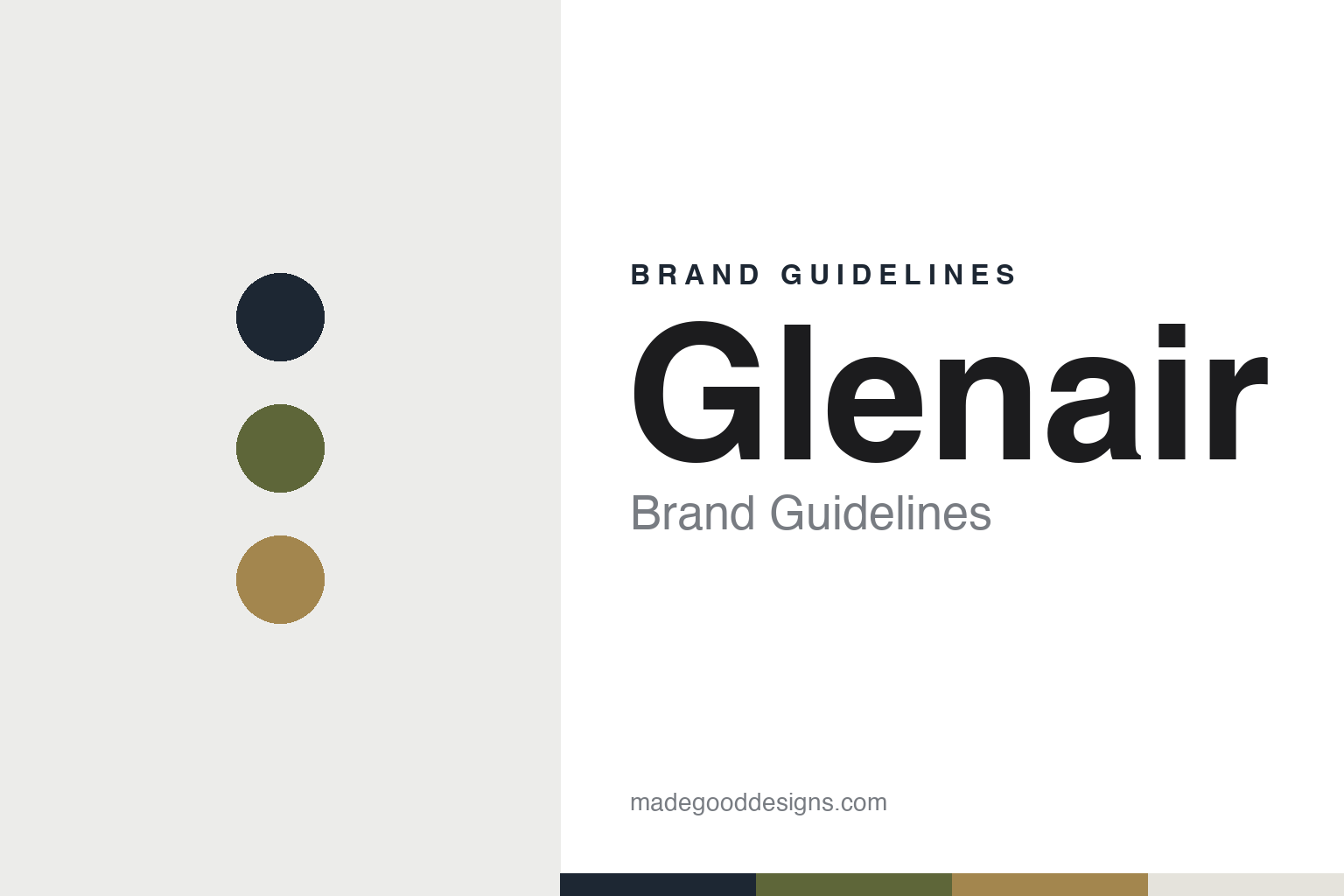
Two constants: a navy, olive and brass palette and a condensed technical sans register. Abstract homage — not a Glenair product or mark; no connector, backshell, logo or nameplate is reproduced.
Backshells
Connector accessories in Southern California.
Glenair is a connector maker from Glendale, California, in Los Angeles County. The company says it began operations in 1956 producing electrical connector backshells and accessories — the fittings that attach to the rear of a connector where the cable leaves it — and a company brochure of 2021 calls it “at home in Southern California since 1956.” In 2026 it marks the date with a catalogue titled 70 Years of Interconnect Innovation, offered on its website.
Glenair describes itself as privately held. Its president, Chris Toomey, signs a note on the company website about its fifteen original Guiding Principles, which he says are deliberately not called rules. Among his favourites he lists “Protect the reputation of the organization,” “Bow to the customer’s convenience,” “Be reality oriented” and “Build win-win business relationships.” He calls Glenair “a unique, privately-held, made-in-America outfit” that “marches to a different drummer,” and writes that the principles have done more to shape the company’s culture, and its focus on customer service, “than any book of rules could ever be.” The principles are drawn up as an illustrated poster on the same page, and the website also offers a factory tour of the American, British and Italian operations.
Glendale remains the company’s base. The City of Glendale’s annual financial report for the fiscal year to June 2025, as tabulated in English Wikipedia, lists Glenair Inc. as the seventh-largest employer in the city, with 1,770 employees; a similar table for Arcadia, California, lists another 220 Glenair staff there. The 2021 brochure describes the Glendale operation as having “complete vertical integration of manufacturing resources.”
Colour
Mil-spec circulars and a mouse.
From backshells the range widened into complete connectors and cable systems. Glenair says it now offers dozens of connector product lines for land, sea, air and space uses, including military-qualified designs to the MIL-DTL-38999 Series III specification and its own micro-miniature Series 80 “Mighty Mouse.” Other families on its video pages include SuperNine, Series 79, fibre optics and hermetic connectors, alongside its Band-Master tools. It also publishes a technical magazine, QwikConnect, and claims “the industry’s largest standing inventory” of commercial and Mil-Spec electrical and optical connector components.
Manufacturing is spread across four countries. Glenair says its connectors, backshells and cable assemblies are all made in the United States or at its own facilities in Mansfield, England, Bologna, Italy, and Salem, Germany, and sets that against other interconnect makers moving production to Estonia, Mexico, India, China and elsewhere. Its 2021 brochure describes Glenair UK, home of its SuperG55 connector, with an accredited test laboratory for connector qualification; Glenair Italia, making harsh-environment interconnects for military, nuclear, rail and industrial uses; and Glenair Space Systems at Salem, which builds space-grade harnesses in clean rooms.
The British operation has a long paper trail. Companies House lists a company now called Glenair (1972) Limited, whose earlier names include Glenair UK Limited and Glenair International Limited, incorporated in May 1972 with its office in Mansfield, Nottinghamshire. Offices named on the company site also include Toulouse, Bad Homburg, Madrid, Solna, Nagoya and Yongin in South Korea, with a Microway Systems unit in Lincolnwood, Illinois, and a site in Connecticut.
Glenair also appears in outside rankings. In the research firm Bishop & Associates’ regional rankings for 2022 and 2023, reported by Connector Supplier in December 2023 and November 2024, Glenair was among the companies that reached the top 10 in at least one geographic region. The company says its quality system is registered to AS9100 and ISO 9001, and it lists a Nadcap accreditation for cable and harness assemblies at its Anaheim facility.
Typography
How the category presents itself.
Wire, cable and connector makers sell parts that disappear once they are installed, so their pictures tend to show the moment before that happens. Yards stacked with wooden cable drums, reels of insulated conductor and coils of copper set the scale of a cable business; close-ups of gold-plated contacts, crimped terminals and push-pull plugs show the precision of a connector maker. Bundles of colour-coded wires, laid out on a harness board, explain more about the trade than any slogan.
The customers shape the imagery. Many of these companies supply aircraft, rail vehicles, cars, factories and communications networks, and their brochures return again and again to the same scenes: a wiring harness threaded through an airframe, a connector on a train bogie, a cabinet of fibre-optic cable in a data centre. The product is rarely the hero on its own; it appears in the machine it serves.
Much of the industry’s public life happens at trade fairs. electronica, the electronics trade fair, is where component makers show connectors, sensors and assemblies to engineers and buyers, and Wire Düsseldorf gathers the makers of wire, cable and the machines that produce them. Stands are often built around cut-away samples, test rigs and walls of plugs in every size.
The names themselves reflect a long history of mergers. Several of the companies in this guide carry coined names, initials or the names of founders whose businesses were later bought and combined, and the same plug may be sold under a brand that has changed owner more than once. This guide sets out who founded each company, who owns it now and what it says about where its products are made, and marks clearly what rests only on the company’s own word.
Aa
A condensed technical sans for part numbers and spec sheets. (Specimen set in Barlow Condensed, a sans STAND-IN; NOT the Glenair logo.)
Glenair
Mission-critical, in plain words.
Glenair’s public voice is plain and engineering-led. Its tagline, “Mission-Critical Interconnect Solutions,” sits under the name across its website, and its About page offers the company logo for download in print and web formats. Most of the character comes from product names: a micro-miniature series called “Mighty Mouse,” families called SuperNine and SuperG55, and a magazine called QwikConnect.
Place is the other strand. One of the company’s own brochures is titled “Made in America, England, Germany, and Italy,” and its About page returns to the point, saying it is proud to keep making its products in its own plants in the United States and, for selected connectors, in Western Europe. Mr Toomey’s note on the Guiding Principles makes the same case for the culture, contrasting principles with rules and trust with micro-management.
The markets it names follow the same line. Glenair says its products serve land, sea, air and space applications; its brochure names military, nuclear and rail work for the Italian plant and space-grade harnesses for the German site; and its catalogue library and product-video pages are organised by series number and military specification.
For a design guide, Glenair shows how a privately held maker of military and aerospace connectors builds an identity from product names, plain principles and the places it makes things. Compare Amphenol, another American connector maker, and LEMO. For this guide we use navy, an olive and a brass with a condensed sans, an unofficial interpretation; no product or logo is reproduced.
Explore & save
Keep Glenair’s identity on hand — save it to a board in the Made Good inspiration library.
Glenair identity set
Pin the Glenair navy, olive and brass palette and the condensed technical sans register to your own board.