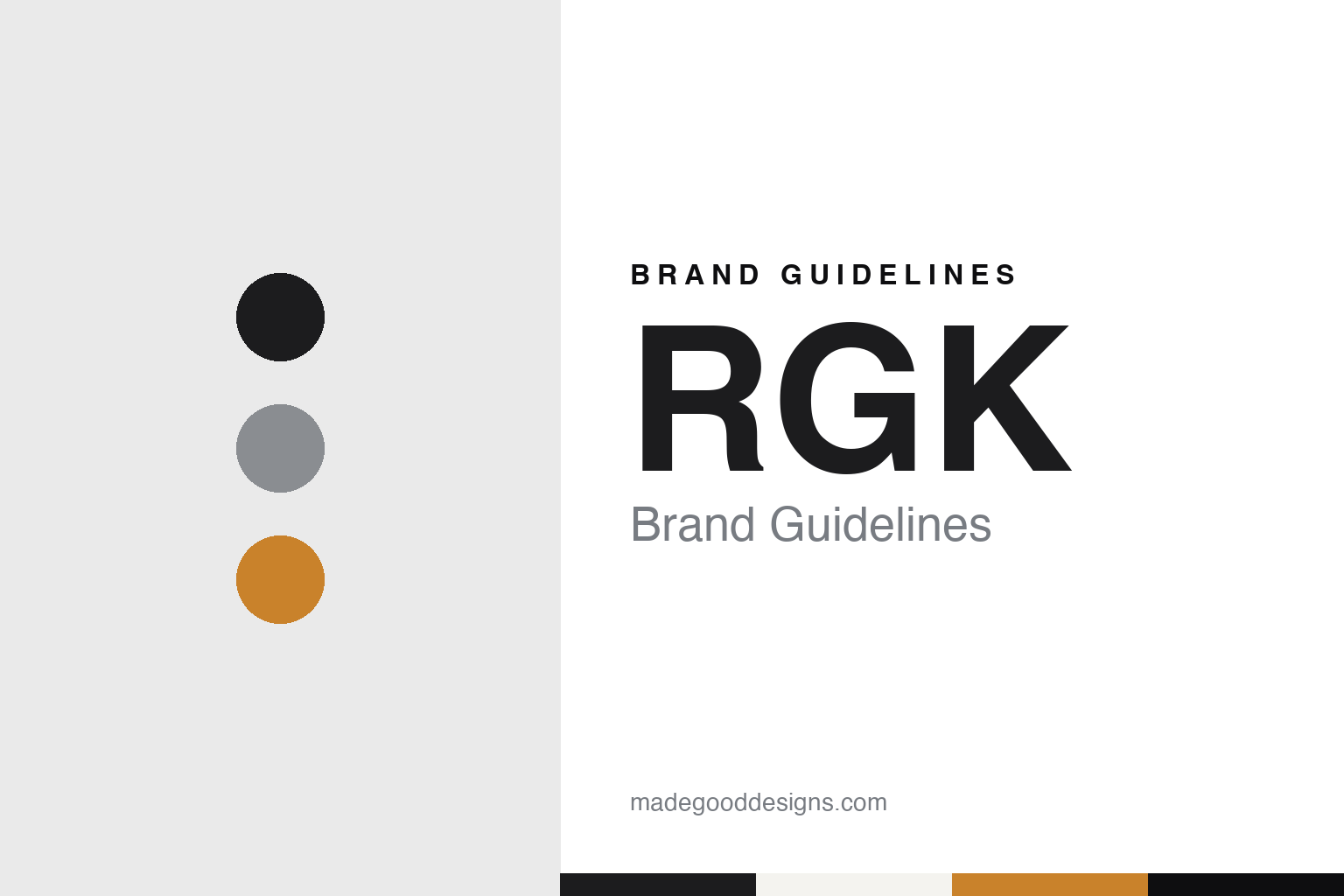
RGK Brand Guidelines
Hand-built chairs measured to the millimetre, from a Staffordshire kitchen to the court.
Aa
Two constants: a carbon, titanium and amber palette and a condensed sports sans register. Abstract homage — not an RGK product or mark; no wheelchair, logo or nameplate is reproduced.
Bespoke
Two basketball players and a kitchen.
RGK was started in 1988 by Russel Simms and Greg Eden, whom the US trade magazine Mobility Management described in May 2015 as wheelchair-basketball fanatics at the time. Simms, then the company’s commercial director, said in a company profile quoted by the magazine that rigid-frame designs had by then reached Britain’s high-performance manual wheelchair market, but “there was nothing of a really bespoke design available,” and that this was where the idea came from. The aim, he said, was to build “the world’s finest hand-built wheelchairs” — a project that, according to the same report, began in his kitchen.
That founding story still shapes how the brand talks. Bespoke, the British word for something made to its owner’s order, is the core of its pitch: the company says all its made-to-measure products are hand-crafted for the person who will use them, with measurements taken to the millimetre, and that options such as ergonomic seat shapes and seat tapers are set to each rider. When Sunrise Medical North America launched the range in the United States in 2022, Rehab Management reported that RGK typically takes more than 30 measurements for each chair.
The business is based on Burntwood Business Park in Burntwood, Staffordshire, north of Birmingham, according to its website, whose product pages speak of the “rider” and which introduces its ambassadors under the line “Unlock your unstoppable ambition.” Earlier material, including Sunrise Medical’s 2015 announcement, pointed readers to a different web address, rgklife.com; the current site is rgkwheelchairs.com.
Colour
Court chairs, daily chairs and carbon fibre.
RGK’s reputation was built on the court. Sunrise Medical’s announcement of April 2015 described it as a developer, designer and maker of high-end, fully tailor-made court-sports and basketball wheelchairs, and called it the industry’s global leader in that field; it added that RGK also offered a broad range of high-end daily manual chairs. The current sport range includes the Elite and Allstar basketball chairs, the GrandSlam tennis chair, the Elite RL and Predator for wheelchair rugby, the Sprint racing chair and the Danza for wheelchair dance, the company’s website shows.
Materials are central to the range. English Wikipedia’s article on technological change at the Paralympic Games cites RGK’s own 2017 product page when it notes that carbon fibre and titanium are now used in basketball-chair seats. The daily range names its metals outright: the Tiga in aluminium, the Octane in titanium and the Chrome in chrome-moly steel, with a junior Tiga for children. The newest flagship is the Veypr Sub4, which the company calls the world’s first truly made-to-measure carbon-fibre wheelchair. It says the frame is laid up in four layers of hand-made carbon fibre, three structural layers each offset by 45 degrees and a final layer hand-laid in a herringbone weave.
Beyond the frames, RGK’s website lists add-ons sold with its chairs — front-mounted power attachments, rear power-assist units, power wheels and seating from the wider Sunrise group. The brand has also helped new sports along. English Wikipedia says inline sledge hockey, invented by the British Paralympian Matthew Lloyd and played in sports halls rather than on ice, was developed through several organisations, including the Hull Stingrays ice-hockey team, the British Sledge Hockey Association, Wheelpower and RGK.
Typography
How wheelchair makers present themselves.
Wheelchair and seating makers sell to several audiences at once: the people who ride their chairs, the therapists and seating specialists who measure and prescribe them, and the dealers and funders who supply them. Their catalogues and websites tend to show all three sides together — people using chairs at home, at work, outdoors and in sport, next to plain product views and pages of measurements and options.
The product picture is often a clean side profile on a white or pale ground, which lets the frame line, wheel camber and seat angle read clearly. Close-ups follow the materials: welded aluminium and titanium tubes, carbon-fibre weave, castors, push rims and folding mechanisms. Some makers name their models after the frame material or the sport, and offer made-to-measure versions built to a rider’s own dimensions.
Sport is a large part of the visual language. Court chairs for wheelchair basketball, tennis and rugby, with steeply cambered wheels and rear anti-tip castors, appear alongside racing chairs and handbikes. An International Paralympic Committee feature from April 2013 noted that, beyond size rules, basketball-chair designers face few restrictions, and that recent advances had come mostly in materials and welding. Makers often show their chairs with Paralympic athletes and club teams, and some sponsor sports associations.
The trade meets at fairs. REHACARE in Düsseldorf describes itself as a trade fair for rehabilitation, prevention, inclusion and care, with its next edition set for September 2027; in the United States, Medtrade serves the home medical equipment trade. This guide sets out what can be checked about each brand — who founded it, who owns it and where it says its chairs are made — and marks clearly what rests only on the company’s own word.
Aa
A condensed sans for a maker of court-sport and made-to-measure chairs. (Specimen set in Barlow Condensed, a sans STAND-IN; NOT the RGK logo.)
RGK
A Staffordshire maker inside a global group.
RGK changed hands 27 years after its founding. On 30 April 2015 Sunrise Medical, the wheelchair group behind Quickie and Sopur, announced that it had acquired RGK Wheelchairs Ltd. Sunrise said the purchase would support its position in high-end sports products and that RGK’s daily chairs added another choice alongside its own premium active brands. Mobility Management reported in May 2015 that the deal was announced by Equistone Partners Europe, one of Sunrise’s owners at the time, and came just weeks after Sunrise bought Switch-It, a maker of alternative driving controls for power wheelchairs, in March. Sunrise’s chief executive, Thomas Rossnagel, said he was excited about a united RGK and Sunrise “especially leading up to the Rio 2016 Paralympics.”
The same announcement said Sunrise’s high-performance lines formed the basis for connecting active-wheelchair and sports users in their social-media communities. The brand kept its own name, website and Staffordshire base after the deal. In August 2022 Rehab Management reported that RGK’s made-to-measure manual chairs had become available through Sunrise Medical North America, together with an “RGK Genius” programme under which a specialist on the range joins each fitting, in person or by video, to help with measurements. Sunrise’s North American launch described RGK as founded on the principles of “challenging convention, breaking down barriers, and empowering people.” The website footer today reads “Part of the Sunrise Medical Group” and gives the Burntwood address; the company describes its chairs as hand-crafted to order.
For a design guide, RGK shows how a small specialist can keep a distinct voice — riders, millimetres, carbon weave and the court — inside a much larger group. Compare Sunrise Medical, its owner since 2015, and TGA Mobility, another British mobility maker. For this guide we use carbon black, a titanium grey and a court amber with a condensed sans, an unofficial interpretation; no product or logo is reproduced.
Explore & save
Keep RGK’s identity on hand — save it to a board in the Made Good inspiration library.
RGK identity set
Pin the RGK carbon, titanium and amber palette and the condensed sports sans register to your own board.