Rondo Brand Guidelines
The Burgdorf workshop whose reversing dough sheeter became a brand.
Aa
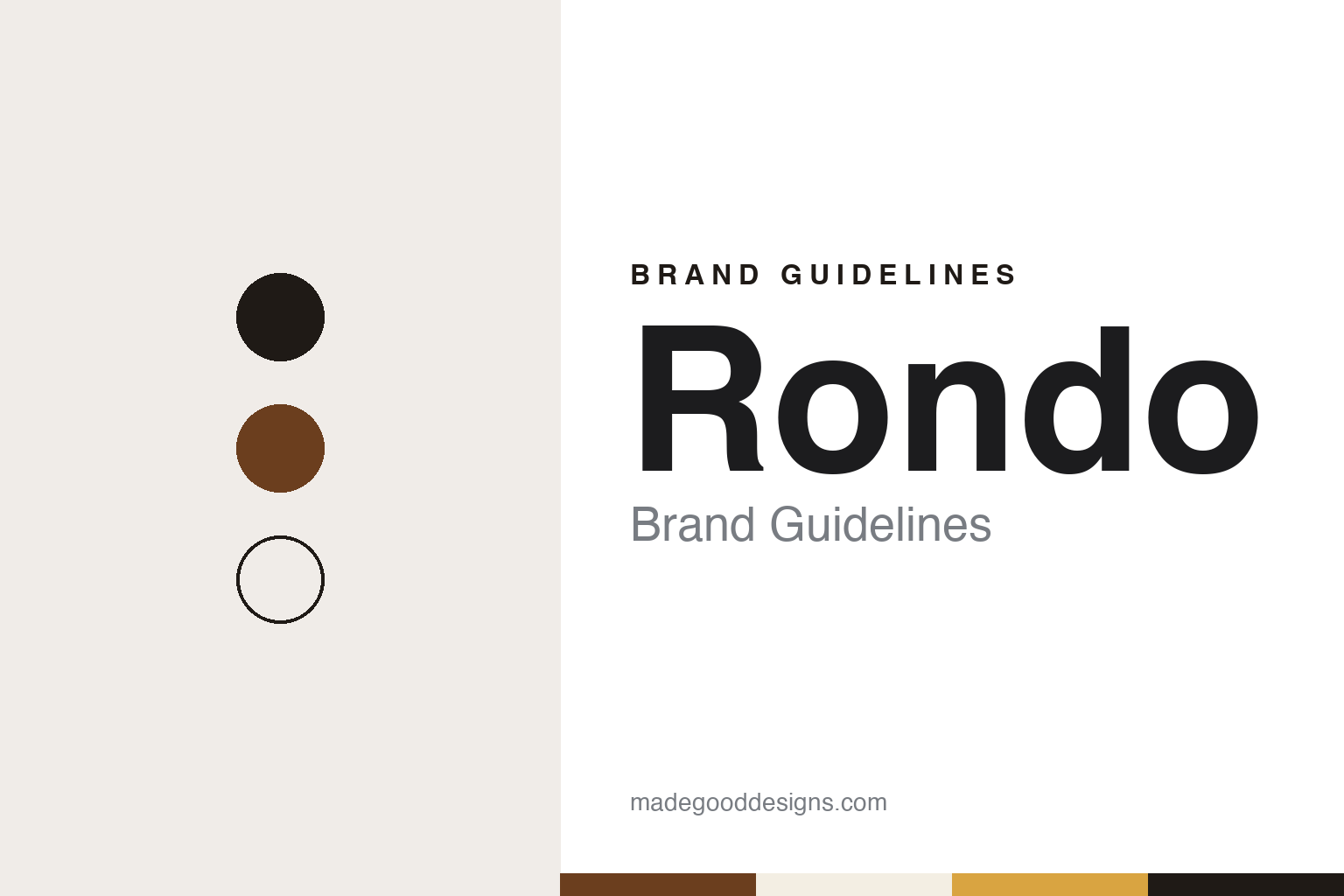
Two constants: a Rondo oven brown, flour and butter palette and a Swiss sans register. Abstract homage — not a Rondo product or mark; no machine, logo or nameplate is reproduced.
Konstruktions-Werkstätte Burgdorf
A workshop, then a sheeter.
Rondo began in Burgdorf, in the Swiss canton of Bern, in 1948. The company’s timeline says that on 1 May that year Gustav A. Seewer took over the mechanical workshop of Max Ludwig and founded the Konstruktions-Werkstätte Burgdorf, or KWB. Moffat, which sells the machines in Australia, wrote in a 2018 history of the brand that Seewer built special machines to order and carried out repairs, while wanting to make something of his own. Rondo’s headquarters today carries the same address as that first workshop.
The product arrived five years later. Rondo says that in 1953 Seewer applied for a patent for Switzerland’s first dough-sheeting machine with two directions, and that the “RONDO” then became KWB’s flagship. The patent record supports the date. US patent 2,792,792, “Dough Sheeter,” granted in May 1957 to Gustave August Seewer of Burgdorf, claims priority from a Swiss application of 10 July 1953. It describes a pair of superposed sheeting rolls whose rotation can be reversed, so that dough is worked in alternating passes until it reaches the thickness wanted. English Wikipedia’s article on dough sheeting records an earlier American sheeter patent, filed in 1941 by Anetsburger Brothers; Rondo’s own wording is limited to Switzerland.
Sales abroad followed. Rondo dates its German sales company, and its first automatic cutting table, to 1960, and its American sales company to 1964. France came in 1974 and the United Kingdom in 1984. In 1971 the sole proprietorship became a public limited company, Seewer AG, Maschinenfabrik Burgdorf. The timeline also records a setback: it says the firm fell into a serious crisis in 1972, with heavy investment, a shortage of skilled staff, high inflation and poor sales among the causes, and recovered after a comprehensive restructuring. In 1981 Gustav Seewer handed the management to his eldest son, Ruedi Seewer.
Colour
The Compas, and a move into industry.
After the “RONDO” itself came the Compas. Rondo says it launched and patented the machine in 1987 as the world’s first electronic dough sheeter, and that the design was the first with dough-band width control. Its current descendant, the Compas 4.0, arrived in 2020, and Rondo describes it as the first dough sheeter with four individual drives. The company’s other sheeters today include the Rondostar 5000, the Rondomat 4000 and the Econom 4000.
Until the late 1990s, Rondo says, it had concentrated on machinery for artisan bakeries. That changed when it bought Doge of Schio, in northern Italy, and entered industrial bakery equipment. Rondo gives the purchase as 1997 and the new name, Rondo Doge, as 1998; Moffat’s 2018 history gives 2000 for the acquisition.
The Swiss public broadcaster’s international service, swissinfo, visited Burgdorf in January 2007 and left a useful picture of the business at that point. Its reporter described a test bakery where a group from eastern Europe was checking what the machines could do, and a despatch bay with machines marked for France, Russia, South Africa and Austria. The chief executive, Robert Rohrer, told swissinfo that the end users ran from “the shop around the corner” to multinationals such as the Barilla group. Asked why the firm did not make mixers or ovens, he replied that hundreds of companies around the world already did. “I would describe the process as pretty complex, the machines rather simple,” he said, adding that flour varies “tremendously” depending on where it comes from.
The range has since grown from single machines into lines. Rondo showed the Polyline and Starline make-up lines and the Rondostar 4000 at the iba trade fair in 2006, and launched its ASTec industrial lines in 2010. In 2017 it introduced the RONDObot, for shaping bread loaves and rolls, and in October 2023 the Croissomat 4.0, a croissant machine for artisanal bakeries. The Starline 5, which Rondo says took five years of development, was announced in May 2025 and presented at a world conference in Burgdorf. Rondo says the line won the Bakery China Innovation Award in Shanghai in 2026. In February 2024, Rondo says, a Compas 4.0 and a Polyline helped BakeryBakery make a pain au chocolat more than 22 metres long in Bern, which Rondo reports as a Guinness World Record for the largest vegan pastry.
Typography
Dough, rollers and test bakeries.
Bakery equipment makers sell machines, but what they show is mostly dough. The picture language of the trade is familiar: dough sheets gliding along white belts, laminated croissant lines, rack ovens opening on golden trays, deck ovens with stone soles, and flour-dusted hands beside stainless machines.
The test bakery is part of that presentation. Rademaker invites customers to its Technology Centre in Culemborg to try their products with its technologists and test bakers, and it runs an Experience Centre near Chicago; Sveba Dahlen says its Bakery Innovation Centers let distributors and customers test its machines using their own recipes and ingredients, with master bakers on hand. In both cases the offer is to see a recipe run on the machine.
The calendar runs on trade fairs, and that is where the machines are seen working. iba, held in Düsseldorf in 2025, returns to Munich from 24 to 28 October 2027, its organiser says. At the 2025 show, World Bakers reported, a Glimek bread line was to be demonstrated live with dough several times a day. Sigep World meets in Rimini in January 2027, IBIE in Las Vegas in September 2028, and südback at Messe Stuttgart. Sirha Bake & Snack, where the old Europain web address now leads, is next in Paris in January 2028.
This guide sets out what can be checked about each maker: who founded it, who owns it, and where it says its machines are made. Company statements are given as company statements. Where a maker publishes no brand colours or typefaces, the palette and type here are our own interpretation.
Aa
A Swiss sans — “Dough-how.” (Specimen set in Inter Tight, a sans STAND-IN; NOT the Rondo logo.)
Rondo
From Seewer to “Dough-how.”
The Seewer family name did not stay on the door. Rondo says Robert Rohrer took over as managing director in 1999, and that in 2001 the shares were transferred to Fabrel AG, “a buyer who prioritises continuity, long-term commitment and strategic support.” swissinfo described the same sale in 2007 from the outside: the company had carried the Seewer name for more than 50 years and was sold in 2001 to a private equity company that came out of a family-owned Swiss industrial group. Rondo says the group has been known worldwide only as RONDO since 2008. The headquarters company is now Rondo Burgdorf AG, and the careers page calls it a “financially self sufficient and stable family-owned company.”
The company says it employs more than 450 people and has seven subsidiaries and three sales offices, and it names development and production sites in Switzerland, Italy and France. swissinfo gave the production plants in 2007 as Burgdorf and Schio, with Schio handling industrial equipment. Rondo’s careers page says it is training 28 apprentices in five disciplines. Peter Studer is named as chief executive on the company’s website.
The brand’s verbal identity rests on one pun. “Dough-how,” Rondo explained in a March 2025 article, is a play on “know-how”; the word now names its motto, its services and its three Dough-how Centers, where customers can test recipes and production processes, including one at the Burgdorf headquarters. The company’s line “We combine dough and technology” does the same job in plainer words, and “since 1948” recurs across its pages as a date of origin. Its website uses the capitalised RONDO throughout.
For a design guide, Rondo shows how a single machine name can outlast a founder’s family name and become the identity of a whole group. Compare FRITSCH, the German maker whose Rollfix sheeter dates from 1954, and Rademaker, the Dutch maker of bakery lines. For this guide we use oven brown, flour and butter with a sans, an unofficial interpretation; no product or logo is reproduced.
Explore & save
Keep Rondo’s identity on hand — save it to a board in the Made Good inspiration library.
Rondo identity set
Pin the Rondo oven brown, flour and butter palette and the Swiss sans register to your own board.