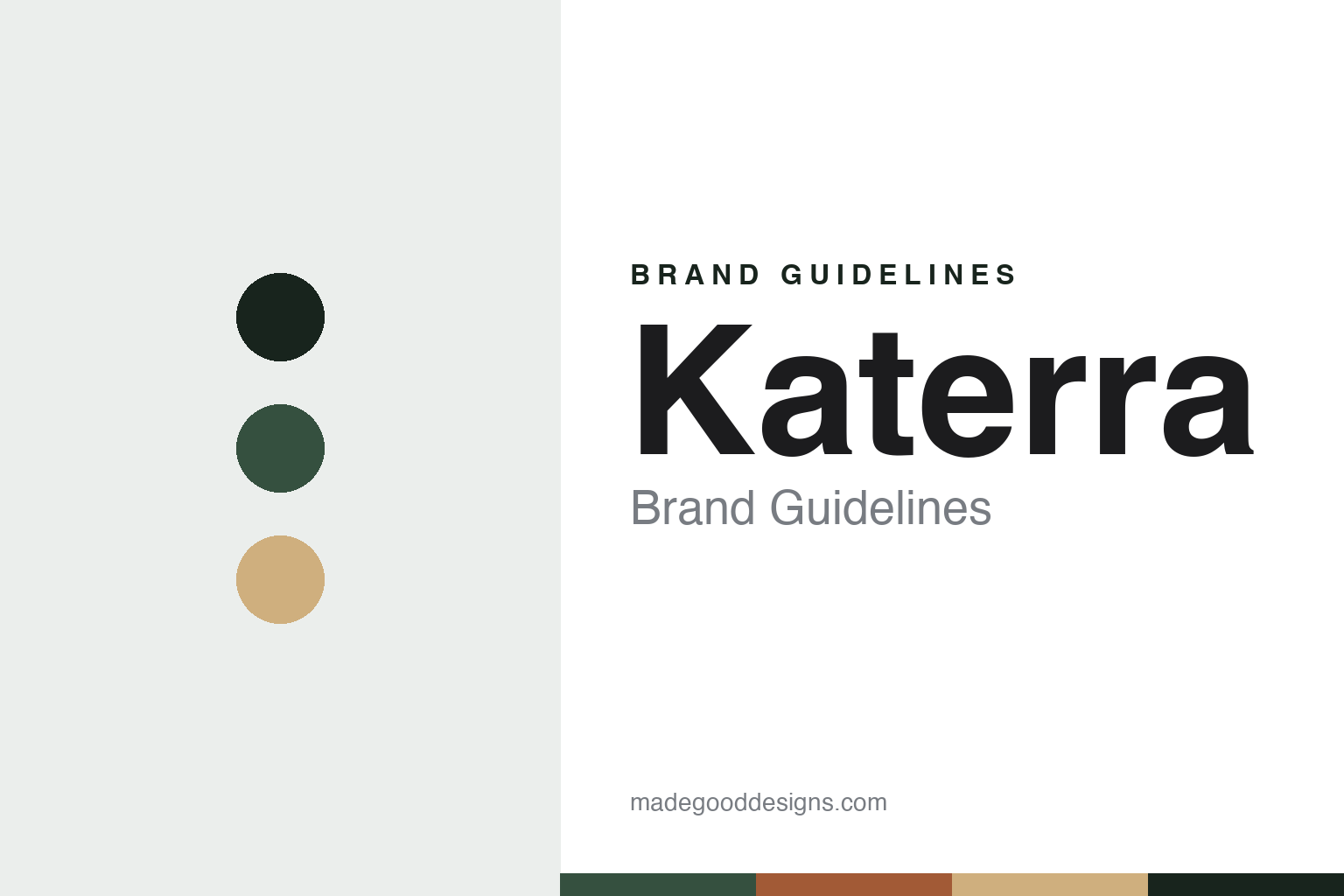
Katerra Brand Guidelines
The SoftBank-backed building start-up that closed in 2021.
Aa
Two constants: a Katerra timber green and pine palette and a Sturdy slab serif register. Abstract homage — not a Katerra product or mark; no building, logo or nameplate is reproduced.
The Last Craft Industry
An electronics manufacturer turns to buildings.
Katerra closed in 2021. It was a construction company, founded in 2015 in Menlo Park, California, that set out to design, make and build everything itself. It shut down after a bankruptcy filing in June of that year, and its American factories were sold in a court-supervised process.
The founders came from outside construction. Michael Marks had led the electronics manufacturer Flextronics for 13 years and Fritz Wolff was executive chairman of the real-estate investor The Wolff Company; Bloomberg, reporting in January 2018, also named Jim Davidson, a founder of Silver Lake, among those who started it. Construction Dive says Marks’s vision was to use mass manufacturing to streamline building.
The company put its case in strong terms. Its website, as quoted by Engineering.com, called construction “the last craft industry” and said it had “yet to enter the industrial or technology age.” Marks told Bloomberg in 2018: “It’s tech guys in Silicon Valley driving into a new industry that has never had any technology.” The Wall Street Journal ran a July 2017 article headlined “Why You’d Want to Build a Skyscraper Like an iPhone,” Construction Dive noted, and LinkedIn named Katerra among its top start-ups that year.
The money followed. SoftBank’s Vision Fund led a large round in January 2018, joined by a fund overseen by Soros Fund Management and the Canada Pension Plan Investment Board, and SoftBank became its largest investor. Bloomberg listed five target building types at that time: multifamily, student, senior and hospitality buildings, with single-family homes to follow.
Colour
Walls, timber and bought-in architects.
Katerra’s product was less a single building than a whole chain. Construction Dive says it branded itself as the architect, engineer, general contractor and subcontractor of its projects. In practice the prefabrication meant whole wall sections made off site. Its Phoenix factory made walls including windows, insulation, electrical wiring and plumbing, according to Construction Dive.
Two larger plants followed. The Tracy, California, factory, 577,000 square feet and opened in 2019, was designed to make wall panels, floor systems, roof trusses, windows, cabinets and countertops, according to the company that later bought its assets. The 270,000-square-foot Spokane Valley, Washington, plant made cross-laminated timber, or CLT; the Spokesman-Review and Timber-Online date its opening to 2019, while Construction Dive gives 2017. Engineering.com also recorded two factories in India.
The building it is known for used that timber. The Catalyst building in Spokane, designed with the Vancouver architect Michael Green and completed in 2020 with Avista Development, McKinstry and Eastern Washington University, was the first office building in Washington state built with CLT, the Spokesman-Review reported, and Architectural Record said it used the first panels from Katerra’s own factory.
Vertical integration extended to buying firms. In 2018 Katerra acquired Michael Green Architecture in May, the design firm Lord Aeck Sargent in June and the general contractor Bristlecone Construction in October, according to Construction Dive. In 2019 it held a product launch called TAKE OFF, which Panel World says covered building platforms, Apollo software, a CLT line, HVAC, interior fixtures and a bath kit.
It also went abroad. Its overseas work covered India and Saudi Arabia, where Engineering.com recorded a May 2019 deal for 4,000 homes and Construction Dive a January 2020 contract for 8,000. At its peak in 2020, Architectural Record reported, it employed more than 8,000 people.
Typography
Design and documentation.
Home builders that work in factories have an unusual problem of presentation. Their product is a house, a thing people expect to see standing on a street, yet much of what makes it distinctive happens indoors, long before anyone arrives on site. So the imagery of the category tends to start at the plant: walls moving along a line, panels stacked by size, roof sections waiting under a gantry. In a brochure, these pictures do the work that a craftsman’s portrait does elsewhere.
The second stage is the arrival. A section of house on a flatbed, a crane lifting a module over a hedge, a timber package unloaded in a clearing: these are the category’s most recognisable photographs. Log and timber makers add their own version, with stacks of numbered logs and yards of drying wood, so that the raw material becomes part of the sales story.
Then comes the place where buyers actually meet the product. Show villages and display parks let a family walk through several finished models in one afternoon, and sales lots do the same job along an American highway. Alongside them sits the catalogue, a storefront that travels by post. Its cover can show a single finished house, and its inside pages turn to cut-away drawings and floor plans, numbered and named like models of car.
That naming habit shapes the graphic side of the category. A plan may carry a code, a series title or a family name, and it has to sit comfortably beside a line drawing, a dimension table and a photograph. The result is a design language closer to a technical manual than a lifestyle magazine, softened by warm wood tones and a little domestic optimism. The guides that follow look at how individual builders have used it, and at the company history behind each one.
Aa
A sturdy slab serif — “the last craft industry.” (Specimen set in Roboto Slab, a serif STAND-IN; NOT the Katerra logo.)
Katerra
Layoffs, a lender’s collapse and a court sale.
The trouble was visible by late 2019. Wolff left the company in November of that year, and in December Katerra cut about 200 jobs and closed its Phoenix factory, moving the work to Tracy, according to Construction Dive. In May 2020, as part of a new SoftBank funding round, chief operating officer Paal Kibsgaard, the former head of Schlumberger, was named to replace Marks; Kibsgaard himself dated his start as chief executive to July 2020. The pandemic put projects on hold, and SoftBank provided a further recapitalisation in December 2020.
In a letter that month, Kibsgaard wrote that Katerra “at times became overcommitted and spread itself too thin.” The company had also moved its North American headquarters to Houston, and InnovationMap reported that he stepped down about five months after the December funding.
The end came quickly. In March 2021 its former lender, Greensill Capital, also backed by SoftBank, entered insolvency proceedings. On June 1, 2021, Katerra told staff it was winding down most of its American operations, and Panel World reported that more than 80 projects were being wound down and 730 of its 1,300 American employees let go. On June 6, 2021, the company and its affiliates filed for Chapter 11 in the Southern District of Texas. Katerra blamed the pandemic, its inability to obtain bonding after its lender’s insolvency, and unsuccessful attempts to raise money and win business. Its international operations were outside the filing, and on June 10 it said business continued in India, Engineering.com reported.
The pieces went separate ways. Lord Aeck Sargent re-emerged in July 2021 as an independent firm owned by its principals and directors, Architect reported. Michael Green Architecture said its shares had moved back into its own control. In August 2021 a bankruptcy court approved the sale of the Tracy assets to Volumetric Building Companies and the Spokane Valley plant to Mercer International, whose chief executive told the Spokesman-Review it would supply timber rather than repeat Katerra’s model. Construction Dive reported that SoftBank’s Masayoshi Son labelled Katerra one of his company’s biggest investment failures.
For a design guide, Katerra shows how a brand can rest on one promise, owning every stage of a building, and how that promise ended in a court sale of the parts. Compare Boxabl, a later American factory-housing venture, and Sekisui House, a Japanese house builder known for prefabrication. For this guide we use a timber green and a pine with a serif, an unofficial interpretation; no product or logo is reproduced.
Explore & save
Keep Katerra’s identity on hand — save it to a board in the Made Good inspiration library.
Katerra identity set
Pin the Katerra timber green and pine palette and the Sturdy slab serif register to your own board.