Ceva Santé Animale Brand Guidelines
A management buyout from Sanofi that stayed in its managers’ hands.
Aa
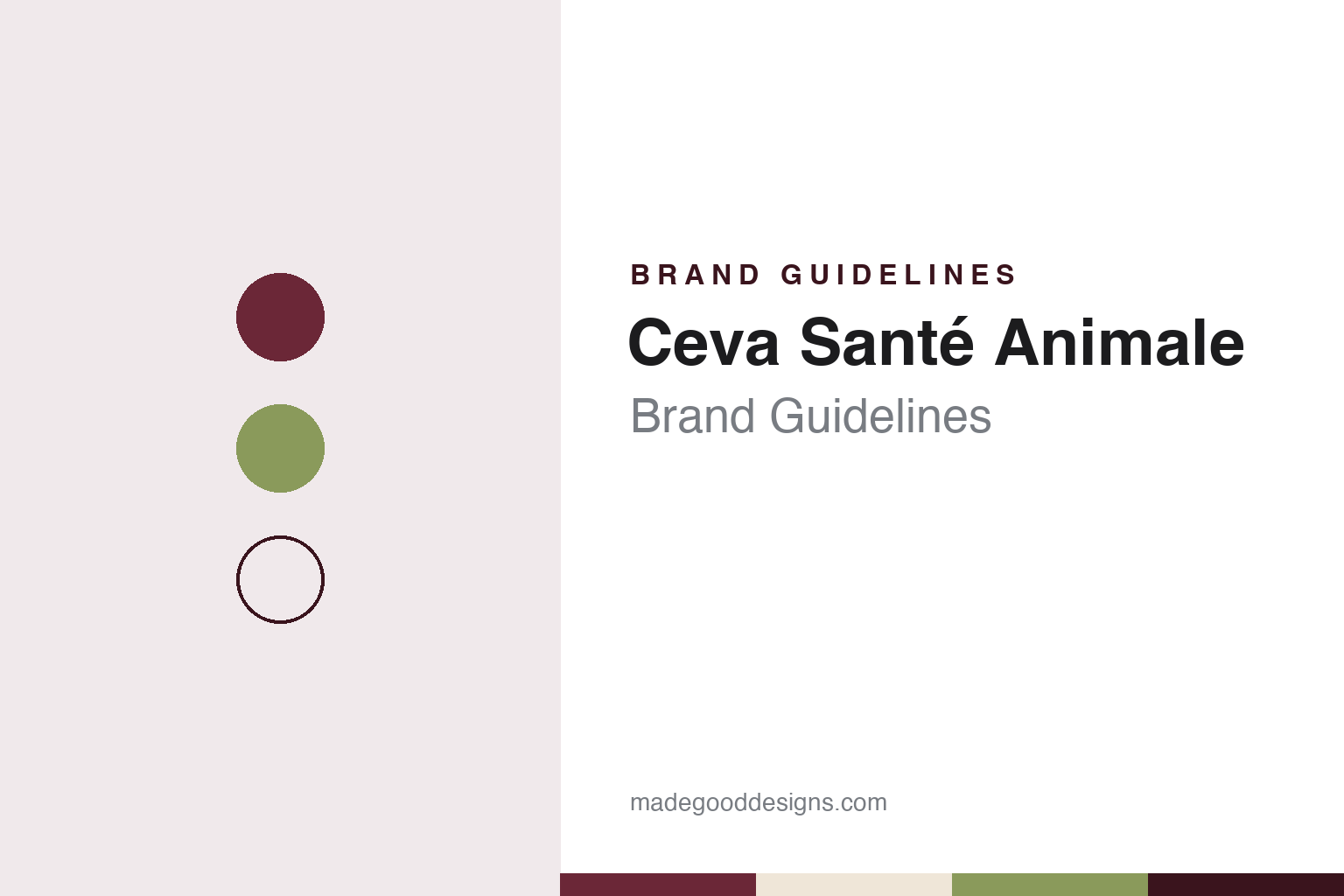
Two constants: a claret, vine green and limestone palette and a bookish serif register. Abstract homage — not a Ceva product or mark; no pack, logo or label is reproduced.
Out of Sanofi
A merger, a divestment and a buyout near Bordeaux.
Ceva Santé Animale was born of a merger. In 1999 the French drug makers Sanofi and Synthélabo combined as Sanofi-Synthélabo, and the new group soon sold its animal health and nutrition business, the company and English Wikipedia say. That business was bought through a leveraged management buyout, and the result was Ceva Santé Animale, with its headquarters at Libourne, near Bordeaux. Le Figaro, reporting with AFP in February 2020, gave 1999 as the founding year, and L’Usine Nouvelle wrote in March 2020 that the company had been taken over by former managers in 1999.
The buyout was the first of a series. English Wikipedia says the investment firm IK Partners bought Ceva from PAI Partners in September 2003, and that in June 2007 it was sold to its management with a group of investors. That 2007 round is the turning point in the company’s own account: Ceva says its managers and employees, many of them veterinarians, became majority shareholders in the third financing round, and Le Figaro confirmed in 2020 that managers and staff had been the majority shareholders since 2007. The company is led by Dr Marc Prikazsky, a veterinarian, whom it lists as executive chairman.
Ceva also inherited an older vaccine business. Through its Hungarian subsidiary Ceva-Phylaxia, the company says, it traces its vaccine work to the Phylaxia vaccine producer founded in Hungary in 1912, which it credits with the first vaccine for classical swine fever and links with the scientists József Marek and Aladár Aujeszky. English Wikipedia says Ceva has been Phylaxia’s sole shareholder since 1999.
Colour
Poultry, swine, ruminants and pets.
Ceva organises its work around four groups of animals: companion animals, poultry, swine and ruminants. The company says it has worked in poultry vaccination for more than 20 years and offers services and equipment for vaccinating birds in hatcheries as well as the vaccines themselves; for ruminants it names a vaccine for Q fever, and for dogs and cats it names behaviour, cardiology and nephrology, and dermatology as research areas. English Wikipedia names the Feliway pheromone range for cats among its products and says products in that range have received Cat Friendly Awards from the charity International Cat Care.
Much of the group was built by acquisition. English Wikipedia lists purchases including Biomune, a poultry vaccine maker in Lenexa, Kansas, in 2005; Summit VetPharm of New Jersey in 2010; the Canadian poultry vaccine maker Vetech Laboratories in 2011; Sogeval of Laval in 2013; Polchem in India in 2015; and Biovac of Angers and two Brazilian companies in 2016. In 2019 Ceva bought the veterinary business of Germany’s IDT Biologika, which its chairman told L’Usine Nouvelle had strengthened its swine vaccine work. The same 2020 report described the Ceva Laval Campus as the group’s global innovation centre for companion animals and a new site near Angers for autogenous veterinary vaccines.
The company now says it has more than 7,000 employees in 47 countries, with 21 research and development centres and 32 production sites. In France, French Wikipedia, citing Les Echos, lists sites at Libourne, Laval, Angers, Landivisiau and Loudéac.
Ceva has also faced public criticism. French Wikipedia, citing Libération and Le Monde from October 2017, says Ceva bought the hormone eCG, used in livestock breeding, from South American farms that animal welfare groups accused of cruelty to mares. La Dépêche Vétérinaire reported in August 2018 that Ceva had stated on its website on 3 August that it would no longer source eCG in Latin America.
Typography
How the sector presents itself.
Animal health companies speak to several audiences at once: veterinarians in clinics, farmers and producers, and the owners of dogs and cats. Their imagery tends to follow those audiences. A vet examining a dog or a cat on a consulting-room table is one of the most familiar scenes, alongside cattle in a barn, pigs in a pen and flocks of poultry, often shown with the people who look after them.
The products themselves are less photogenic, so the same few objects recur: vaccine vials, syringes, blister packs of tablets, spot-on pipettes and collars, along with laboratory benches, protective clothing and production lines. Many companies in the sector make both medicines for pets and vaccines for livestock, and their websites usually split the range by species rather than by product.
The sector also meets its customers in person. Trade fairs and congresses such as the VMX veterinary conference in Orlando and the World Veterinary Congress are where companies launch products, run booths and sponsor talks, and their stands carry much of the same photography of animals, clinics and farms.
Many of these companies also present themselves through the idea of One Health, which links the health of people, animals and the environment, and through the language of independence, family control or shared ownership where it applies. Ceva, for example, uses the slogan “Together, beyond animal health,” while Virbac points to the family that still controls it. This guide sets out what can be checked about each company: who founded it, who owns it and where it works.
Aa
A bookish serif for a Bordeaux-region company. (Specimen set in Source Serif 4, a serif STAND-IN; NOT the Ceva logo.)
Ceva
Together, beyond animal health.
Ceva is not listed on a stock exchange, and its ownership has been rebuilt in rounds. In February 2020 Le Figaro and AFP reported a fifth round that brought in four new investors — Téthys Invest, the Bettencourt-Meyers family’s holding company; the Canadian pension investor PSP; Japan’s Mitsui; and Germany’s Klocke Gruppe, which had sold IDT Biologika to Ceva — while managers and employees kept at least two-thirds of the voting rights. Temasek, EMZ, Sagard, HOPU Investments and Continental Grain were among the other investors named.
A sixth round followed in 2025. The Poultry Site reported in March 2025 that all existing investors had renewed their stakes, that management led by Prikazsky had increased its holding and still held the majority of the voting rights, and that the French healthcare fund Archimed, led by the veterinarian Denis Ribon, had joined. Ceva’s governance page adds that the Institut Mérieux entered the capital alongside Mérieux Equity Partners, and describes the company as “an independent company, majority-owned by our employees.”
The brand line comes from the company’s tenth anniversary. English Wikipedia says that in 2010 Ceva adopted a mission statement shortened to the slogan “Together, beyond animal health,” and the phrase still heads its website, where the company calls itself a One Health company that links the health of people, animals and the planet. Ceva describes itself as the leading French animal health company and the fifth largest in the world; those rankings are its own.
For a design guide, Ceva Santé Animale shows how a company carved out of a larger group can build a brand around independence and shared ownership. Compare Virbac, the family-controlled French group from the Côte d’Azur, and Vetoquinol, another French veterinary group. For this guide we use claret, vine green and limestone with a serif, an unofficial interpretation; no product or logo is reproduced.
Explore & save
Keep Ceva Santé Animale’s identity on hand — save it to a board in the Made Good inspiration library.
Ceva identity set
Pin the Ceva claret, vine green and limestone palette and the bookish serif register to your own board.