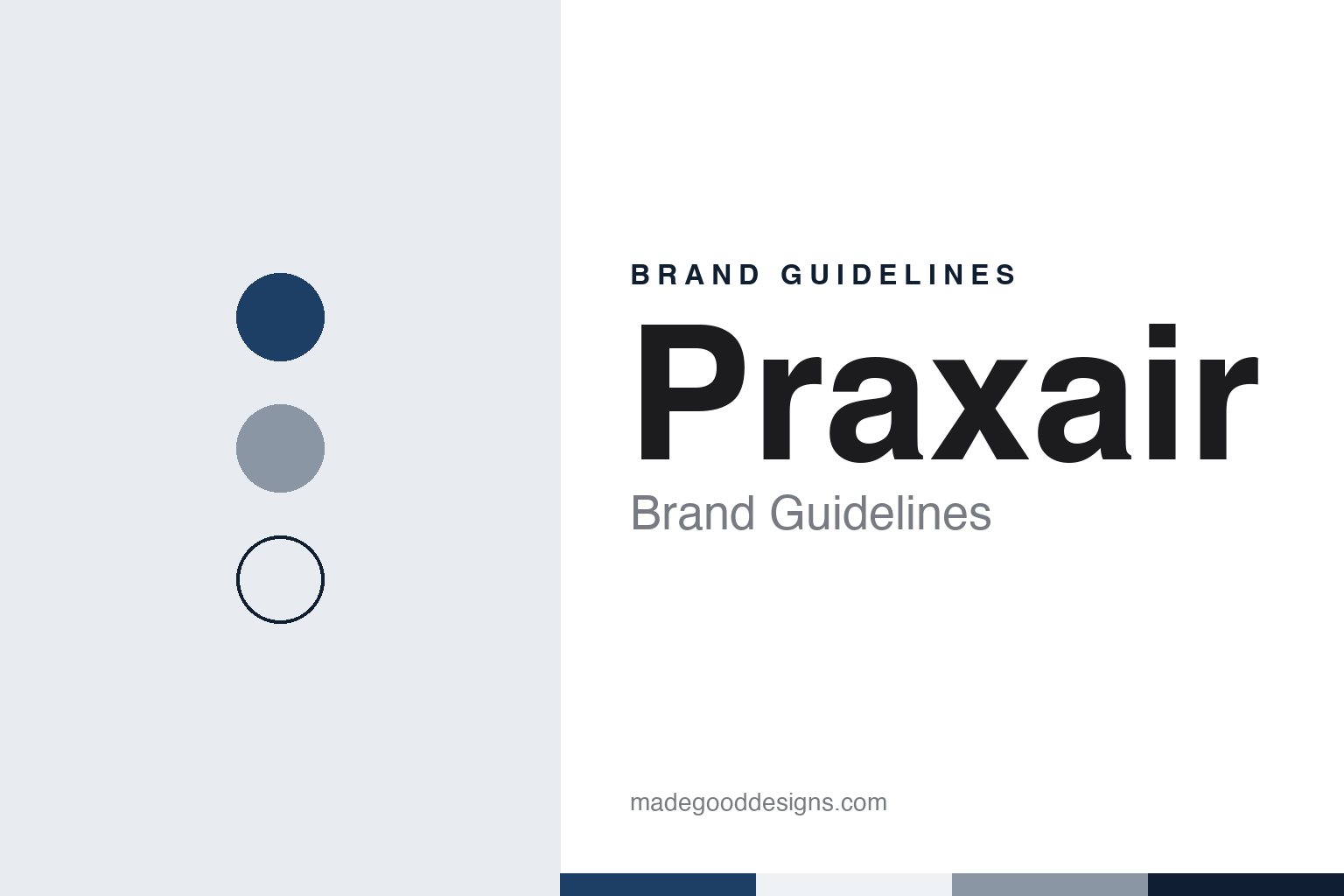
Praxair Brand Guidelines
Linde Air Products, a 1992 spin-off and the Linde name again.
Aa
Two constants: a deep blue, steel grey and frost white palette and a plain engineering sans register. Abstract homage — not a Praxair asset or mark; no cylinder, logo or wordmark is reproduced.
Linde Air Products
Cleveland, 1907, and a place inside Union Carbide.
Praxair’s story starts under another name. The International Directory of Company Histories says the German engineer Carl von Linde, whose cryogenic air liquefier dated from 1895, founded the Linde Air Products Company in Cleveland, Ohio, in 1907, and calls it the first firm in the United States to produce oxygen from air by a cryogenic process. The directory adds that storing and moving gases in heavy containers was costly, so the young company put research first.
The link with Union Carbide began, the directory says, around 1911, with joint experiments on acetylene, a gas that burns in oxygen with a flame hot enough to cut metal. In 1917 Linde joined National Carbon, Prest-O-Lite, Electro Metallurgical and Union Carbide to form the Union Carbide and Carbon Corporation, a holding company whose members largely ran themselves. Within the group, the directory says, Linde soon became one of the world’s largest producers of acetylene, hydrogen and nitrogen.
The war years left a record too. During the 1940s, according to the directory, Linde took part in Union Carbide’s contribution to the development of the atomic bomb: its scientists worked out a process for refining uranium concentrates through gaseous diffusion. In the late 1940s Union Carbide dissolved the holding-company structure and turned its subsidiaries into divisions, and the gas business became the Linde Division.
After the war the division grew with Union Carbide’s expansion abroad from the mid-1950s. The directory says the spread of oxygen-fired furnaces in steelmaking and of nitrogen as a refrigerant widened its markets in the 1960s, and that a surface-coatings business, later Praxair Surface Technologies, was developed in the 1950s.
Colour
Practical air: a spin-off in 1992.
The parent’s troubles shaped the next step. The directory describes how, after the December 1984 disaster at Union Carbide’s pesticide plant in Bhopal, India, the chemical group took on heavy debt to fend off a takeover and cut back to three main businesses, industrial gases among them. In 1988 the Linde division was renamed Union Carbide Industrial Gases.
In June 1992 Union Carbide distributed the shares of its gas business to its own shareholders, one share of the new Praxair, Inc. for each share of the parent. The name, the directory says, joins the Greek praxis, practical application, to “air,” the company’s main raw material; English Wikipedia gives the same derivation. The new company kept ties to its old parent, which remained one of its largest customers, and the two continued to share a headquarters.
Praxair grew by building plants and buying businesses. The directory says it supplied its largest customers through dedicated plants built on or beside their sites, delivered liquid gases by tanker truck and rail car, and sold smaller volumes in metal cylinders. In early 1996 it acquired CBI Industries of Oak Brook, Illinois, whose Liquid Carbonic subsidiary brought it into carbon dioxide, and it set up its packaged-gas business as a subsidiary, Praxair Distribution. In 1994, the directory adds, Praxair received an ISO 9002 certificate covering its bulk-gas sites in North America.
The Linde name went back to Germany. Under a deal made in 1996, the directory says, Praxair sold the North American rights to the name to Linde AG, and it stopped using the name in 1999. The same year Praxair and Britain’s BOC announced plans to combine; the plan did not go ahead.
Typography
Cylinders, tanks and air.
Industrial gas companies sell something nobody sees. Oxygen, nitrogen, argon, carbon dioxide and hydrogen are colourless, so the identity of a gas supplier has to live on the things that hold and move the product: the cylinder, the storage tank, the delivery truck and the plant where air is separated into its parts.
The cylinder is the most familiar object in the category. Rows of steel and aluminium bottles, their shoulders painted in colours that identify the contents, appear in almost every supplier’s photography, often chained in racks at a welding shop or a filling plant. Beside them stand the larger forms of the trade: white or pale-grey bulk tanks outside factories and hospitals, and long tanker trucks that carry liquefied gases from plant to customer, usually wearing the supplier’s name and colours along the side.
The plants themselves have become an image of their own. An air-separation unit is a tall column, often wrapped in cladding and pipework, that cools air until its components can be drawn off one by one. Photographed at night, lit against a dark sky, these columns give the sector its most dramatic pictures, and many companies use them in annual reports and on their home pages.
The human scenes are fewer and more settled. A welder behind a mask in a shower of sparks stands for the industrial side; a hospital corridor or a patient at home with an oxygen concentrator stands for the medical side. Between the hardware and those two scenes, most of the visual language of the category is set. The brands in this guide work within that shared vocabulary, and what separates them is largely the name on the truck and the colour of the paint.
Aa
A plain engineering sans for a company named after practical air. (Specimen set in IBM Plex Sans, a sans STAND-IN; NOT the Praxair logo.)
Praxair
Back under the Linde name.
The two halves of the old Linde business met again in the 2010s. English Wikipedia says Praxair and Linde AG held merger talks in 2016 that stopped in September and resumed by December, and that in 2017 the companies agreed an all-share merger of equals. On 22 October 2018 Linde plc announced that the last conditions had been met, after the European Commission approved the buyer of the European business Praxair had to sell and the US Federal Trade Commission cleared the deal; shares of Linde plc were due to start trading in Frankfurt on 29 October and in New York on 31 October 2018.
The European business went to a Japanese group. Process Technology Online reported in May 2019 that since 3 December 2018 Praxair’s European industrial gases business, except its Russian part, had belonged to Taiyo Nippon Sanso, and that it was taking the name Nippon Gases Europe.
Then the name itself was retired. On 13 August 2020 Linde announced from Danbury, Connecticut, that its US subsidiary, Praxair, Inc., would operate under the Linde name from 1 September 2020, with information on the US business moving to a Linde website. Praxair is now part of Linde plc, and its US business trades as Linde.
For a design guide, Praxair shows how a name invented for a 1992 spin-off carried a business for nearly three decades and then gave way to the older name it came from. Compare Linde, the name it rejoined, and Nippon Sanso, whose group took over its European arm. For this guide we use a deep blue, a cool steel grey and a frost white with a sans, an unofficial interpretation; no product or logo is reproduced.
Explore & save
Keep Praxair’s identity on hand — save it to a board in the Made Good inspiration library.
Praxair identity set
Pin the Praxair deep blue, steel grey and frost white palette and the plain engineering sans register to your own board.