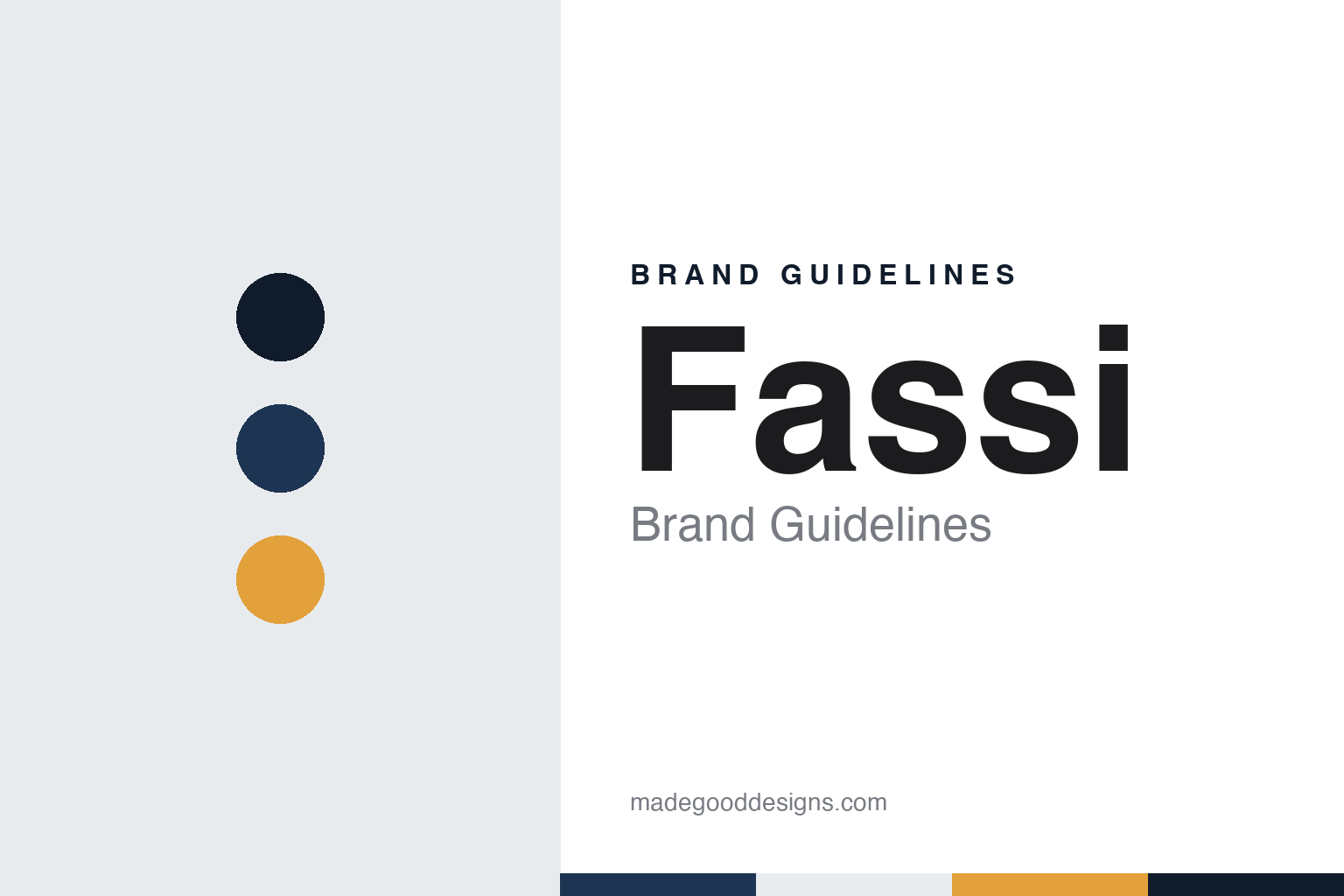
Fassi Brand Guidelines
The Albino knuckle-boom crane maker building cranes since 1965.
Aa
Two constants: a navy, steel and amber palette and a condensed sans register. Abstract homage — not a Fassi product or mark; no crane, logo or nameplate is reproduced.
Albino, 1965
A vehicle workshop that turned to cranes.
Fassi’s story starts in Albino, in the province of Bergamo in Lombardy. The company says its first plant was set up there in 1946, and that the work at first was converting industrial vehicles with bodywork fittings. The first Fassi crane followed in 1965, and that is the year the company now counts from: its website opens with “since 1965,” and the financial news agency Teleborsa, reporting in January 2024, gave 1965 as the year the business was founded by the Fassi family. Giovanni Fassi, then chief executive, told the trade magazine Vertikal.net the same month that he was proud of “the business my father founded in the 1960s.”
What Fassi makes is the knuckle-boom crane, also called an articulated or loader crane: a hydraulic crane mounted on a truck chassis, with a boom that folds at a joint and extends in sections, so that a lorry can lift its own load on and off. In Italian it is a gru articolata, and the “Gru” in the company’s legal name, Fassi Gru S.p.A., simply means crane.
The company’s own timeline marks the steps that followed. It puts the first exported crane in 1968 and the thousandth crane in 1971. It lists its first continuous-rotation crane in 1982 and its first electronic load moment limiter in 2000, and it opened an Innovation Center in 2023, which it describes as 11,500 square metres where mechanics, electronics, hydraulics and software are developed together. In 2025 it marked sixty years of cranes and, the company says, rebranded the business as Gruppo Fassi, the Fassi Group.
Colour
Light, medium and heavy duty.
Fassi sorts its cranes into light-duty, medium-duty and heavy-duty ranges, plus a special series, and its current models carry the TECHNO label. Model names follow a code of letters and numbers rather than nicknames. In November 2025 the company presented the F1750R.2.9 HXP TECHNO, a version with nine hydraulic extensions; in June 2026 it launched the F605R.2-HXP TECHNO, which it calls the lightest and most compact model in the TECHNO range. At the Conexpo show in Las Vegas in 2026 its main exhibit was an F2350RL.2.8-HXP configuration that the company describes as the longest outreach it has ever developed.
On where the cranes are made, the company is emphatic. Its website says every Fassi crane is made in Italy from an entirely Italian supply chain, and lists eight manufacturing plants; its group page says the crane business consists of eight independent companies in Italy, and that every stage from welding to painting and testing is carried out inside the group. The wider group reaches further: Vertikal.net reported in January 2024 that the company ran 18 production facilities in Italy, France, Sweden and Malaysia, employed about 1,600 people and made 85 percent of its sales outside Italy. The website now puts exports at 90 percent and the dealer network across 61 countries.
Those foreign sites belong to brands Fassi has gathered around the cranes. The group page names Marrel, a French maker of hydraulic hooklifts at Andrézieux-Bouthéon in the Loire, which dates itself to 1919 and credits itself with the Ampliroll hydraulic hooklift; and Cranab, a maker of forestry cranes in northern Sweden. Cranab’s street-cleaning brand Slagkraft and the forest-machine maker Vimek also sit in the group. The mini-crane maker Jekko appears on the same page, and a Fassi news release of April 2026 describes it as an Italian company in which the group is a shareholder and strategic partner.
Fassi’s own crane finder reads like an engineering catalogue: buyers filter models by lifting capacity in tonne-metres, by maximum reach in metres and by rotation, up to continuous rotation.
Typography
The loader-crane trade.
Crane makers present very large machines largely through pictures. Their catalogues and websites lean on a small set of pictures: a tower crane standing over an unfinished skyline, a mobile crane with its telescopic boom fully extended, a crawler crane lifting a turbine section on a wind farm, or a loader crane folded neatly behind a truck cab. The machine itself becomes the logo at a distance, so the paint matters as much as the nameplate.
That is why colour does so much work in this category. Booms and jibs are painted in strong, flat tones, often yellow, red or white, with the maker’s name lettered large along the steel so it can be read from the street. Some makers go as far as naming their colours and applying them across a whole fleet, so that a crane on a distant site can be placed before its lettering can be read.
Closer in, the presentation shifts to the operator. Cab interiors, joysticks, load-moment displays and remote controls appear in brochures alongside outrigger layouts and load charts, with lettering that has to work on a decal, in a manual and on a small screen.
Trade fairs are the other stage. bauma in Munich, ConExpo-Con/Agg in Las Vegas, bauma CONEXPO INDIA and national shows in China and Japan are where new cranes are unveiled, often fully rigged on outdoor stands, and where companies announce acquisitions and new models. This guide sets out what can be checked about each maker — who founded it, who owns it and where its cranes are built — and marks clearly what rests only on the company’s own word.
Aa
A condensed, technical sans for model codes and capacities. (Specimen set in Barlow Condensed, a sans STAND-IN; NOT the Fassi logo.)
Fassi
From family firm to investor-backed group.
For almost sixty years Fassi was a family company. That changed in January 2024, when the investment firm Investindustrial bought a 70 percent stake from the Fassi family through its Luxembourg subsidiary Elevation Investment Opportunities, part of its Investindustrial VII fund, Vertikal.net reported. The family kept the remaining 30 percent, and Giovanni Fassi stayed on as chief executive. Teleborsa reported that the partners planned to grow the company through international expansion, product diversification and closer integration of the supply chain.
The leadership has since changed shape. By December 2025 the company was naming Giovanni Fassi as president of the Fassi Group and Victor Gottardi as chief executive of Fassi Gru. The group has also kept buying. In December 2025 it completed the purchase of Tecnove, a sheet-metal and metal-fabrication company in Novellara, near Reggio Emilia. In April 2026 it bought all of Fascan International, its long-standing importer of Fassi and Jekko products in the United States. The same month it completed the purchase of Barin, founded in 1963 at Cittadella, near Padua, which makes platforms for inspecting and maintaining bridges and viaducts, opening what Fassi calls a new business segment. All three deals are set out in the company’s own releases.
Through all of it the headquarters has stayed in Albino, where the company still lists its head office, and the brand on the cranes is still the family name.
For a design guide, Fassi shows how an industrial brand can let a founding year and a family name carry the identity while the product line speaks in model codes. Compare Effer, the other Italian knuckle-boom maker founded in 1965, and Palfinger, the Austrian loader-crane group. For this guide we use a deep navy, steel grey and a signal amber with a condensed sans, an unofficial interpretation; no product or logo is reproduced.
Explore & save
Keep Fassi’s identity on hand — save it to a board in the Made Good inspiration library.
Fassi identity set
Pin the Fassi navy, steel and amber palette and the condensed sans register to your own board.