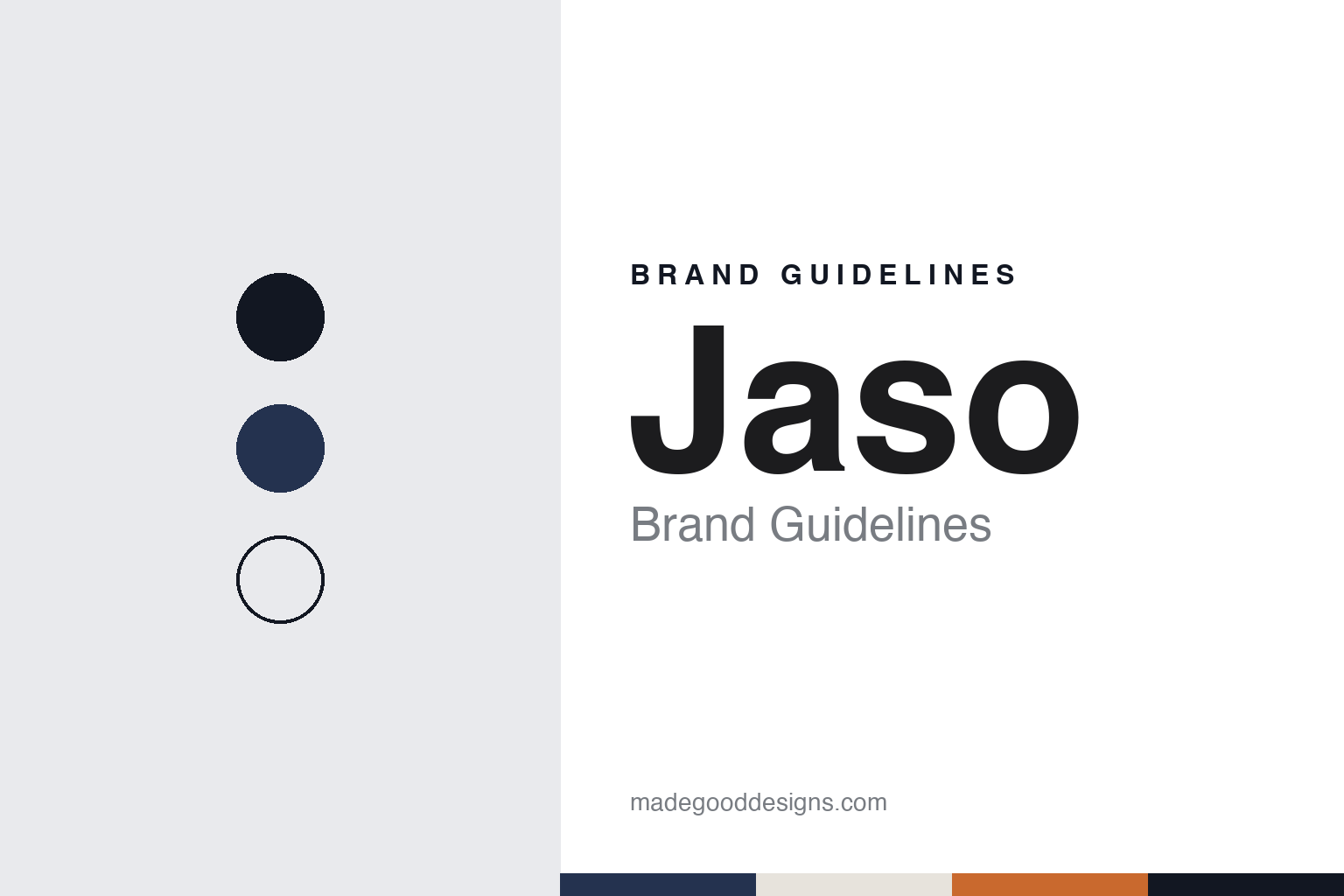
Jaso Brand Guidelines
The Basque tower crane maker that sorts its cranes by the shape of their tops.
Aa
Two constants: a steel navy and signal orange palette and an Engineered sans register. Abstract homage — not a Jaso product or mark; no crane, logo or nameplate is reproduced.
From Idiazabal
A Basque family maker.
Jaso is a tower crane maker from Idiazabal, a town in the province of Gipuzkoa in the Basque Country of northern Spain. Its website names the company as JASO Equipos de Obras y Construcciones, S.L. and dates its crane work to 1975. “We have accompanied on all kinds of projects since 1975,” the English home page says, and the Spanish version puts it more briefly: “Desde 1975, de Idiazabal al mundo” — from Idiazabal to the world. The company says it was born “in the Basque Country as a family company,” in a setting it describes as technology-based and entrepreneurial.
An independent account fills in the present. In an interview published on 26 August 2026 by American Cranes & Transport, a KHL Group magazine, its editor reported that Josu Tornay was recruited in 2023 to restructure Jaso and prepare it for international expansion, and that he became its chief executive. Tornay had previously worked at the Mondragon Corporation, the Basque industrial group, for about 27 years. He described Jaso to the magazine as “a very well-known historical manufacturer in the Basque Country for overhead cranes, gantry cranes, construction hoists, elevators for the wind energy sector and tower cranes.” In the same interview he said the company had been in the market “for more than 50 years.”
The name is used for two businesses on one website. Jaso Tower Cranes covers the crane range. Jaso Elevation Systems covers lifts, and says it has specialised since 2000 in designing, making and installing lifting systems for the wind energy and construction sectors. Both use the same set of company pages, which present Jaso under four headings: manufacturer, technology, commitment and service.
Colour
High top, flat top, low top, luffing.
Jaso organises its cranes by the shape of the crane top. Its website lists High top cranes, with a reach of up to 75 metres and a maximum load of 2.5 to 16 tonnes, aimed at light loads and quick assembly; Flat top cranes, which have no tower head and are meant for crowded sites; Low top cranes, with a very short tower head, a reach of up to 85 metres and a maximum load of 18 to 64 tonnes; and Luffing cranes, whose jib is raised and lowered rather than carrying a trolley along a horizontal arm, with a reach of up to 70 metres and loads of 5 to 75 tonnes. A hydraulic luffing range, recovery cranes and derricks used to take other cranes down, and a lift that carries the crane driver up the tower complete the list. The company says its low top cranes suit PPVC construction and that all their parts travel in standard high-cube containers.
The company calls itself a pioneer of the luffing crane and says it ranks among the five largest European makers of tower cranes; both are its own claims. It says it has built more than 16,000 cranes and is present in more than 70 countries. On manufacturing it is direct: it says it makes its cranes completely in its own factory, and it describes every range as a “full in house solution.” It names the standards its cranes are built to, including EN 14439, the European standard for tower cranes, FEM 1001 and Hong Kong wind rules.
Several of its markets are documented in the 2026 interview. Tornay said Jaso had been active in North America for almost 20 years: it began in 2007 with lifts for wind-turbine towers and moved into tower cranes in 2014, working with Allied Crane in British Columbia, Canada. It sells there through dealers on both coasts of the United States and Canada and keeps some cranes of its own to support them. The magazine pictured two Jaso J265PA luffing cranes working in Vancouver. Tornay also said that PPVC — prefabricated, prefinished volumetric construction, in which buildings are assembled from factory-made room modules — had been one of Jaso’s core markets in Singapore for more than a decade, and that the company held a leading position in Australia, the United Kingdom, Spain, Mexico and Argentina; those are his words.
Typography
Cranes and documentation.
Crane makers present very large machines largely through pictures. Their catalogues and websites lean on a small set of pictures: a tower crane standing over an unfinished skyline, a mobile crane with its telescopic boom fully extended, a crawler crane lifting a turbine section on a wind farm, or a loader crane folded neatly behind a truck cab. The machine itself becomes the logo at a distance, so the paint matters as much as the nameplate.
That is why colour does so much work in this category. Booms and jibs are painted in strong, flat tones, often yellow, red or white, with the maker’s name lettered large along the steel so it can be read from the street. Some makers go as far as naming their colours and applying them across a whole fleet, so that a crane on a distant site can be placed before its lettering can be read.
Closer in, the presentation shifts to the operator. Cab interiors, joysticks, load-moment displays and remote controls appear in brochures alongside outrigger layouts and load charts, with lettering that has to work on a decal, in a manual and on a small screen.
Trade fairs are the other stage. bauma in Munich, ConExpo-Con/Agg in Las Vegas, bauma CONEXPO INDIA and national shows in China and Japan are where new cranes are unveiled, often fully rigged on outdoor stands, and where companies announce acquisitions and new models. This guide sets out what can be checked about each maker — who founded it, who owns it and where its cranes are built — and marks clearly what rests only on the company’s own word.
Aa
An engineered sans — JASO in capitals. (Specimen set in Inter Tight, a sans STAND-IN; NOT the Jaso logo.)
Jaso
“50 years building the world.”
The lift business runs alongside the cranes. Jaso Elevation Systems says it designs, makes and installs rack-and-pinion and cable-guided lifts for wind-turbine towers, under names such as GW and GWR, as well as construction hoists and work platforms, and that it tests its wind lifts on a test tower of its own. The 2026 interview places those lifts at the start of Jaso’s North American business, seven years before its first tower cranes there.
The company is also changing how it presents itself. Tornay told American Cranes & Transport that his first tasks had been to streamline management roles, set up quality assurance and continuous-improvement procedures and overhaul the supplier base, and that Jaso was “modernizing the brand image and scope internationally.” Its website now carries a newsroom, a project gallery, a video titled “50 years building the world” and a “Jaso Community” page for fans of its cranes, offering scale models and merchandise. Its Spanish news page summed up the interview in one line: quality, service and engineering are fundamental, but relationships come first. On its website the name is set in capitals, as JASO.
For a design guide, Jaso shows how a regional family maker can organise an international crane brand around the shapes of its products. Compare Comansa, another Spanish tower crane maker, and Potain, the French tower crane name. For this guide we use a steel navy and a signal orange with a sans, an unofficial interpretation; no product or logo is reproduced.
Explore & save
Keep Jaso’s identity on hand — save it to a board in the Made Good inspiration library.
Jaso identity set
Pin the Jaso steel navy and signal orange palette and the Engineered sans register to your own board.