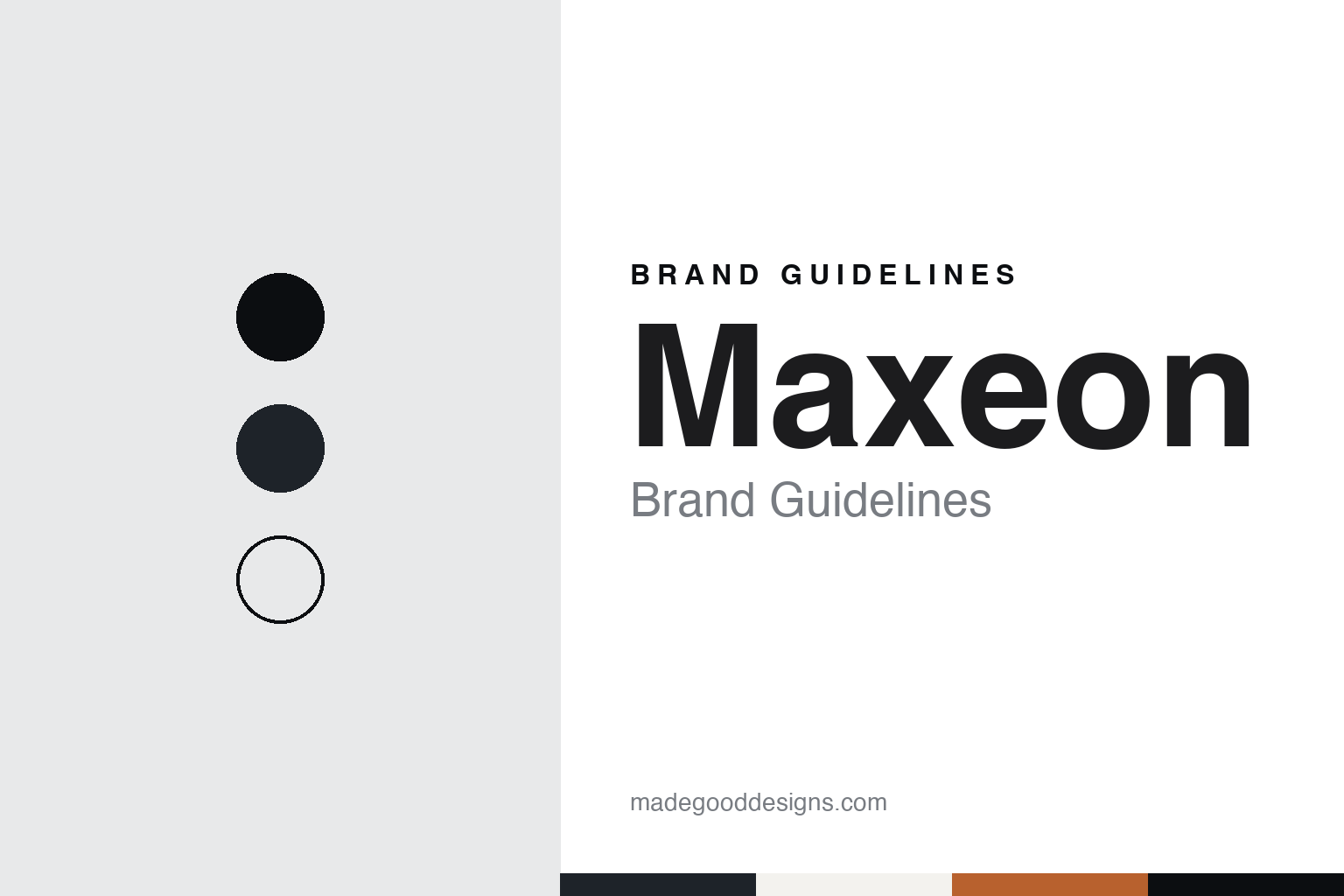
Maxeon Brand Guidelines
SunPower’s back-contact spin-off, from Singapore to judicial management.
Aa
Two constants: an all-black, graphite and copper palette and a clean grotesque register. Abstract homage — not a Maxeon product or mark; no panel, logo or nameplate is reproduced.
SunPower
A Stanford cell, a Silicon Valley company and a 2020 split.
Maxeon’s history starts inside another company. English Wikipedia’s article on SunPower says that company was founded in 1985 by Richard Swanson, an electrical-engineering professor at Stanford University who had studied solar-cell efficiency in the Stanford Electronics Laboratory. It began under the name Eos and took the SunPower name in 1989. Cypress Semiconductor acquired a controlling interest in 2002, SunPower went public in 2005 and was spun off from Cypress in 2008, and in 2011 the French energy company Total agreed to buy a majority interest, according to the same article.
For most of those years SunPower both made panels and sold and installed solar systems. In 2019 it announced that it would separate its manufacturing into a new business based in Singapore called Maxeon Solar Technologies, with the Chinese wafer maker Tianjin Zhonghuan Semiconductor taking a minority stake. The spin-off was completed in August 2020, English Wikipedia’s Maxeon article says. SunPower kept the American residential installation business and continued to buy panels from Maxeon; Wikipedia says Maxeon remained SunPower’s main panel supplier until March 2024.
The split also divided the name. Wikipedia says Maxeon received the right to use the SunPower brand outside the United States, while SunPower kept it at home. That arrangement later grew more tangled: the original SunPower filed for Chapter 11 bankruptcy protection in August 2024, and in April 2025 Complete Solaria, which had bought several of its assets, announced that it was renaming itself SunPower, according to Wikipedia. The SunPower name in the United States now belongs to that company, not to Maxeon.
Maxeon’s own website draws a straight line back to 1985, describing the company as “built from 40 years of boundary-pushing solar DNA” and saying it spun off from US-based SunPower Corporation in 2020.
Colour
Contacts on the back, an all-black face.
Maxeon’s signature product is the interdigitated back-contact (IBC) solar cell. In most cells, thin metal lines run across the sunlit front face to collect current; in a back-contact cell those contacts sit on the rear. English Wikipedia explains that this keeps the front clear, and says the panels are often chosen where roof space is limited and for their appearance as well as their output.
The company presents that look as part of the product. Its website describes an “elegant all-black aesthetic” for its IBC panels and says the back-contact design gives “a seamless appearance on the surface of the cell.” It also sells the cells on their own, saying they can be used “from space to sea,” and markets a second family, the Performance line, which it says uses conventional cells cut into smaller shingled pieces, with glass-glass construction on its bifacial versions.
Patents are central to how Maxeon describes itself. Its website says it holds more than 2,000 granted patents, across back-contact cells, TOPCon cells and shingled module designs. Wikipedia records that in March 2024 Maxeon filed a patent-infringement suit against Canadian Solar over TOPCon cell technology, and the company says it also sued Hanwha Qcells that year. In a later post on its website, Maxeon said the US Patent and Trademark Office had found certain claims in two of its patents unpatentable in the Canadian Solar matter while upholding another patent in full, and announced a patent-licensing agreement with the Chinese module maker AIKO.
In its marketing the company uses the line “Powering Positive Change,” and says more than one million families in over 100 countries use its technology. It describes a network of installers and partners, with a partner portal and installer training.
Typography
Grids, roofs and trade fairs.
Solar panel makers sell a product that looks much the same from a distance: a dark rectangle of glass divided into a grid of cells. Their visual identities work around that sameness. Company websites and brochures return again and again to a few scenes — black or blue module grids on house roofs, long rows of panels across desert or farmland at utility-scale plants, and close-ups of individual cells, where the fine lines of the metal contacts, or their absence, become the detail that sets one technology apart from another.
The factory is the second stage set. Makers show clean production lines, robotic handling and testing laboratories, and they name their cell technologies — TOPCon, heterojunction, back contact — the way other industries name materials. Product families are given short, branded names, and colour is used sparingly: a corporate blue, green or orange against white, with the dark face of the module doing most of the visual work.
Because most panels reach homes and businesses through others, makers also speak to installers. Partner programmes, installer training, distributor networks and warranty pages appear prominently on their websites, addressed to the people who specify and fit the panels.
Trade fairs are where the industry shows itself in public. Intersolar Europe at the Messe München and SNEC in Shanghai draw module makers from China, Europe, North America and elsewhere, who use large booths to launch new module families, storage systems and inverters side by side. This guide sets out what can be checked about each maker — where it began, who owns it, and what it makes — and marks clearly what rests only on the company’s own word.
Aa
A clean grotesque for an all-black panel. (Specimen set in Inter Tight, a sans STAND-IN; NOT the Maxeon logo.)
Maxeon
TCL control, a US turn and a Singapore court.
Ownership shifted towards China after the spin-off. Wikipedia says the Chinese electronics group TCL bought Tianjin Zhonghuan and so became a major investor. In May 2024, pv magazine reported that TCL Zhonghuan planned to raise its holding in Maxeon from 22.39% to at least 50.1% through convertible bonds and new shares, making Maxeon a controlled subsidiary; Maxeon called it a recapitalization with its “strategic partner.” By January 2026 EnergyTrend described Maxeon as TCL Zhonghuan’s controlling subsidiary.
The business then narrowed. pv magazine USA reported in April 2026 that US Customs and Border Protection had detained all of Maxeon’s Mexico-made products in 2024 — Wikipedia says the detentions cited the Uyghur Forced Labor Prevention Act — and denied the company’s appeal in March 2025, after which Maxeon took the matter to the US Court of International Trade. In late 2024 Maxeon said it would concentrate entirely on the US market, and the magazine listed the sale of its non-US business among its restructuring steps; in February 2026 it gave up the lease on a planned factory site in Albuquerque, New Mexico, saying it would keep using contract manufacturers in the US to build modules with its back-contact cells. EnergyTrend reported in January 2026 that a Maxeon subsidiary had agreed to sell its Malaysian manufacturing company.
In early April 2026, pv magazine USA reported, Maxeon and its subsidiary Maxeon Solar Pte. Ltd. applied to Singapore’s courts to be placed under judicial management, a Singapore restructuring process, seeking either an arrangement with creditors that would let the company survive or a better outcome than a winding-up. Maxeon’s website now states that its affairs, business and property are managed by judicial managers appointed by the High Court of Singapore on 29 May 2026. The company now operates under that court-appointed management.
For a design guide, Maxeon shows how a single product feature — a clean, all-black panel face made possible by back-contact cells — can carry a brand through changes of name, owner and market. Compare First Solar, another module maker with American roots, and AIKO. For this guide we use near-black, graphite and a copper accent with a sans, an unofficial interpretation; no product or logo is reproduced.
Explore & save
Keep Maxeon’s identity on hand — save it to a board in the Made Good inspiration library.
Maxeon identity set
Pin the Maxeon all-black, graphite and copper palette and the clean grotesque register to your own board.