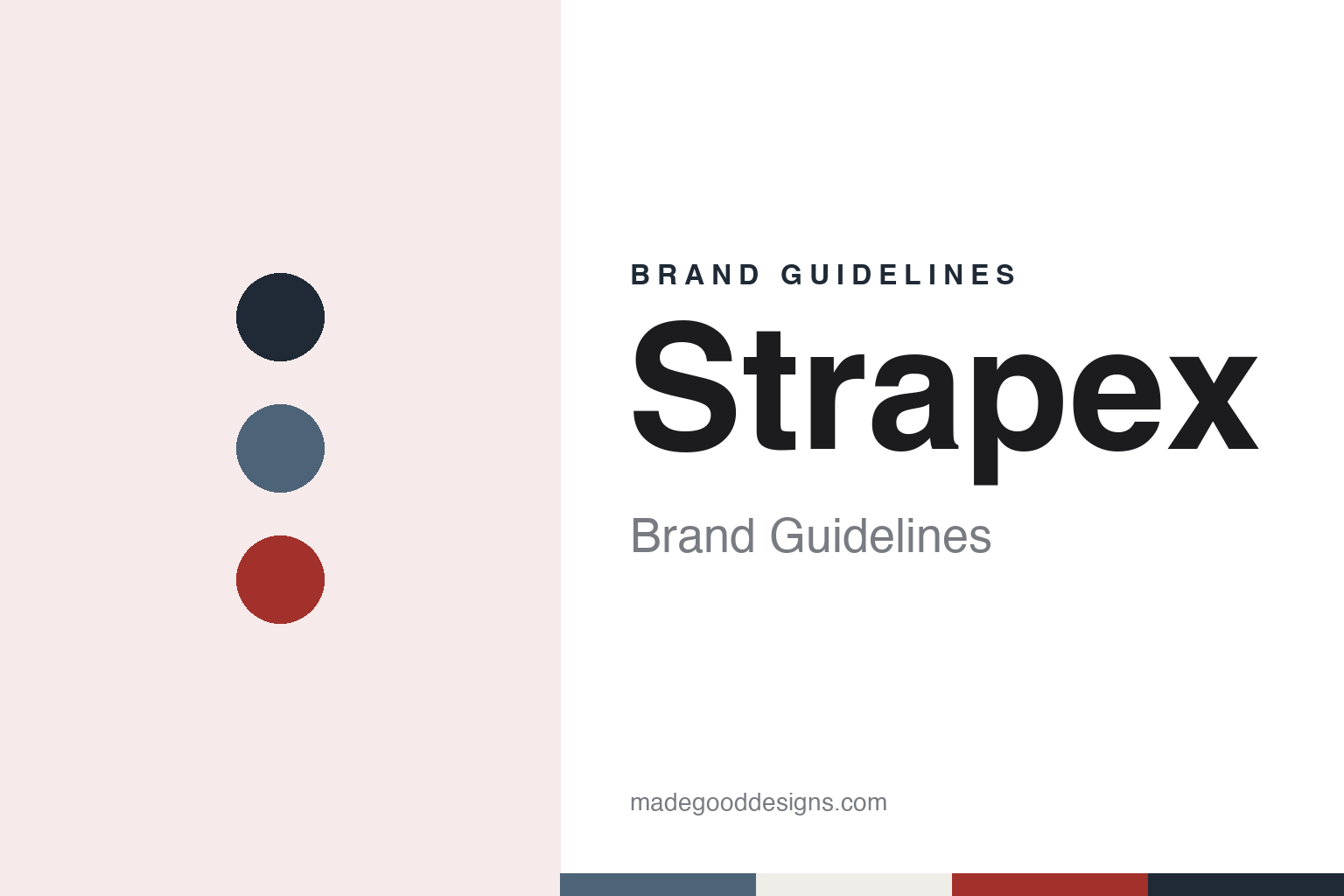
Strapex Brand Guidelines
A Swiss strapping name that has passed through three owners.
Aa
Two constants: a Strapex alpine red and slate blue palette and a Swiss sans register. Abstract homage — not a Strapex product or mark; no machine, tool, logo or nameplate is reproduced.
A Swiss strapping name
Machines, tools and strap from Dietikon.
Strapex is a Swiss brand of strapping machines, hand tools and strap. Its website gives its location as Dietikon, west of Zurich, and describes the brand as providing “innovative solutions and services for product securement during transportation across production, trade, and logistics,” offering machines, hand tools and consumables for bundling and transport. The name is written with a registered-trademark sign, Strapex®, throughout its pages.
Today Strapex belongs to Signode. Signode’s brand page says it “provides a wide range of strapping equipment, hand tools and consumables under the Strapex brand name,” and claims “over half a century of industry knowledge” for the team behind it. It presents Strapex as a source of product combinations for particular industries and applications, backed by consulting, installation, training and the delivery of consumables, with local sales and service staff.
Signode itself is an old American name. It began in Chicago in 1913, when the inventor Ellsworth E. Flora and his partner J. Fremont Murphy organised the Seal and Fastener Company, and adopted the Signode name in 1916, its timeline says. By the same account it developed plastic strapping and tools in 1962, a polypropylene strap called Contrax in 1965 and Tenax polyester strapping in 1977 — the materials that Strapex’s own machines and tools now handle.
Signode was international early. Its timeline says it formed Signode Britain, its first foreign subsidiary, in 1923 and Signode International in 1936 to hold its businesses abroad, and it says that in 1946 it developed the first fully automatic power strapping machine. In 1988, by its account, it started a closed-loop programme to recycle used polyester strapping into new strap.
Colour
Three owners in four decades.
For much of its recent history Strapex has sat inside large American groups. Illinois Tool Works bought Signode in 1986 and restructured it as Signode Packaging Systems, Signode’s timeline says. ITW’s 2010 annual report listed Strapex among the primary brands of its Industrial Packaging segment, alongside Signode, Orgapack and Angleboard. ITW described that segment as making steel, plastic and paper products and equipment used for bundling and shipping goods.
In 2014 Signode was acquired by the private-equity firm The Carlyle Group and restructured as Signode Industrial Group, according to Signode. On 3 April 2018 Crown Holdings, the Philadelphia packaging group, announced that it had completed its purchase of Signode Industrial Group Holdings (Bermuda) Ltd. from Carlyle. Crown’s release placed Signode’s headquarters in Glenview, Illinois, said it operated in 40 countries across six continents, and named Strapex and Orgapack among its brands. ITW’s 2010 report had given the segment’s main end markets as general industry, primary metals, food and beverage, and construction.
Signode now calls itself the Transit Packaging Division of Crown Holdings. Its timeline lists that change under 2017, while Crown’s release dates the completed purchase to April 2018. Signode says it launched its own name as a unified global master brand in 2019 and moved its global headquarters to Tampa, Florida, in 2022. Strapex kept its name through those changes: it appeared in Crown’s 2018 list of brands and still runs its own website under the Strapex name.
Typography
Design and documentation.
The makers in this guide sell much of their range to people who use tape and strapping at work: warehouse teams sealing cartons, packers securing pallets, contractors masking a wall or sealing a duct. Their catalogues tend to be organised around jobs and materials. Shurtape’s industrial website, for example, sorts its range by trade — construction, HVAC, packaging, marine — while IPG lists pressure-sensitive and water-activated tapes, stretch and shrink films and packaging machinery side by side.
That gives the category a recognisable set of pictures for a designer to study: rolls of tape on their cardboard cores, often stacked by colour or width; cartons running through a case sealer at the end of a packing line; steel or plastic strapping drawn tight around a loaded pallet with a hand tool or a machine; and close-ups of an adhesive face or a cut edge. Some makers, Shurtape among them, give their trade tapes short codes of letters and numbers rather than names.
The trade also meets in person. PMMI’s Pack Expo shows in the United States, interpack in Düsseldorf and FachPack in Nuremberg, which held its 2025 edition in September, gather makers of packaging materials, tapes, strapping and the machines that apply them together, and a maker’s stand there is one of the places its identity is seen at full size.
This guide sets out what can be checked about each brand — who founded it, who owns it now, and what it says about where its products are made — and marks clearly what rests only on the company’s own word. The colours and typefaces shown are our own unofficial interpretation, not any maker’s official palette.
Aa
A Swiss sans — a product name with a registered sign. (Specimen set in IBM Plex Sans, a sans STAND-IN; NOT the Strapex logo.)
Strapex
Swiss made, by its own account.
The current range comes in two families. Strapex pitches its hand tools at the strapping of packages and pallets, in a fixed spot or on the move, and its machines at operations with low to high volumes. The hand tools run from the battery-powered STB series, for plastic and for steel strap, to pneumatic STR tools for steel strap and manual STM and STT tools; the machines are automatic and semi-automatic units that run polypropylene or polyester strap, which Strapex also supplies. Its site sorts the tools by strap type, sealing method — friction weld, seal, sealless or push-type joint — and power source, and offers brochures and data sheets through a download centre.
The newest tools are the STB series, which the company says uses what it calls EasyTrigger technology and the AMPShare battery system from Bosch. Manufacturing is a claim the brand makes openly: Strapex describes its machines as offering “Swiss-made quality,” labels its STB tools “Swiss made,” and says they are “DEKRA-tested and certified.” It lists the STB tools’ features as fine adjustment of strap tension, tensioning speed and welding, an optical check that the strap has been inserted correctly, and a balanced body meant to be quick to learn. We give these as the company’s own statements.
The brand also sits beside a sister name. Orgapack, another strapping-tool brand, appeared next to Strapex in ITW’s 2010 brand list and in Crown’s 2018 release, and both brands now carry their own websites within Signode.
For a design guide, Strapex shows how a Swiss product name can pass through several owners and stay a separate brand inside a larger group. Compare Signode, its owner, founded in Chicago in 1913, and Orgapack, its sister brand in the same group. For this guide we use an alpine red, a slate blue and a night ink with a sans, an unofficial interpretation; no product or logo is reproduced.
Explore & save
Keep Strapex’s identity on hand — save it to a board in the Made Good inspiration library.
Strapex identity set
Pin the Strapex alpine red and slate blue palette and the Swiss sans register to your own board.