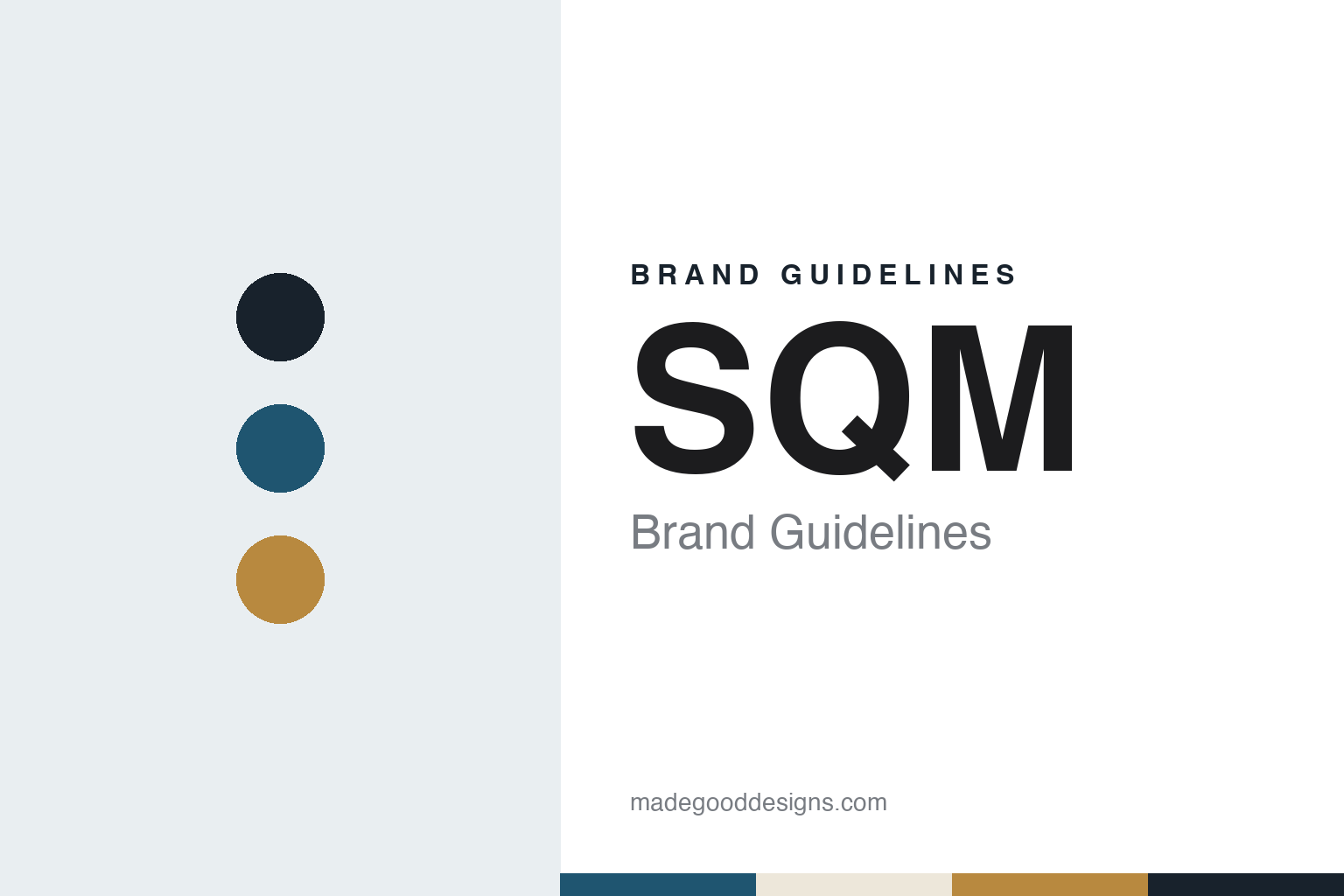
SQM Brand Guidelines
Chile’s saltpetre company, from potassium nitrate to lithium.
Aa
Two constants: an SQM brine blue, salt and ochre palette and an Industrial sans register. Abstract homage — not an SQM product or mark; no sack, logo or label is reproduced.
From saltpetre to SQM
A nitrate company formed by merger in 1968.
SQM — Sociedad Química y Minera de Chile, also known as Soquimich — was formed on 11 June 1968, English Wikipedia says, as a mixed company of private investors and the Chilean state. The Compañía Salitrera Anglo-Lautaro held 62.5 percent and the state development agency CORFO 37.5 percent, and the new company combined Anglo-Lautaro’s deposits and assets with those of CORFO’s Empresa Salitrera Victoria. Its task was to restructure Chile’s declining natural nitrate, or saltpetre, industry, and it was given a monopoly on mining and selling nitrate.
The company traces its roots further back. Its own history page says the María Elena works began in 1926 after the Guggenheim family acquired land in the El Toco district, that the Pedro de Valdivia plant started in 1931 using the Guggenheim process to make sodium nitrate and iodine, and that a nitrate crystallisation plant was built at Coya Sur in 1951. SQM also recalls the saltpetre posters that Chile used from the late 19th century to promote nitrate in more than 30 countries, adapted to each market’s language and farming, and presents them as part of its identity.
Ownership swung twice. In 1971 CORFO took 100 percent and nitrate mining was nationalised. Between 1983 and 1988, under the military government, the company was privatised again: English Wikipedia says CORFO’s 93 percent stake was transferred to the businessman Julio Ponce Lerou for less than its estimated value, and SQM’s history page says pension funds also became shareholders. In 2015, English Wikipedia says, Ponce Lerou’s Pampa group was the largest shareholder, with 32 percent.
Colour
Potassium nitrate, iodine and lithium from the Atacama.
SQM’s resources lie in the Atacama Desert, in the Tarapacá and Antofagasta regions. Two raw materials matter: caliche, the nitrate ore of the northern pampas, which yields sodium nitrate and iodine, and the brines of the Salar de Atacama, which yield potassium salts and lithium. The company says it first produced potassium nitrate at Coya Sur in 1986 with a process of its own design, opened a technical-grade potassium nitrate plant there in 1993 and began making potassium chloride in the Salar de Atacama in 1995. Lithium carbonate production at the Salar del Carmen followed in 1997. SQM dates its first American depositary receipt to 1993; English Wikipedia gives 1995 for its New York Stock Exchange listing.
Fertiliser is the oldest business. SQM describes itself as a global leader in natural-source potassium nitrate, which it presents as a chloride-free, fully water-soluble fertiliser for fertigation, and says its agronomy teams work in more than 100 countries. It widened that business by buying Kemira Emirates Fertiliser Company, a soluble-fertiliser maker, in 2005, and through joint ventures in 2009 with Coromandel in India, Qingdao Star in China and Roullier in France. Iodine grew with the purchase of DSM’s iodine business in Chile in 2006; SQM calls itself the world’s leading iodine producer.
Lithium made the company widely known outside farming. English Wikipedia says that by 2017 SQM was the world’s biggest lithium producer, and that in 2018 China’s Tianqi Lithium bought a 23.77 percent stake in SQM from Nutrien. In 2023, the company says, it split its operations into two divisions, Lithium on one side and Iodine Plant Nutrition on the other.
Typography
Design and documentation.
Fertiliser companies sell something most people never see up close: granules, prills and crystals that leave a mine or a chemical plant in bulk and end up spread across fields. Their visual language tries to bridge that distance. A familiar image is a handful of granules held in open palms, which turns a commodity into something a farmer can weigh and judge, and links the product to the people who use it.
The second register is the field. Corporate reports and websites in this sector lean on green crops, wide horizons and drone shots looking straight down on rows of maize, rice or vines. These images speak to growers and investors at once: they show the end use of the product, and they suggest scale without showing a single factory.
The third register is industrial. Open-pit mines, conveyor belts, evaporation ponds, acid plants and port terminals with ships at the quay appear alongside the fields, because extraction and logistics are the business. Packaging carries the brand into the farmyard: printed sacks and big bags, often with a crop icon, a nutrient formula and a product-range name on the front. Trade events such as the International Fertilizer Association’s Annual Conference add another stage, with stands, lanyards and presentation decks.
This guide sets out what can be checked about each company — when and where it was founded, who owns it, where it mines and makes its products, and how its name has changed — and marks clearly what rests only on the company’s own word. The palettes and typefaces shown here are our own unofficial interpretations, not official brand assets.
Aa
An industrial sans for a company of salt flats and nitrate plants. (Specimen set in IBM Plex Sans, a sans STAND-IN; NOT the SQM logo.)
SQM
A state partner for lithium, a private company for fertiliser.
The lithium side has since changed shape. Chile’s National Lithium Strategy, announced in 2023, called for the state to take part directly in lithium production in the Salar de Atacama. A Codelco press release of 29 December 2025 says negotiations between Codelco and SQM began in May 2023, led to a memorandum of understanding that December and a partnership agreement on 31 May 2024, and were reviewed by authorities in Chile and eight other countries. On 27 December 2025 SQM’s Salar subsidiary absorbed Codelco’s Minera Tarar and was renamed NovaAndino Litio, English Wikipedia says; its first board met on 29 December, with three directors from each company, and the partnership runs until 2060. Reporte Minero reported on 28 January 2026 that Chile’s Supreme Court had rejected an appeal by Tianqi on 26 January, and that SQM considered the merger complete.
The record also includes legal findings. From 2015 the company was investigated in Chile over political campaign financing and tax fraud covering 2006 to 2014, a matter Spanish Wikipedia calls the Caso SQM. In January 2017, English Wikipedia says, SQM settled parallel civil and criminal cases in the United States under the Foreign Corrupt Practices Act, following a Securities and Exchange Commission investigation into improper payments to Chilean political figures.
SQM is based in Santiago. Its corporate site carries the line “Strategic industries for Human Progress,” and its identity page traces the brand through its stages — the full Sociedad Química y Minera de Chile name, Soquimich in the 1990s, and the lines “Solutions for human progress” and “Solutions for Human Development.”
For a design guide, SQM shows how a nitrate company with a poster-advertising past built one name across fertiliser, iodine and lithium. Compare Coromandel, its joint-venture partner in India, and Nutrien, a former shareholder. For this guide we use a brine blue, a salt white and a caliche ochre with a sans, an unofficial interpretation; no product or logo is reproduced.
Explore & save
Keep SQM’s identity on hand — save it to a board in the Made Good inspiration library.
SQM identity set
Pin the SQM brine blue, salt and ochre palette and the Industrial sans register to your own board.