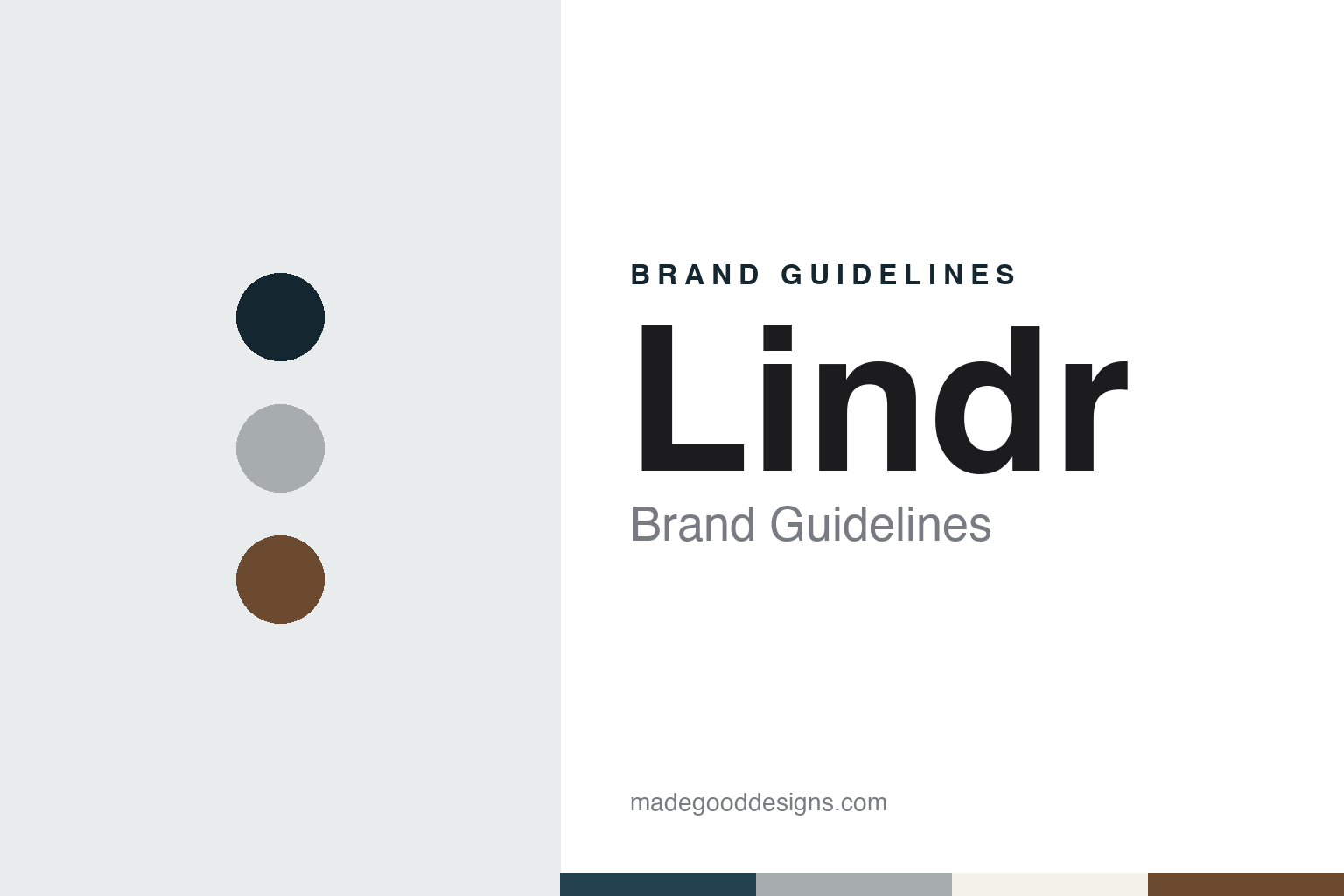
Lindr Brand Guidelines
The Czech village workshop that grew into a beer-cooler maker.
Aa
Two constants: a Lindr slate, steel and hardwood palette and an engineered sans register. Abstract homage — not a Lindr product or mark; no cooler, tower, logo or nameplate is reproduced.
Sadová, 1992
A refrigeration workshop in the Hradec Králové district.
Lindr began in 1992, when Miloš Lindr set up a production and service company in refrigeration and cooling technology, the company says on its English “About us” page. The member directory of the Czech refrigeration and air-conditioning association, Svaz chladicí a klimatizační techniky, gives the same founding year for LINDR.CZ s.r.o., lists Miloš Lindr as its owner and records about 180 employees in the field; the company’s own page speaks of more than 150.
The firm grew up in Sadová, a village in the Hradec Králové district of the Královéhradecký region. Czech Wikipedia puts its population at 314, dates its first written mention to 1086 and notes that it became a municipality in its own right on 24 November 1990, after more than a century as part of neighbouring Sovětice. The company still calls the Sadová site its “original” plant and keeps a showroom and offices there.
The company’s own timeline shows how it moved from repair work to a product range. In 1992 it describes its work as service and modified custom production. In 1997 it began serial production of its AS range of water coolers, and in 1999 it added soda water machines. In 2002 came the contact coolers Pygmy 15 and Kontakt 115, and in 2003 a luxury cooler model called Soudek.
Lindr presents itself as a family business. The company says it remains true to “the vision of a family company with purely Czech capital,” and that it is still committed to what Miloš Lindr began to build some thirty years ago. It says it sells in the Czech Republic and in more than a hundred countries; that figure is its own.
Colour
Contact coolers, towers and soda water.
Most of Lindr’s range is built around one job: chilling beer, and other drinks, on its way from the keg to the tap. The company calls its Contact range of portable coolers “the flagship line” of its production, and describes them as suited to households, garden parties, bars and festivals. The current list runs from small Pygmy units to larger Kontakt machines that cool two or more drinks at once.
Its FAQ explains the two main families. In a dry, or contact, cooler the drink coil is chilled by touching a cooling coil inside a purpose-built thermal block, so no water bath is needed. In a water cooler, such as the AS range, a coil sits in a tank of water and builds up an ice bank around it, which then chills the drink coil. The number in a model name, as in Pygmy 25/K, is the machine’s continuous output in litres per hour, the company says, and models marked Green Line use the refrigerant R290 with an adapted cooling system.
In 2009 Lindr introduced the CWP, which it describes as combining the contact and water principles in a professional cooler that does not work with ice. The company dates its Green Line to 2012, an “Exclusive” design line to 2013 and its CWP technological cooling to 2018; in 2020 it added a Kontakt 300 Twin Power in the Green Line.
Then there are the dispense towers. The Lindr T towers date from 2004, the Naked and Naked One towers from 2014 and the Grand from 2016, with Tube and Cold Bridge models alongside. Lindr says the Naked series has “clean curves in full stainless steel design without a single weld,” and that its products pair polished stainless steel with hardwood. It now also offers its towers with a sandblasted finish.
The catalogue also covers refrigerated counters for bottles, kegs and barrels, wine coolers, dispense heads and taps, party pumps, keg fillers and air compressors. For export, Lindr says its products are tested at the Engineering Testing Institute for the European market, that it holds cULus marking for products sold in the United States and Canada, and that it holds NSF certification, which it describes as a basic requirement for those markets.
Typography
Design and documentation.
Beverage dispensing makers sell to two very different counters. In a pub or bar, the visible parts are the font on the bar top and the tap handles fixed to it, which usually carry the brewer’s branding while the equipment maker’s name sits on the hardware underneath. In a quick-service restaurant, the visible part is the post-mix tower or self-serve dispenser, where drink brands and, more and more, touchscreens take over the front panel.
Most of the machinery is out of sight, so the makers explain it on paper. Catalogues and spec sheets lean on cutaway diagrams of coolers, carbonators and insulated beer lines, on line drawings and wiring diagrams, and on photographs of keg cellars and cold rooms where kegs, gas cylinders and couplers are connected. The literature is written for installers, service technicians and distributors as much as for the owner of the bar.
The trade meets at shows. The National Restaurant Association Show in Chicago gathers foodservice equipment, including fountain dispensers and ice machines; BrauBeviale in Nuremberg covers brewing and the wider beverage supply chain; and the Craft Brewers Conference in the United States brings draught-system suppliers face to face with brewers. Makers also name certifications, audits and sustainability ratings in their own newsrooms, as Lancer does with its ISO certificates.
Ownership often runs through larger groups. Lancer has been part of the Japanese refrigeration maker Hoshizaki since 2006, according to Hoshizaki’s corporate history, and Cornelius went to Berkshire Hathaway when the British engineering group IMI agreed to sell it in 2013, according to English Wikipedia; its website now says it is powered by Marmon Foodservice Technologies. This guide sets out what can be checked about each maker and marks what rests on the company’s own word.
Aa
An engineered sans for a maker of steel coolers and towers. (Specimen set in Archivo, a sans STAND-IN; NOT the Lindr logo.)
Lindr
Two sites a few kilometres apart.
Lindr now runs its production, administration, sales and logistics from two sites, the company says: the original plant at Sadová and a newly built production plant at Dohalice. Czech Wikipedia places Dohalice, a municipality of 439 people first mentioned in 1352, about thirteen kilometres north-west of Hradec Králové, in the same district as Sadová.
The new building also appears in a supplier’s records. The Czech air-handling maker REMAK lists “Lindr Dohalice” among its industrial references for 2020, saying its AeroMaster XP 04 and XP 10 units were part of its delivery for the construction of the new production hall. REMAK describes Lindr as a production and service company in refrigeration and tap technology and as “the largest European manufacturer and supplier of beer coolers”; that ranking is REMAK’s description, not an independent measurement. Lindr itself says it has the widest range of dry beer coolers and compact cooling devices on the European market.
Ownership has stayed with the founder’s family business. The trading company is LINDR.CZ s.r.o., a Czech limited company; the refrigeration association’s directory names Miloš Lindr as owner, and the company describes its capital as purely Czech. It says it brings out new machines every year while updating existing ones, with recent changes including the sandblasted towers and simpler tap fitting on the Kontakt 300.
For a design guide, Lindr shows how a small regional refrigeration firm can turn polished steel, hardwood and its own model names into a recognisable line. Compare Micro Matic and Celli, two more names in draught beer equipment. For this guide we use a deep slate, brushed steel and a hardwood brown with a sans, an unofficial interpretation; no product or logo is reproduced.
Explore & save
Keep Lindr’s identity on hand — save it to a board in the Made Good inspiration library.
Lindr identity set
Pin the Lindr slate, steel and hardwood palette and the engineered sans register to your own board.