CAIRE Brand Guidelines
The oxygen maker Chart built and Niterra bought in 2018.
Aa
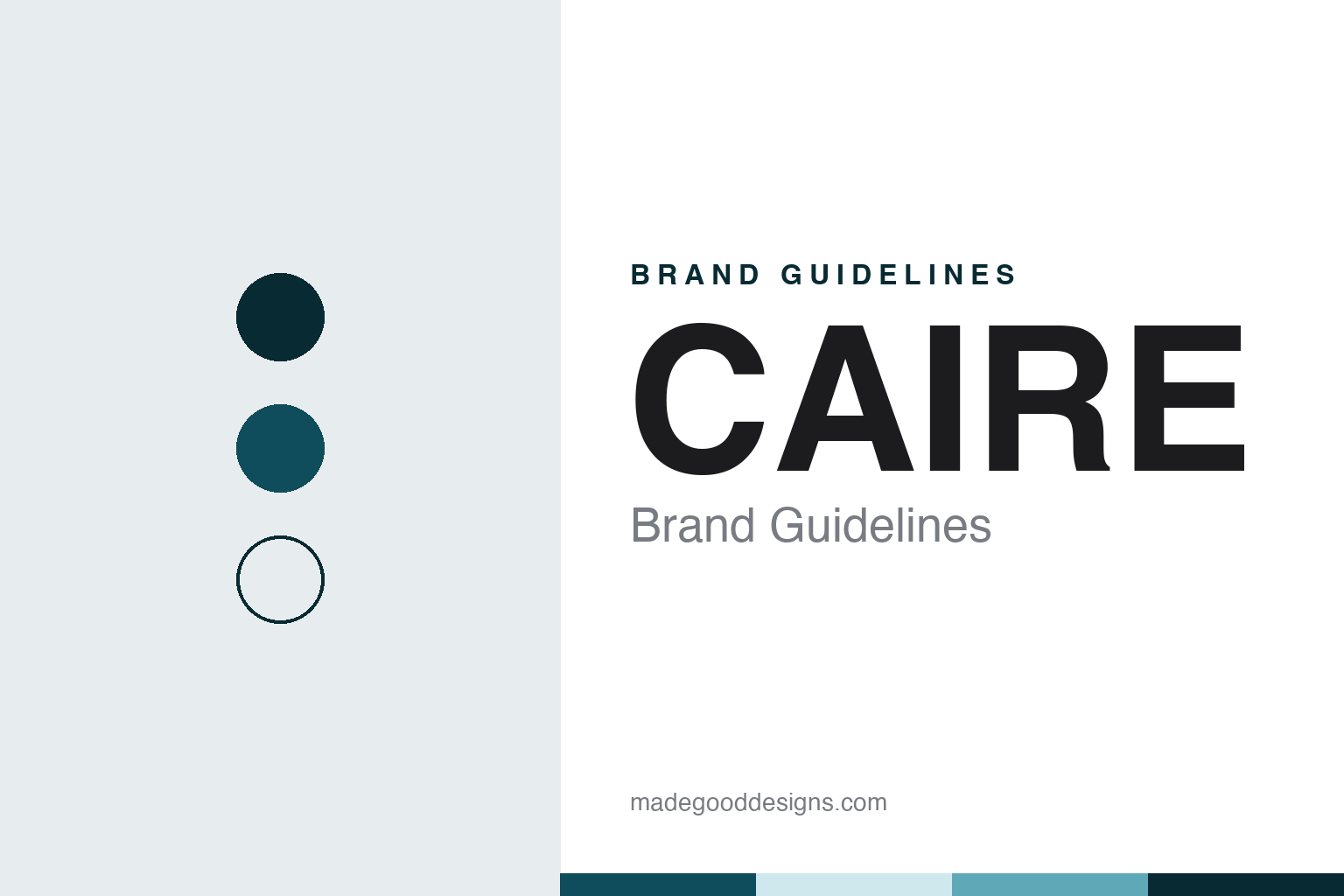
Two constants: a CAIRE deep teal and pale air palette and a Rounded sans register. Abstract homage — not a CAIRE product or mark; no device, logo or nameplate is reproduced.
From cryogenics to oxygen
A small business inside a tank maker.
CAIRE Inc. calls itself “a leading global dedicated oxygen supply manufacturer,” and its strapline is short: “O2 is what we do.” The company, which writes its name in capitals, is based in Ball Ground, Georgia, in the northern Atlanta area, and says it has developed oxygen delivery equipment for more than 50 years. That long history is the company’s own account; the documented record begins in the 1990s.
Its route to the present runs through the cryogenics industry. Chart Industries, a maker of equipment for liquefied gases, says on its corporate history page that in 1999 it acquired MVE Holdings — the business that grew out of Minnesota Valley Engineering — including the Czech firm Ferox and CAIRE, which Chart describes as “a small business specializing in liquid respiratory oxygen equipment.” Chart says that purchase formed the base of its BioMedical business. Chart’s timeline also records that MVE had bought Cryogenic Services Inc. of Ball Ground, a maker of cryogenic tanks, in 1990.
The United States Food and Drug Administration’s 510(k) database, which lists the devices a company has cleared for sale, shows the name moving with the business. Caire, Inc. received a clearance for an oxygen concentrator in August 1995 with an address in Littleton, Colorado; filings in 2001 list Burnsville, Minnesota, in 2005 Marietta, Georgia, and from 2012 Ball Ground.
Under Chart, the oxygen business grew by acquisition. Chart lists the purchase of Covidien’s liquid oxygen therapy business in 2009, of SeQual Technologies, a San Diego maker of medical oxygen concentrators, in 2010, and of AirSep Corporation of Buffalo, New York, a maker of medical and commercial oxygen supply systems, in 2012. The FDA database shows AirSep clearing oxygen concentrators from 1987 and SeQual from 2001. Chart’s timeline then records, for 2018, the “sale of the respiratory healthcare business (CAIRE Medical).”
The buyer was NGK Spark Plug Co. of Nagoya, Japan, according to CAIRE. English Wikipedia says the company was founded in 1936 and changed its English name to Niterra in April 2023; CAIRE published the name change on its own news page in June 2023. CAIRE says Niterra has spent some fifteen years applying its sensing and ceramic technologies to health care, and Wikipedia lists medical as one of the four business fields Niterra has set out for its future.
Colour
Concentrators, liquid oxygen and lung tests.
CAIRE sells under several names it has gathered: AirSep, HELiOS and SeQual appear on its corporate pages as “recognized brands,” alongside product families such as FreeStyle, Eclipse and the Companion 5 stationary concentrator. Its customers, it says, include home care, hospice, long-term care, hospitals, the military and industrial users, and it groups its work into oxygen therapy, cardiorespiratory diagnostics and commercial on-site gas generation.
The portable concentrator is the centre of its story. In April 2022 CAIRE marked the twentieth anniversary of the LifeStyle, introduced under the AirSep brand, which the company calls “the first portable oxygen concentrator”; it also says the LifeStyle became the first such device approved by the US Federal Aviation Administration for use on commercial flights, in 2005. Both are the company’s claims. Its current portable model, the FreeStyle Comfort, is described by CAIRE as “award-winning”; in October 2025 the company said a version with its autoSAT feature, which it says adjusts oxygen delivery to the user’s breathing rate, had become available in the United States. The FDA database lists a clearance for FreeStyle Comfort to Caire, Inc. of Ball Ground in July 2025.
In January 2023 CAIRE said it had completed the acquisition of MGC Diagnostics Holdings of St. Paul, Minnesota, a maker of cardiorespiratory diagnostic systems including the Platinum Elite body plethysmograph and the Ultima CardiO2 gas exchange analysis system, and said it would use its own “global distribution and manufacturing footprint” to widen access to them. In February 2026 MGC announced the US launch of Fenom Flo, a portable device for breath testing. The FDA database had cleared a related device, Fenom Pro, to Caire Diagnostics, Inc. in 2023.
CAIRE lists its locations as Ball Ground; Buffalo, New York, home of AirSep Corporation; St. Paul, Minnesota, home of MGC Diagnostics; Chengdu in China; Anjo in Japan; Langenfeld in Germany; and Padova in Italy, with Niterra’s Australian company handling CAIRE in Melbourne. The company does not set out on those pages which products are built at which site, so this guide leaves the question there.
Typography
Design and documentation.
Respiratory care and patient monitoring sit in two places at once: the hospital ward and the patient’s home. Companies in this field make ventilators, CPAP and bi-level machines, oxygen concentrators, pulse oximeters and bedside monitors, and the way they present themselves usually follows the device to wherever it is used — a ventilator beside an intensive care bed, a small machine on a bedside table at home, a clip on a fingertip.
Their pictures tend to fall into a few familiar scenes. In hospital settings, clinicians stand at monitors with waveform screens showing pressure, flow or oxygen saturation; at home, patients sleep with a mask on or carry a portable concentrator through an ordinary day. Patient stories, often tied to a named model, sit alongside product pages written for respiratory therapists, doctors and home-care providers.
The field also meets in public at medical congresses and trade fairs. The European Respiratory Society congress, the American Thoracic Society conference and the Medica fair in Düsseldorf are among the gatherings where respiratory and monitoring products are shown to clinicians and buyers, and company news is often timed around them.
The companies in this guide differ widely in age, size and ownership — family firms, units of larger groups and makers that have changed hands several times. Each section sets out what can be checked about one brand: who founded it, who owns it now, what it makes and what it says about itself, with the company’s own claims marked as its own. Where sources disagree on a date or an owner, both versions are given.
Aa
A rounded sans — open letters for a name that sounds like air. (Specimen set in Manrope, a sans STAND-IN; NOT the CAIRE logo.)
CAIRE
One word for several makers.
CAIRE’s identity has to hold together companies that were founded separately and gathered over about two decades. The corporate name stays in capitals, while older names live on beneath it: AirSep Corporation still appears in Buffalo on CAIRE’s locations page, and CAIRE’s copyright line lists CAIRE and AirSep as its registered trademarks, “as well as individual product brands.” The strapline “O2 is what we do” puts the chemical symbol for oxygen at the front of the brand voice, and its stated vision speaks of helping customers “live healthier and more productive lives.”
The ownership chain is unusual for the category. A respiratory business that began inside a maker of cryogenic tanks now belongs to a Japanese company whose English Wikipedia entry describes it first as a maker of spark plugs and technical ceramics. CAIRE presents that pairing as “a natural fit,” pointing to Niterra’s sensing and ceramic work. In November 2025 the chain gained a link to monitoring as well: the former head of MGC Diagnostics, described by Nonin in November 2025 as having led “a subsidiary of CAIRE Inc. and Niterra,” became chief executive of the Minnesota pulse oximeter maker Nonin.
Readers searching online should note the domain. The company’s site is caireinc.com; caire.com, checked in November 2026, is a parked page that says the domain may be for sale and has no connection to the oxygen maker. AirSep keeps its own address at airsep.com, which CAIRE lists on its locations page.
For a design guide, CAIRE shows how a short capitalised name can sit over a portfolio of inherited brands without replacing them. Compare Inogen, another American maker of portable oxygen concentrators, and Nonin, the Minnesota monitoring company now led by a former CAIRE subsidiary chief. For this guide we use a deep teal and a pale air blue with a sans, an unofficial interpretation; no product or logo is reproduced.
Explore & save
Keep CAIRE’s identity on hand — save it to a board in the Made Good inspiration library.
CAIRE identity set
Pin the CAIRE deep teal and pale air palette and the Rounded sans register to your own board.