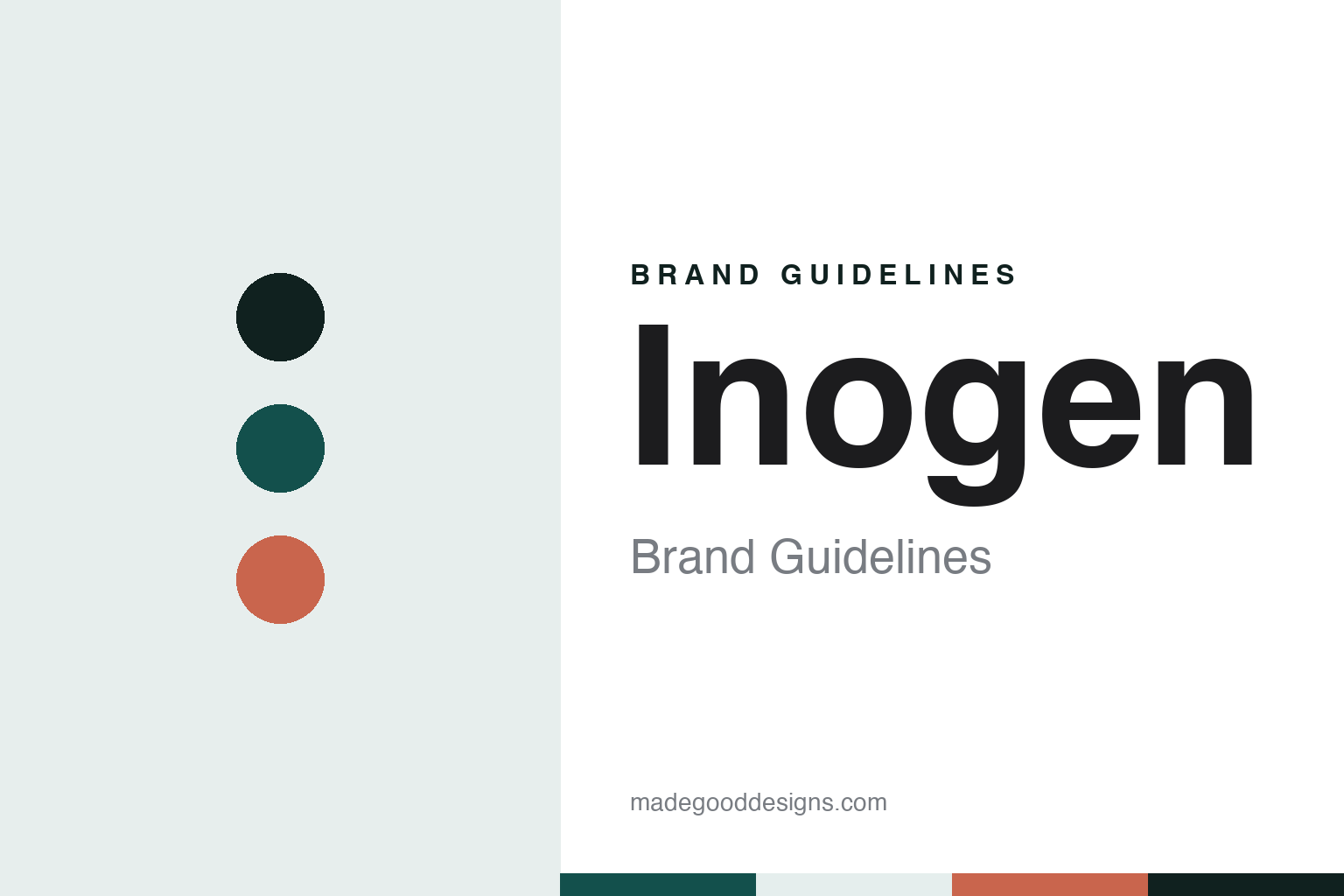
Inogen Brand Guidelines
The Goleta oxygen concentrator maker born from a 2001 business plan.
Aa
Two constants: an Inogen teal, mist and coral palette and a friendly sans register. Abstract homage — not an Inogen product or mark; no device, logo or nameplate is reproduced.
A student business plan
Three founders and a campus competition.
Inogen is an American maker of portable oxygen concentrators based in Goleta, California, beside Santa Barbara. It was incorporated in Delaware on 27 November 2001, according to its annual report. Its founders were Ali Bauerlein, Brenton Taylor and Byron Myers, who started the company in 2001 after winning the annual business plan competition of the Technology Management Program at UC Santa Barbara’s College of Engineering. That account comes from a May 2014 announcement made jointly by Inogen and the program, when the three received the program’s Venky Narayanamurti Entrepreneurial Leadership Award for leadership in the region’s technology community.
The product came soon after. The company’s annual report says it has been developing and refining the manufacture of its oxygen concentrator systems since 2004, and the US Food and Drug Administration’s 510(k) database records the Inogen One oxygen concentrator as cleared in May 2004, filed from Goleta. A stationary unit for the home, the Inogen At Home, followed, cleared by the FDA in June 2014.
Inogen became a public company in February 2014, when it completed an initial public offering and began trading on the Nasdaq Global Select Market under the ticker INGN, its annual report says. Its investor site still lists the shares on Nasdaq in November 2026.
Colour
From Goleta to Texas, the Czech Republic and France.
Inogen has grown by acquisition as well as by product. Its annual report lists the purchase of the Dutch company MedSupport Systems in May 2017, which began operating as Inogen Europe; of New Aera, Inc. in August 2019; and of the French company Physio-Assist in September 2023, which brought the Simeox airway clearance device. The FDA database records the Simeox 200 as cleared in December 2024. In January 2025 Inogen signed a strategic collaboration agreement with the Chinese maker Yuwell (Jiangsu Yuyue Medical Equipment & Supply), under which Inogen began distributing the Voxi 5 stationary concentrator and, from November 2025, the Aurora CPAP masks in the United States, while Yuwell distributes some Inogen portable concentrators in parts of the Asia-Pacific region.
The portable range is sold under two names. The Inogen One line includes the G5; the newer Inogen Rove line includes the Rove 4, cleared by the FDA in December 2022, and the Rove 6, cleared in June 2023. The annual report calls the Rove 4 its newest portable concentrator and describes the Inogen At Home as the company’s own five-litre stationary concentrator with continuous flow. The company says all its portable systems use what it calls Intelligent Delivery Technology, a form of pulse-dose delivery in which oxygen is released as the user breathes in, and it offers Inogen Connect, a mobile app for patients with a back-end portal for equipment providers.
On where the products are made, the annual report is specific. Inogen says it assembles its oxygen concentrators in a leased building in Plano, Texas, having brought the assembly of compressors, sieve beds and concentrators in-house after starting with mostly outsourced production; that the Rove 6 is produced, and repairs carried out, for European customers by the contract manufacturer Foxconn in the Czech Republic; and that Simeox is made in a leased facility in France. Goleta houses the company’s design facility, and a site in the Netherlands handles European customer support.
The company is changing shape. On 30 September 2026 Inogen announced an agreement to sell its US oxygen rental business to Rotech Healthcare, together with a long-term supply agreement under which Rotech would distribute Inogen concentrators; by 5 November 2026 its investor site reported the divestiture as completed. The same day it named its chief operating officer, Andy Reding, president and chief executive, succeeding Kevin Smith.
Typography
Design and documentation.
Respiratory care and patient monitoring sit in two places at once: the hospital ward and the patient’s home. Companies in this field make ventilators, CPAP and bi-level machines, oxygen concentrators, pulse oximeters and bedside monitors, and the way they present themselves usually follows the device to wherever it is used — a ventilator beside an intensive care bed, a small machine on a bedside table at home, a clip on a fingertip.
Their pictures tend to fall into a few familiar scenes. In hospital settings, clinicians stand at monitors with waveform screens showing pressure, flow or oxygen saturation; at home, patients sleep with a mask on or carry a portable concentrator through an ordinary day. Patient stories, often tied to a named model, sit alongside product pages written for respiratory therapists, doctors and home-care providers.
The field also meets in public at medical congresses and trade fairs. The European Respiratory Society congress, the American Thoracic Society conference and the Medica fair in Düsseldorf are among the gatherings where respiratory and monitoring products are shown to clinicians and buyers, and company news is often timed around them.
The companies in this guide differ widely in age, size and ownership — family firms, units of larger groups and makers that have changed hands several times. Each section sets out what can be checked about one brand: who founded it, who owns it now, what it makes and what it says about itself, with the company’s own claims marked as its own. Where sources disagree on a date or an owner, both versions are given.
Aa
A friendly sans — one company name across a product family. (Specimen set in Figtree, a sans STAND-IN; NOT the Inogen logo.)
Inogen
One name across a product family.
The brand works through its product families. The company name leads the range: Inogen One, Inogen Rove, Inogen At Home and Inogen Connect. The annual report lists “Inogen,” “Inogen One,” “Inogen Rove” and “the Inogen design” among the company’s registered US trademarks. Products that came through acquisitions and partners keep names of their own alongside it: Simeox from Physio-Assist, and Voxi and Aurora through the Yuwell collaboration, with the stationary unit sold as the Inogen Voxi 5.
Inogen sells to two audiences at once. Its annual report describes sales to home medical equipment providers, distributors and resellers in the United States and abroad, and direct to consumers; its September 2026 announcement describes a cash-pay direct-to-consumer channel that continues alongside distributors after the rental sale. Its investor site says its products aim to give patients “the chance to remain ambulatory.”
The story the company tells about its beginnings is a Santa Barbara one: a campus business plan, an engineering program’s award to the three founders, a public listing in 2014, and a Goleta address on both its first FDA clearance in 2004 and its 2025 annual report.
For a design guide, Inogen shows how a single company name can carry a family of portable products. Compare CAIRE, another maker of oxygen concentrators, and Resmed, founded in Sydney in 1989. For this guide we use a deep teal, a mist blue and a coastal coral with a sans, an unofficial interpretation; no product or logo is reproduced.
Explore & save
Keep Inogen’s identity on hand — save it to a board in the Made Good inspiration library.
Inogen identity set
Pin the Inogen teal, mist and coral palette and the friendly sans register to your own board.


