Vygon Brand Guidelines
The Écouen family firm built on single-use hospital devices.
Aa
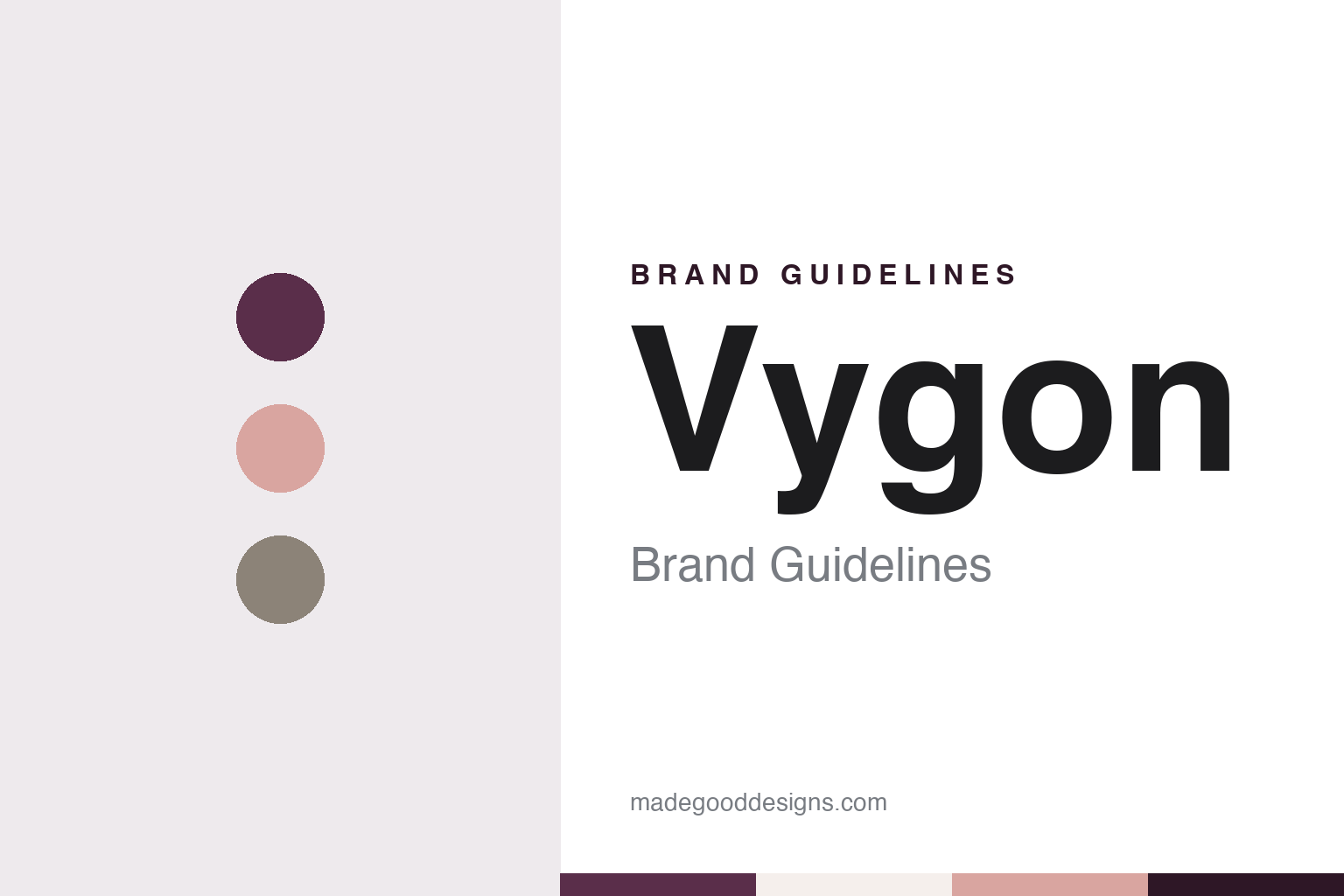
Two constants: a plum, rose and warm grey palette and a humanist serif register. Abstract homage — not a Vygon product or mark; no device, logo or packaging is reproduced.
Pierre Simonet
Plastic, single use and a hospital stay.
Vygon was founded in 1962 by Pierre Simonet, and its head office is in Écouen, in the Val-d’Oise north of Paris. French Wikipedia gives that founding year and founder; English Wikipedia describes Simonet as a Belgian engineer and places the founding in Écouen. The company says Simonet decided to offer single-use equipment after a short stay in hospital, where he saw how hard sterilisation procedures were and how complex the work of health staff could be, at a time when plastic was first appearing in hospitals.
Vygon looked abroad early. The company says it set up a German subsidiary in 1968 and opened a plant in Aachen in 1973, and that its Belgian plant, Dimequip at Frameries, dates from 1970 and makes suction probes among other products. French Wikipedia describes the same expansion into Germany and Belgium, followed by subsidiaries in the United Kingdom, Spain, the Netherlands and Ireland. French Wikipedia adds that the 1980s and 1990s brought new subsidiaries or plants in the United States, Portugal, India, Bulgaria, Colombia, Uruguay and Sweden. Further French plants followed at Saint-Saulve, for single-use surgical drapes and custom packs, and at Avesnes-sur-Helpe, for respiratory, drainage and regional anaesthesia devices, the company says.
In Britain, Vygon (UK) was founded in 1973 in Cirencester, English Wikipedia says. In September 2011 the BBC reported that it had moved from Cirencester to the former Motorola building in north Swindon, a building opened in 1998 that made a brief appearance in the 1999 James Bond film The World Is Not Enough. English Wikipedia says the company renamed it the Pierre Simonet Building after the founder.
Colour
Catheters, connectors and newborns.
Vygon makes single-use devices for hospitals and home care. French Wikipedia says the company designs, manufactures, packages, sterilises and sells them, and lists its clinical areas as neonatology, adult and paediatric intensive care, anaesthesia, oncology, emergency care, surgery and home care.
The company tells its own history through named products. It dates Leadercath, a catheter for the Seldinger technique of reaching blood vessels, to 1975 and calls it the first catheter compatible with that technique. It presents Epicutaneo Cava, a catheter for intravenous feeding of premature babies and newborns, as the origin of its work in neonatology, later joined by Premicath, which it describes as its smallest catheter, for babies weighing less than a kilo. It calls Bionector the first needle-free closed-system connector, and dates the Nutrisafe2 enteral feeding system for newborns to 2005 and the Vadsite connector to 2013. A CPAP device named after Dr Boussignac followed in 1999, the company says.
Growth also came through acquisitions. The company says it bought the US companies Churchill Medical Systems and Advanced Medical Systems. French Wikipedia records Medwin, an enteral feeding pump maker at Les Aires in the Hérault, in 2014; Perouse Medical, which brought cardiovascular devices, in 2015; the Italian company Pilot, maker of an ECG-based system for locating central venous catheters, in 2019; the start-up Advanced Perfusion Diagnostics in 2020; and the Peruvian distributor Macatt Médica in March 2022. Vygon says Medwin had been making feeding pumps for hospital and home use for 15 years; in January 2017 Vygon announced its easymoov6 enteral feeding pump, which it said had received CE marking in October 2016 and was designed for both hospital and home care. In June 2023 Vygon signed an exclusive agreement with Carmat, the French maker of an artificial heart; Vygon says the work covers the vascular graft that connects the device to the patient’s arteries.
Typography
The hospital device category.
Hospital device makers sell to clinicians, purchasing teams and hospital engineers rather than to shoppers, and their brands are built for that audience. Their catalogues and websites tend to show the equipment where it is used: infusion pumps on poles beside a bed, dialysis machines lined up in a treatment room, monitors and consoles in intensive care.
Much of the product is small and disposable, so the pictures often come close. Gloved hands hold a catheter, a cannula or an infusion set; blood tubing is coiled for a dialysis session; a dialyzer or a single-use endoscope is photographed on plain white so that every connector and label can be read. Product names usually lean on model numbers and technical terms rather than on lifestyle words.
People appear too, usually in uniform: nurses and doctors at the bedside, technicians at a workbench, trainers at a company teaching centre. Several makers in this group run their own training facilities for clinicians, and they present them as part of what they sell alongside the devices.
The trade meets at congresses and fairs. Medica in Düsseldorf gathers hospital suppliers from around the world each autumn; ASN Kidney Week, the American Society of Nephrology’s annual meeting, draws dialysis makers; and Digestive Disease Week brings together gastroenterologists and endoscopy suppliers. Stands, booth graphics and congress brochures are where many of these brands are seen at their largest, and this guide sets out what can be checked about each company: who founded it, who owns it, and where it says its products are made.
Aa
A humanist serif for a family-owned French maker. (Specimen set in Source Serif 4, a serif STAND-IN; NOT the Vygon logo.)
Vygon
Family-owned, with eleven factories.
French Wikipedia gives its legal form as a simplified joint-stock company, an SAS, and the company describes itself as “a family-run, entrepreneurial business” whose model rests on family share ownership, which it says leaves it free in its strategic choices. Its website names Stéphane Regnault as chairman of the board and Ludovic Richard-Vitton as chief executive; French Wikipedia lists both among its managers.
Vygon says it chose to stay a manufacturer when much of the industry was moving production elsewhere, and that it prefers to produce close to its markets. It says it runs 11 factories, nine of them in Europe and five in France, making about 210 million devices a year, with 26 subsidiaries and sales in 120 countries. Among those sites it names the plant at Écouen, Dimequip in Belgium, Aachen in Germany and Barranquilla in Colombia, which it says makes surgical brushes and endotracheal tubes for South American markets.
The company says it wants to be recognised worldwide as a clinical adviser in neonatology and vascular medicine, and that in 2023 it set up an in-house training centre for its staff, Vycademy; it also runs training programmes and local partnerships with hospital departments.
For a design guide, Vygon shows a family-owned company that tells its story through a timeline of named products and the factories that make them. Compare B. Braun and Ambu. For this guide we use a plum, a soft rose and a warm grey with a serif, an unofficial interpretation; no product or logo is reproduced.
Explore & save
Keep Vygon’s identity on hand — save it to a board in the Made Good inspiration library.
Vygon identity set
Pin the Vygon plum, rose and warm grey palette and the humanist serif register to your own board.