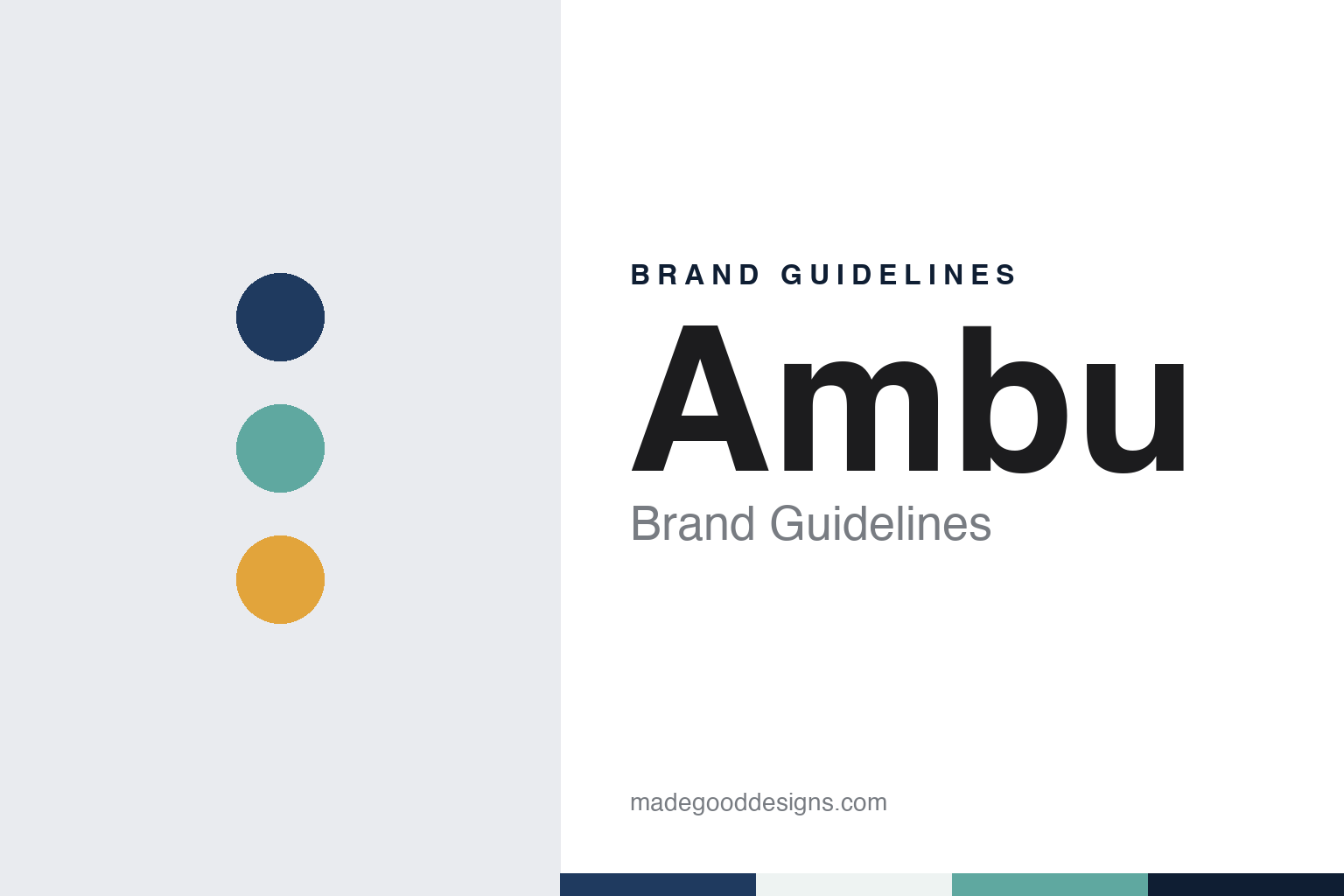
Ambu Brand Guidelines
The Danish maker that took its name from a self-inflating bag.
Aa
Two constants: a navy, sea-glass and amber palette and a clinical sans register. Abstract homage — not an Ambu product or mark; no device, logo or packaging is reproduced.
Testa Laboratorium
A German engineer’s laboratory in Glostrup.
Ambu began in 1937 as Testa Laboratorium, founded in Glostrup, west of Copenhagen, by the German engineer Holger Hesse. Danish Wikipedia and Lex, the Danish national encyclopaedia, both give that founding story, and Lex adds that Hesse set out to develop products that could save lives. English Wikipedia gives Berlin as his birthplace. The sources read for this guide do not describe Testa Laboratorium during the German occupation of Denmark in 1940–45.
The company says its first product was the Sicca Hemometer, which let doctors in private practice measure the haemoglobin in a blood sample without sending it to an outside laboratory.
The turn came in the 1950s through the Danish anaesthetist Henning Ruben. In a profile published in the BMJ in January 2005, the anaesthetist John Zorab wrote that a lightweight foot-operated suction device Ruben developed in 1953 brought him into contact with Hesse, “the founder of the company Ambu-Testa,” and that Ambu was the first to market it. Zorab traced the self-inflating bag to a 1954 strike by Danish truck drivers that kept oxygen deliveries off the road: Ruben had a mechanic weld bicycle-wheel spokes into a frame that held an anaesthesia bag open, so that it filled itself again when released. Combined with Ruben’s non-rebreathing valve, Zorab wrote, “the self-inflating bag was born,” and in 1964 the American Medical Association named it among the most significant advances in anaesthesia of the previous 25 years.
The Ambu bag reached the market in 1956. Ambu calls it the world’s first self-inflating resuscitator; Lex describes it as the first portable resuscitation bag that could be used without a power supply or a separate oxygen supply. Danish Wikipedia notes that in Denmark it is also called the “Rubenballon.” In time the product gave the company its name.
Ambu’s US website sets the bag against Denmark’s polio epidemic of the period and the oxygen shortage, and quotes the anaesthesia historian Christine Ball of the Alfred Hospital in Melbourne, who calls Ruben’s use of bicycle spokes an idea “so brilliant and so simple.”
Colour
From bags to single-use scopes.
Ambu says the business was led by Ruth Hesse through the 1960s and 1970s, when it added training manikins, a PEEP valve and an ECG simulator and built up distributors and sales companies abroad; by the late 1970s its range fell into two groups, resuscitation and training. Zorab’s BMJ profile records that in 1957 Ruben built a manikin on which people could practise using the bag.
The name followed the product. Testa became Ambu International in the 1980s — in 1986, the company says, while Danish Wikipedia gives 1988 for the adoption of the Ambu name — and, according to Lex, the company was listed on the Copenhagen stock exchange in the early 1990s. Ambu’s own timeline places the listing six years after the change of name. In June 2018 it joined Copenhagen’s C25 index, Danish Wikipedia says, citing the news agency Ritzau.
In 2001 Ambu bought Medicotest, which it describes as the largest European maker of electrodes, and with it the BlueSensor range of ECG electrodes. The company says that was also when it began to move production gradually from Denmark to Malaysia and China, and to concentrate on single-use devices.
In 2009 Ambu launched the aScope, which it calls the world’s first single-use flexible bronchoscope. Single-use endoscopy has since become the centre of the business. Lex describes two divisions, Endoscopy Solutions and Anaesthesia & Patient Monitoring: the first makes single-use scopes and displays for lung medicine, urology, gastroenterology and ear, nose and throat work; the second makes resuscitators, laryngeal masks, airway and ventilation masks, and single-use electrodes for ECG and neurophysiology. The company says its endoscopy range now spans bronchoscopes, rhinolaryngoscopes, cystoscopes and a duodenoscope, alongside the Aura laryngeal masks and the Neuroline electrodes.
Typography
The hospital device category.
Hospital device makers sell to clinicians, purchasing teams and hospital engineers rather than to shoppers, and their brands are built for that audience. Their catalogues and websites tend to show the equipment where it is used: infusion pumps on poles beside a bed, dialysis machines lined up in a treatment room, monitors and consoles in intensive care.
Much of the product is small and disposable, so the pictures often come close. Gloved hands hold a catheter, a cannula or an infusion set; blood tubing is coiled for a dialysis session; a dialyzer or a single-use endoscope is photographed on plain white so that every connector and label can be read. Product names usually lean on model numbers and technical terms rather than on lifestyle words.
People appear too, usually in uniform: nurses and doctors at the bedside, technicians at a workbench, trainers at a company teaching centre. Several makers in this group run their own training facilities for clinicians, and they present them as part of what they sell alongside the devices.
The trade meets at congresses and fairs. Medica in Düsseldorf gathers hospital suppliers from around the world each autumn; ASN Kidney Week, the American Society of Nephrology’s annual meeting, draws dialysis makers; and Digestive Disease Week brings together gastroenterologists and endoscopy suppliers. Stands, booth graphics and congress brochures are where many of these brands are seen at their largest, and this guide sets out what can be checked about each company: who founded it, who owns it, and where it says its products are made.
Aa
A clinical sans for a Danish device maker. (Specimen set in Archivo, a sans STAND-IN; NOT the Ambu logo.)
Ambu
A Ballerup head office and four factories abroad.
Today Ambu A/S is a listed company with its head office in Ballerup, outside Copenhagen, and its B shares trade on Nasdaq Copenhagen. Lex, updated in November 2026, names Britt Meelby Jensen as chief executive.
Its products are made outside Denmark. In its statement under the UK Modern Slavery Act, Ambu says it owns and operates factories in Penang in Malaysia, Xiamen in China, Indiana in the United States and Juárez in Mexico. Lex likewise lists factories in the United States, Mexico, Malaysia and China, where most of the company’s single-use products are made, with development and engineering centres in places including Denmark, Germany and Malaysia. Ambu says it employs more than 5,000 people and sells directly in 20 countries, through distributors elsewhere.
The company’s own history page is built around two products it calls firsts: the self-inflating bag of 1956 and the single-use bronchoscope of 2009. The first also supplied the company name, and the registered trademark sign still appears after “Ambu” in the names of its ranges on its website.
For a design guide, Ambu shows how one product name, the Ambu bag, can become the name of a whole company and carry across very different ranges. Compare Boston Scientific and Vygon. For this guide we use a harbour navy, a sea-glass green and an amber with a sans, an unofficial interpretation; no product or logo is reproduced.
Explore & save
Keep Ambu’s identity on hand — save it to a board in the Made Good inspiration library.
Ambu identity set
Pin the Ambu navy, sea-glass and amber palette and the clinical sans register to your own board.


