OilQuick Brand Guidelines
The Hudiksvall family firm that taught excavators to change tools from the cab.
Aa
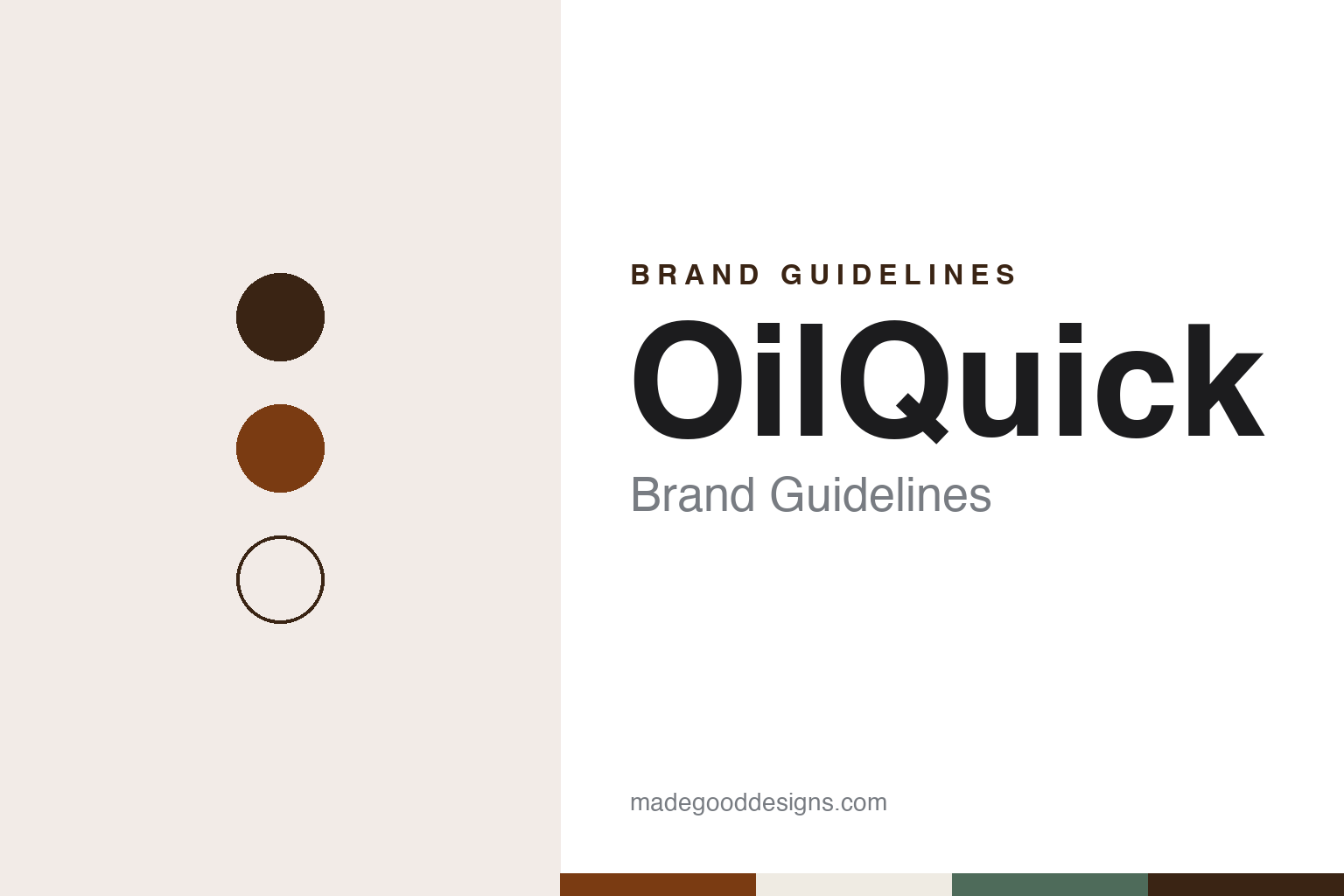
Two constants: a rust, birch and spruce palette and a grotesque sans register. Abstract homage — not an OilQuick product or mark; no coupler, tiltrotator or logo is reproduced.
The Sonerud brothers
From used farm machinery to backhoe loaders.
OilQuick’s story begins long before its name. The company says that in 1952 John Sonerud, a former locomotive driver, and his brother Gottner started a business called Bröderna Soneruds Maskinförmedling, brokering used farm machinery, hay and similar goods between buyers and sellers; a third brother, Erik, joined a year later. By the late 1950s the range had grown, for a time, to chainsaws, freezers, refrigerators and even television sets, and the brothers imported used Ferguson tractors from England.
In 1957 Gottner and Erik left, and John formed Soneruds Maskin AB. With farming in a slump, the company says, he turned to selling the Norwegian-built Hymas backhoe loader, and in 1959 founded Svenska Hymas i Hudiksvall AB with three Norwegian partners, later buying them out. New factories went up in Hudiksvall in 1967 and 1973, and the company says output reached about 600 machines a year between 1974 and 1979. Among the features it credits to that period are mechanical quick couplers, introduced in the mid-1960s. Hymas was sold to Karolin Invest of Skellefteå in 1972, and John moved back to Soneruds Maskin in 1977.
That year his son Åke Sonerud joined, and the company built a new factory in Hudiksvall to develop a self-propelled sea dumper called Sea Dump; about 40 were sold, the company says, before the product was wound down. In 1978 and 1979 Soneruds turned itself into a development and sales company for its own patented attachments for backhoe loaders and excavators, with manufacturing placed with local subcontractors.
The first product of that new policy was the Grab John bucket, launched in spring 1980 with hydraulic grab claws built into it, at first for raising poles. Åke became chief executive the same year. The company says a whole Grab John range for excavators of up to 35 tonnes followed, with special tools for pipe laying, cable ploughing and rock drilling, that about 45 per cent of production was exported by the late 1980s, and that about a hundred buckets were made under licence in Japan. Grab John buckets are still part of the range.
Colour
Hoses that connect themselves.
The idea that gave the company its name dates from 1989. By then, the company says, mechanical and hydraulic couplers that let an excavator or loader change tools quickly were becoming standard in Sweden; the next step was to connect a tool’s hydraulic lines automatically as well, without the operator leaving the cab. The project ran late, and the first OilQuick coupler, for backhoe loaders, was launched in spring 1993, together with a system that placed couplers both above and below a tiltrotator. The Construction Index’s Digger Blog, retelling the story, says that first system was shown fitted below a Rototilt tiltrotator.
The concept then spread from machine to machine. OilQuick’s history records the first wheel-loader system in 1996, on a Volvo L50 at a paper-recycling yard in Hudiksvall, and the first system for forklift trucks a year later. Later came couplers for material handlers, the OQ120 for excavators of 70 to 120 tonnes in 2004, and in 2005 the TX45 M for truck-mounted cranes, sold exclusively through HIAB. In 2009 the company launched its own tiltrotator, which can itself be uncoupled from the cab; its current model is the OQTR-E. In 2011, the company says, the Swedish Defence Materiel Administration ordered Volvo wheel loaders and excavators fitted with OilQuick couplers for international missions.
Trade reporting describes the same spread. KHL reported in September 2021, when OilQuick joined the European Demolition Association, that the Hudiksvall company specialises in automatic quick couplers for excavators, wheel loaders, forklift trucks, material handling machines and cranes, also makes tiltrotators, and had sold more than 37,000 systems, according to the association. The company itself said that more than 40,000 had been delivered by 2022. In February 2024 Forkliftaction reported a partnership giving the Swedish fork-positioner maker Hagaberg access to OilQuick’s OQT forklift range, noting that both companies make their products in Sweden.
Manufacturing has moved back in-house. In autumn 2014, the company says, it decided to produce strategic components itself, and between 2014 and 2017 it invested in premises, welding robots and machining centres. Its website now says most of its manufacturing takes place in Hudiksvall, with five robot welding cells, and that its goal is to make all its products in its own workshop.
Typography
Design and documentation.
Excavator attachments are sold on what they let a machine do. A tiltrotator sits between the arm and the bucket so that the bucket can turn and tilt, and its makers tend to show it at work: a bucket angled along a trench in a city street, a ditch shaped beside a forest road in northern Sweden, a grab sorting stone on a building site. Hydraulic breakers are pictured against rock faces and concrete, demolition shears against steel, and quick couplers in close-up, where the meeting of tool and machine is the point of the picture.
Much of this trade began in the Nordic countries. engcon traces its tiltrotator to the mid-1980s in Jämtland, and Rototilt traces its name to a 1986 launch by Noreco of Umeå; in 2020 Rototilt and Steelwrist launched Open-S, a shared standard for fully automatic quick couplers, KHL reported. Breaker and demolition-tool makers in Italy, Finland, France, Germany and Japan complete the group of makers in these guides.
The makers meet their customers in person. Trade fairs such as bauma in Germany and Intermat in France, Conexpo in Las Vegas and national machinery shows are where new ranges are unveiled; engcon says it first showed its tiltrotator at a Stockholm fair in 1993, and Rototilt presented its Rototilt Control concept at bauma in 2022. Demonstration days, factory open houses and dealer events let operators try the equipment, and much selling goes through local dealers and sales companies.
This guide sets out what can be checked about each maker — who founded it, who owns it, and where it says its products are made — and marks clearly what rests on the company’s own word. The palettes and typefaces shown are our own interpretation, not the brands’ marks.
Aa
A grotesque sans for a name that joins product and company. (Specimen set in Archivo, a sans STAND-IN; NOT the OilQuick logo.)
OilQuick
One name for the product and the company.
For its first decade the coupler and the company had different names. In late 1996 and early 1997, the company says, Soneruds Maskin AB raised capital through two directed share issues and its shares were listed on the market; in 2001 the Sonerud family again became sole principal owner and the listing ended. In 2002, its fiftieth year, the company renamed itself OilQuick AB, so that product and company carried the same name, which it says made the brand easier to build and better suited to international markets. The Construction Index’s Digger Blog gives the same 1952 start and 2002 renaming. The colours and letterforms of the OilQuick mark are not described in the sources used here, so the palette and type on this page are our own choices.
The company has stayed in the family. OilQuick says that in February 2012 Henrik Sonerud succeeded his father Åke as chief executive, the third generation of the family to lead the business, and the company describes itself as a family firm based in Hudiksvall. KHL reported in 2021 that the company was run by the second and third generations, with Henrik as chief executive. Over Christmas 2008, the company says, it moved into new premises of 2,200 square metres in Hudiksvall.
Its reach abroad is built through subsidiaries and dealers. Hub-4 reported in October 2020 that OilQuick, which already had subsidiaries in France and North America, had opened OilQuick UK Ltd on 1 October 2020, working alongside its existing British dealers, and quoted Henrik Sonerud linking the move to interest in the new OQTR-E tiltrotator. The company says exports account for about 80 per cent of its business and that it has agreements to supply excavator manufacturers.
For a design guide, OilQuick shows how a family firm can turn one practical idea into the name on the door. Compare Steelwrist, another Swedish maker of automatic couplers and tiltrotators, and Rototilt, the tiltrotator the first OilQuick system was shown with. For this guide we use a rust brown, birch and a spruce green with a sans, an unofficial interpretation; no product or logo is reproduced.
Explore & save
Keep OilQuick’s identity on hand — save it to a board in the Made Good inspiration library.
OilQuick identity set
Pin the OilQuick rust, birch and spruce palette and the grotesque sans register to your own board.