Rototilt Brand Guidelines
Noreco’s 1986 tiltrotator, a heart and a red.
Aa
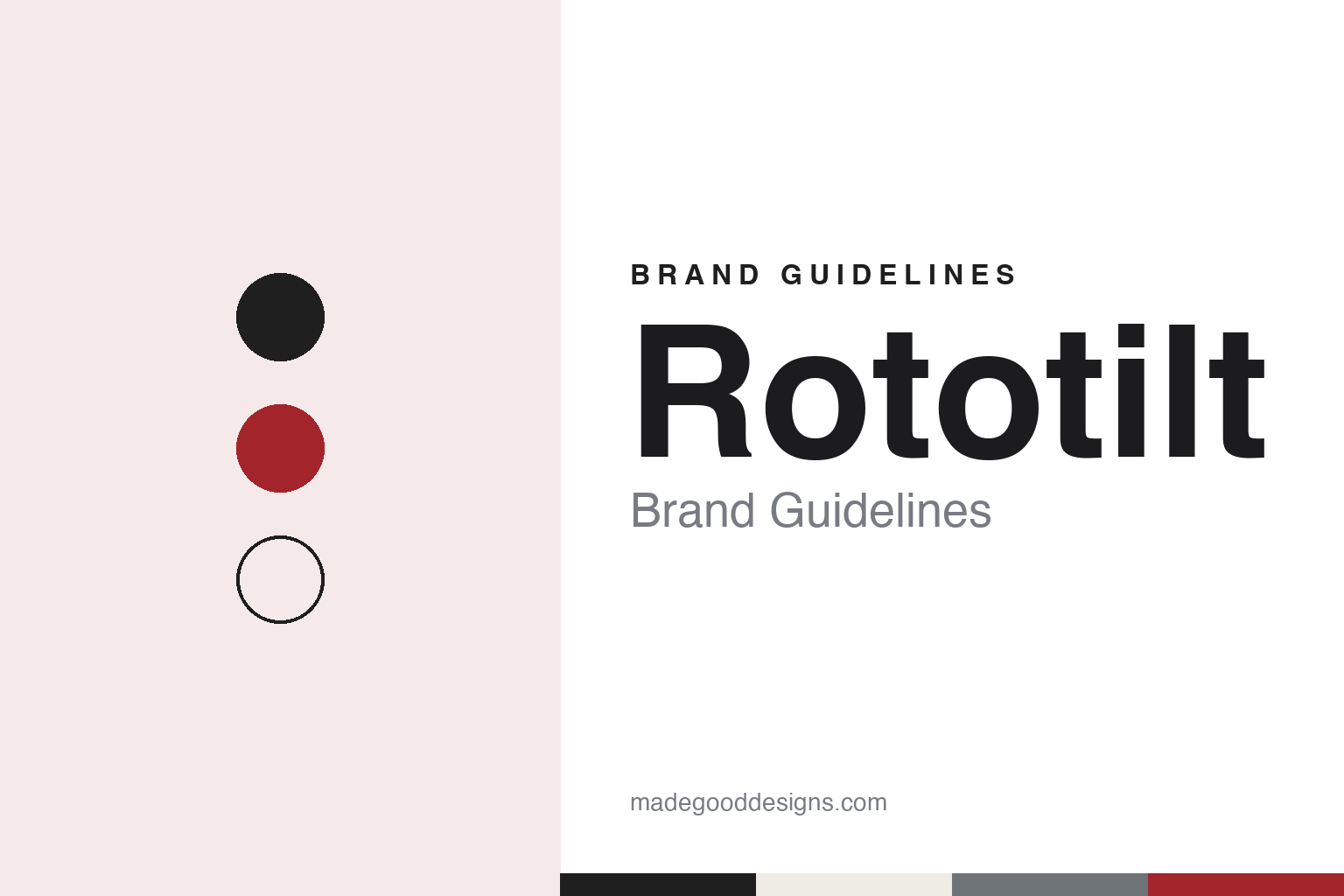
Two constants: a red, charcoal and birch palette and a Titillium sans register. Abstract homage — not a Rototilt product or mark; no tiltrotator, logo or heart symbol is reproduced.
Indexator
A forestry family in Vindeln and a name from Umeå.
Rototilt is the tiltrotator brand of Rototilt Group AB, based in Vindeln, in Västerbotten in northern Sweden. Its roots are in forestry equipment. The company’s history says Allan Jonsson and his brother Rune founded Br. Jonsson in 1953, turned to forestry cranes in 1959, and that in 1963 Allan co-founded the crane maker Cranab. In 1973 he bought Indexator, a maker of hydraulic components that, the company says, had moved to Vindeln from Norrtälje in 1969. English and Swedish Wikipedia also date the purchase to 1973, and the trade magazine Dry Cargo International reported in October 2013 that Jonsson had since built Indexator into a maker of rotators for forestry, cargo handling and recycling.
Rotators, which turn and position a crane’s grab, as Swedish Wikipedia explains, led the way to the tiltrotator. Under Allan’s children, Anders, Hans and Liselottie, together with a co-owner, Åke Karlsson, Indexator concentrated more and more on rotators, the company says. The tiltrotator itself came from elsewhere: in 1986 the Umeå company Noreco, founded by the Norgren brothers according to English Wikipedia, launched what Rototilt calls the world’s first tiltrotator, under the name Rototilt. When Noreco went bankrupt in 1992, Indexator bought the product rights, the trademark and technical solutions in an asset deal, according to the company and English Wikipedia.
Series production began in 1993 with the RT1401 and RT800, the company says, and in 1997 it introduced the RT60, which it calls the world’s first tiltrotator with an oil-filled rotor housing — the platform it says its tiltrotators are still based on. The compact RT20 followed in 2003, a two-storey test facility in 2005 and, in 2007, a new factory built for tiltrotators, the year the company also set up in North America.
Colour
From Indexator to Rototilt Group.
The tiltrotator business gradually separated from the rotator business. In 2012, the company says, Indexator was formally divided into Indexator Rototilt Systems and Indexator Rotator Systems; Swedish Wikipedia describes Indexator Rotator Systems as the Vindeln company that makes rotators and swivels for forestry and transport. In 2015 Anders Jonsson and his family became the sole owners of the tiltrotator company, and on 2 March 2015, English Wikipedia says, it took the name Rototilt Group AB.
The range today covers tiltrotators, machine couplers, work tools and control systems. In 2017 the company launched couplers with its SecureLock system built in, and SecureLock and the QuickChange quick-coupler system won German Innovation Awards in 2019 and 2020, the company says. In spring 2022 it launched its largest tiltrotator, the RC9, the first product of a concept called Rototilt Control, shown in full at bauma that year with a control system, joysticks and an app; the company says its RC joysticks have since won several awards for their ergonomic design.
Standards are part of the story. In October 2020 KHL reported that Rototilt and Steelwrist, two Sweden-based equipment makers, had launched Open-S, a standard for fully automatic quick couplers that builds on the existing S standard, so that tools from makers that follow it fit together. The standard is owned by the Open-S Alliance. “We don’t want to lock customers into a closed interface,” Anders Jonsson told the magazine.
Rototilt remains a family business. The company names Anders, Caroline and Hampus Jonsson as the family behind it, gives Anders Jonsson as chief executive, and says it has more than 300 employees, 15 patents, and subsidiaries and distributors around the world. Its head office and a large share of its production are in Vindeln; it says a factory expansion unveiled in 2021 added 4,600 square metres and a research and development centre, and that it has since brought part of its coupler production in-house with a robotic welding line.
Typography
Attachments in the field.
Excavator attachments are sold on what they let a machine do. A tiltrotator sits between the arm and the bucket so that the bucket can turn and tilt, and its makers tend to show it at work: a bucket angled along a trench in a city street, a ditch shaped beside a forest road in northern Sweden, a grab sorting stone on a building site. Hydraulic breakers are pictured against rock faces and concrete, demolition shears against steel, and quick couplers in close-up, where the meeting of tool and machine is the point of the picture.
Much of this trade began in the Nordic countries. engcon traces its tiltrotator to the mid-1980s in Jämtland, and Rototilt traces its name to a 1986 launch by Noreco of Umeå; in 2020 Rototilt and Steelwrist launched Open-S, a shared standard for fully automatic quick couplers, KHL reported. Breaker and demolition-tool makers in Italy, Finland, France, Germany and Japan complete the group of makers in these guides.
The makers meet their customers in person. Trade fairs such as bauma in Germany and Intermat in France, Conexpo in Las Vegas and national machinery shows are where new ranges are unveiled; engcon says it first showed its tiltrotator at a Stockholm fair in 1993, and Rototilt presented its Rototilt Control concept at bauma in 2022. Demonstration days, factory open houses and dealer events let operators try the equipment, and much selling goes through local dealers and sales companies.
This guide sets out what can be checked about each maker — who founded it, who owns it, and where it says its products are made — and marks clearly what rests on the company’s own word. The palettes and typefaces shown are our own interpretation, not the brands’ marks.
Aa
Titillium Web, which Rototilt names as its primary typeface. (Specimen set in Titillium Web, a sans STAND-IN for the wordmark; NOT the Rototilt logo.)
Rototilt with heart
A heart symbol, a product red and Titillium Web.
Rototilt publishes guidance on its own identity. Its brand pages say the essence of the logo is a heart symbol standing for the company’s origin, and give three approved versions: a red symbol with black text, a red symbol with white text, and a white logo on red. The company says its red is also the colour of its products, and that it keeps a palette of primary and secondary colours around it. Its primary typeface is Titillium Web, used, it says, “as much as possible in all our communications.” Its four cornerstones — precision, commitment, added value and professionalism — go under the collective name “Rototilt with heart,” and its vision is “Rototilt® on every excavator.”
In 2026 the company marked forty years since the 1986 launch. A February 2026 announcement listed trade fairs from Conexpo in Las Vegas to GaLaBau in Germany and CSPI in Japan, customer events at its subsidiaries, user stories from the pioneers of the 1980s onwards, and a celebration in Vindeln with an open house at the factory. Anders Jonsson said the company’s focus now was deeper integration with excavators’ control systems as machines become smarter and electrified.
For a design guide, Rototilt shows how a component brand can be built on one colour carried from product to print, with a named typeface behind it. Compare engcon, the Strömsund maker whose founder first met the tiltrotator at Noreco, and Steelwrist, its partner in the Open-S standard. For this guide we use a deep red, a charcoal and a pale birch with a sans, an unofficial interpretation; no product or logo is reproduced.
Explore & save
Keep Rototilt’s identity on hand — save it to a board in the Made Good inspiration library.
Rototilt identity set
Pin the red, charcoal and birch palette and the Titillium sans register to your own board.


