Samuel Strapping Brand Guidelines
A Toronto metals family’s strapping division, founded in 1963.
Aa
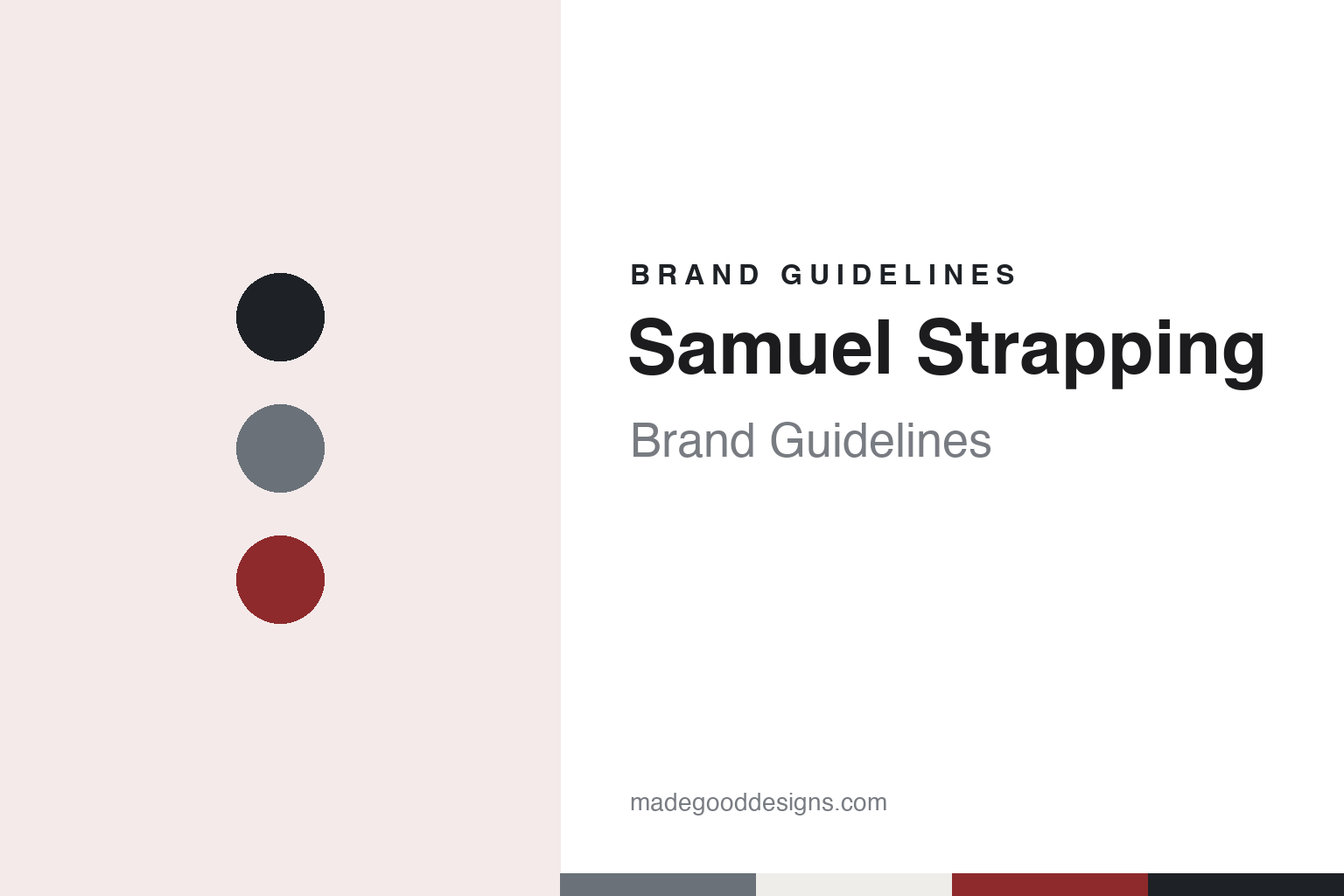
Two constants: a Samuel steel grey and maple red palette and an Industrial sans register. Abstract homage — not a Samuel product or mark; no machine, tool, logo or nameplate is reproduced.
A Toronto family business
A Toronto metals house, 1855.
Samuel Strapping began as a division of a much older Canadian business. Samuel, Son & Co. traces itself to 1855, when the brothers Mark and Lewis Samuel opened M & L Samuel, a hardware and metals import and export business in downtown Toronto, according to both the company’s own history and English Wikipedia. The company says the brothers worked from a narrow corner building known as the Coffin Block, on the site where Toronto’s Flatiron Building now stands.
Lewis Samuel’s son, Sigmund Samuel, became president in 1912, the company says. The business took the name Samuel, Son & Co. when he became its sole owner — in 1935, by the company’s timeline, or in 1931, according to English Wikipedia. The first branch outside Toronto opened in Montreal in 1956. In 1960, after the City of Toronto expropriated the company’s Fleet Street site to build the Gardiner Expressway, Samuel built a new headquarters to the west in Mississauga, the company says; its locations page now gives its corporate office as Oakville, Ontario.
The packaging business arrived in 1963. That year, the company says, Samuel created a packaging division making “a broad range of steel strapping, hand tools and unitizing equipment”; English Wikipedia names it the Samuel Strapping Systems division. In 1985 Samuel combined three of its manufacturing divisions into Samuel Manu-Tech Inc., which was listed on the Toronto Stock Exchange and became a wholly owned subsidiary of the parent again in 2010, the company says. Samuel describes the business as still owned by the Samuel family, and over the past decade it has bought metals and manufacturing firms in Canada and the United States, among them Wilkinson Steel in 2013, Main Steel in 2017 and Sierra Aluminum in 2018, according to English Wikipedia.
Colour
Machines for mills, metals and corrugated board.
Trade press has followed the strapping business through its machines. In July 2012 Canadian Packaging described Samuel Strapping Systems as a Mississauga-headquartered maker of strapping and unitizing equipment and reported the release of a new SCU-8 strapping machine for the corrugated industry. The magazine said the machine could use up to four strapping heads, ran on an Allen-Bradley CompactLogix controller from Rockwell Automation and took polyester or polypropylene strap in several widths.
Lumber has been another market. In November 2013 Canadian Forest Industries, on its Wood Business site, reported that Samuel Strapping Systems was working with sawmills on the use of polyester strapping to hold packages of green lumber together through kiln drying. In October 2018 the same publication reported that the company had shown two automated prototypes at the TP&EE trade show: a robot that places dunnage, and a strapping machine. The company’s site says it has designed and built systems for the forestry industry since the 1970s.
Recycling followed. In August 2020 Recycling Product News reported that the Samuel Packaging Systems Group had introduced its GEN2 PET bale tie system, an all-electric unit designed to work with two-ram balers and to tie bales with polyester strap that, the company said, is made with recycled polyester content.
The name on the business has shifted with that growth. The division now presents itself as Samuel Packaging: the old samuelstrapping.com address forwards to samuelpackaging.com, which still uses the heading “Samuel Strapping Systems” for its machine range. That site lists steel, polyester and polypropylene strapping; engineered systems for metals, forestry, corrugated board, containers and brick and block; standard automatic and semi-automatic machines; protective packaging; and hand tools.
Typography
Design and documentation.
The makers in this guide sell much of their range to people who use tape and strapping at work: warehouse teams sealing cartons, packers securing pallets, contractors masking a wall or sealing a duct. Their catalogues tend to be organised around jobs and materials. Shurtape’s industrial website, for example, sorts its range by trade — construction, HVAC, packaging, marine — while IPG lists pressure-sensitive and water-activated tapes, stretch and shrink films and packaging machinery side by side.
That gives the category a recognisable set of pictures for a designer to study: rolls of tape on their cardboard cores, often stacked by colour or width; cartons running through a case sealer at the end of a packing line; steel or plastic strapping drawn tight around a loaded pallet with a hand tool or a machine; and close-ups of an adhesive face or a cut edge. Some makers, Shurtape among them, give their trade tapes short codes of letters and numbers rather than names.
The trade also meets in person. PMMI’s Pack Expo shows in the United States, interpack in Düsseldorf and FachPack in Nuremberg, which held its 2025 edition in September, gather makers of packaging materials, tapes, strapping and the machines that apply them together, and a maker’s stand there is one of the places its identity is seen at full size.
This guide sets out what can be checked about each brand — who founded it, who owns it now, and what it says about where its products are made — and marks clearly what rests only on the company’s own word. The colours and typefaces shown are our own unofficial interpretation, not any maker’s official palette.
Aa
An industrial sans — a family name on steel strap. (Specimen set in Archivo, a sans STAND-IN; NOT the Samuel logo.)
Samuel Packaging
Steel strap and a family name.
Its tool range shows how the brand is organised today. The STL line includes manual and pneumatic tools for steel strap and battery-powered tools for polyester and polypropylene strap, and the company says its battery steel strap sealer and tensioner use Makita technology. Its markets, by its own list, run from metals and corrugated board to containers, distribution, cotton and brick and block, and the parent’s timeline calls the packaging group “one of the company’s largest businesses.” The packaging site speaks of “more than 60 years of experience.”
Where the strap and machines are made is not set out product by product. Samuel’s locations page lists packaging sites across Canada — in Ontario, Quebec, New Brunswick and British Columbia — and in the United States, including Elk Grove Village, Fort Mill, Cartersville and Lubbock. The machine systems are, in the company’s words, designed, fabricated, installed and serviced for each customer’s line, with in-house research and engineering.
Each version of the name carries the family name. Trade press in the 2010s wrote of “Samuel Strapping Systems”; the 2020 bale tie report used “Samuel Packaging Systems Group”; and the current website uses “Samuel Packaging,” under a copyright line in the name of Samuel, Son & Co.
For a design guide, Samuel Strapping shows how a packaging brand can grow inside a diversified, family-owned metals group and change its name as its range widens. Compare Signode, the strapping maker founded in Chicago in 1913, and Strapex, the Swiss strapping brand now part of Signode. For this guide we use a steel grey, a maple red and an ink with a sans, an unofficial interpretation; no product or logo is reproduced.
Explore & save
Keep Samuel Strapping’s identity on hand — save it to a board in the Made Good inspiration library.
Samuel Strapping identity set
Pin the Samuel steel grey and maple red palette and the Industrial sans register to your own board.