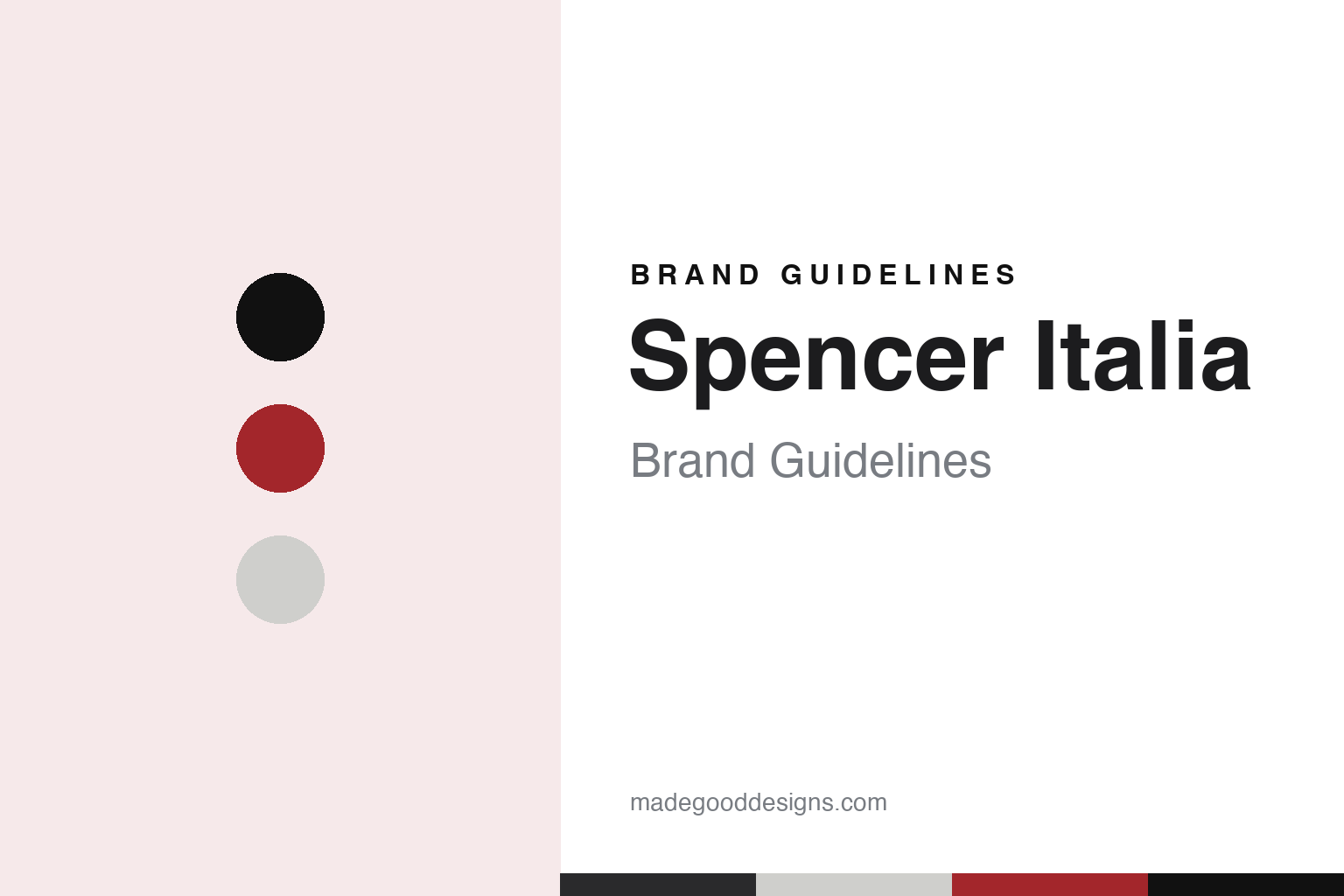
Spencer Italia Brand Guidelines
The Parma stretcher maker made for decisive moments.
Aa
Two constants: a red, graphite and grey palette and a technical sans register. Abstract homage — not a Spencer product or mark; no stretcher, logo or nameplate is reproduced.
A volunteer’s company
A rescuer’s idea in the hills south of Parma.
Spencer Italia is a maker of emergency, rescue and mortuary equipment based at Sala Baganza, in the province of Parma, in Emilia-Romagna. The company dates itself to 1989: its Italian website says Spencer was founded that year by a volunteer rescuer, named on the site as L. Spadoni, and that its mission since then has been to make devices “made for decisive moments,” a phrase it uses as its signature line. On the same page it counts 35 years of experience in the field.
That origin shapes how the company describes its customers. Its website lists rescue associations, ambulance builders, defence and civil protection bodies, hospitals and care homes, workplace safety staff, funeral services and distributors as the people it makes equipment for, and it says its first-aid devices are used every day by paramedics and rescuers. In its own words, it puts “experience, technology and products made in Italy” at the service of emergency professionals, rescue teams and funeral services.
The company frames its history as a short series of steps on its Italian website: the founding; opening branches in America and Asia; the use of Spencer devices at the Athens 2004 Olympic Games; an award in the United States, where it says its Tango spine board was voted the most innovative rescue device; a move to a new, larger site; and, finally, new ownership.
Today the trading company is Spencer Italia S.r.l., a single-member company that its website says is directed and coordinated by Protect Medical Holding GmbH. The brand on its products and website is simply Spencer.
Colour
Stretchers, boards and the mortuary line.
Spencer’s range runs across three fields that its website names as emergency, rescue and evacuation, and funeral. Under emergency it groups equipment for first aid, resuscitation and moving patients in and out of ambulances, including self-loading and powered ambulance stretchers, fastening systems for stretchers, and self-loading trolleys for incubators. The company says it offers some 1,700 devices in all.
Immobilisation is a second core line: spine boards, vacuum mattresses, head immobilisers, cervical collars, splints, traction splints, an extricator and the Spider strap system appear in its English catalogue. Rescue covers basket stretchers, including the Shell, recovery stretchers, field stretchers and patient transport sheets, along with water-rescue equipment and evacuation and transport chairs.
The third field is a mortuary and funeral range of coffin-handling equipment, body-removal cots and systems, and funeral-home supplies. The company says these are made from materials chosen for a long working life and designed to be simple to use.
The company names its quality and regulatory credentials on its website: certification to EN ISO 9001:2015 and EN ISO 13485:2016 + A11:2021, and conformity of its Class I and Class II devices with the EU Medical Device Regulation 2017/745. It also says it has registered 20 patents in the last five years.
Spencer also sells its work as a service. Its website offers after-sales assistance and a stretcher-servicing programme, called revisione barelle in Italian, and publishes catalogues, technical sheets and user manuals for its range. The company says it has more than 4,500 customers, and that its quality system covers every stage from design and development through manufacture, distribution and installation to after-sales work.
Typography
The category and its codes.
Rescue and emergency medical equipment is bought by people who will use it under pressure, so the makers in this field tend to present themselves through the equipment at work rather than through lifestyle imagery. The typical brochure shows a stretcher being loaded into an ambulance, a crew lifting a patient down a narrow stair, or a basket stretcher being lowered on ropes, with the product carrying most of the colour in the frame.
That colour is often functional before it is decorative. Orange and yellow stretchers, spine boards and evacuation chairs are meant to be seen against grey streets, snow or dark water, and product photographs often make those working colours the focus of the frame, set against equipment in dark navy, graphite or black. The language is technical: load ratings, materials, fastening systems and named product lines rather than adjectives.
Training is the other stage where these brands are seen. CPR manikins laid out in rows in a training room, hydraulic cutters and spreaders opening a scrapped car at a vehicle extrication drill, and ambulances and fire trucks parked with their doors open for inspection all serve as the industry’s own advertising. The photographs are rarely staged far from that reality, because the buyers are paramedics, firefighters and fleet managers who know the work.
Trade fairs give the category its calendar. Interschutz in Hannover, RETTmobil in Fulda and EMS World Expo in the United States are where makers show new stretchers, rescue tools and vehicles side by side, and where a stand’s colours and signage have to read from across a crowded hall. For a designer, the lesson of the category is that a brand earns its look from the job its equipment does: clear colour, clear type and the product shown in use.
Aa
A technical sans for a stretcher maker’s catalogue. (Specimen set in Barlow, a sans STAND-IN; NOT the Spencer logo.)
Spencer
Made near Parma, owned within a European group.
Spencer stresses where its equipment is made. Its website says its production plants are at Sala Baganza, cover 26,500 square metres, and turn out an average of 500,000 products a year; it describes its devices as made in Italy. Abroad it lists its own centres, among them Spencer USA, Spencer China, Spencer India and regional centres for Asia-Pacific, Latin America, the Maghreb, the Middle East and the German-speaking DACH region, alongside a network of Italian dealers.
The company changed hands in 2020. On 28 April 2020 Investors in Healthcare reported that Protect Medical, a group backed by the investment firm Borromin Capital, was set to acquire Spencer Italia, which it described as a manufacturer and supplier of emergency medical equipment. Spencer’s website says it has been part of the Protect Medical holding since 2020, in a group that it describes as European medical companies aiming to be a reference point for emergency care, first aid and wound care.
Its sister companies, as Spencer lists them, are W. Söhngen GmbH, a German maker of first-aid kits that it says has been working for a century; Promeba, a Spanish maker of patient-transport systems, carry chairs and ambulance equipment; and PAX, a German maker of emergency bags and backpacks. PAX announced on 23 October 2025 that a further company, the Italian electromedical maker CA-MI, had joined the Protect Medical group.
For a design guide, Spencer shows how a specialist maker can build a whole identity on one working promise, a signature line about the moment the equipment is needed. Compare Ferno, the Ohio cot maker that also began close to the mortuary trade and has its own Italian base, and Stryker. For this guide we use a rescue red, graphite and a stretcher grey with a sans, an unofficial interpretation; no product or logo is reproduced.
Explore & save
Keep Spencer Italia’s identity on hand — save it to a board in the Made Good inspiration library.
Spencer Italia identity set
Pin the Spencer Italia red, graphite and grey palette and the technical sans register to your own board.