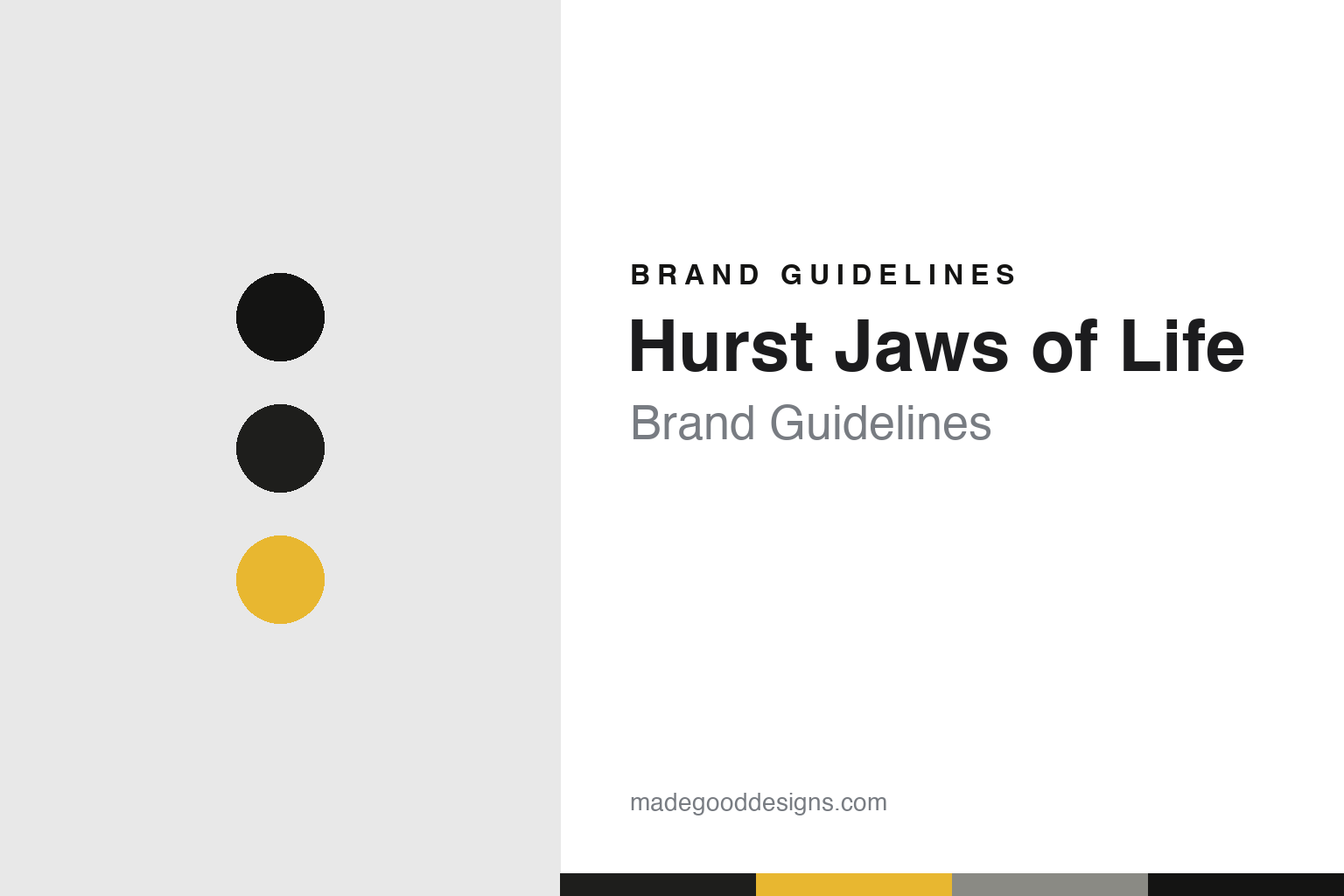
Hurst Jaws of Life Brand Guidelines
A hot-rod shifter name that became a rescue-tool trademark.
Aa
Two constants: an asphalt, yellow and gunmetal palette and a Condensed sans register. Abstract homage — not a Hurst product or mark; no tool, logo or nameplate is reproduced.
From the drag strip
A shifter maker’s rescue tool.
The Hurst name came from hot rods before it came to rescue. The Specialty Equipment Market Association, which inducted George Hurst into its Hall of Fame in 1978, describes him as a hot rodder who designed motor-mount kits for engine conversions and the popular Hurst shifters, and as a key figure in drag racing in the 1950s. Its citation adds that he invented the Jaws of Life cutting device used by fire and rescue crews.
The brand’s own account puts the start in the early 1970s. According to the timeline on the Hurst website, now run by IDEX Fire & Safety, George Hurst, founder of Hurst Performance, Inc., watched a driver struggle to get out of a wrecked car at a racetrack and worked with the engineer Jim Dobbins on a hydraulic tool. An early prototype was demonstrated at Hurst’s headquarters in Warrington, Pennsylvania, in 1971, and the tool, then called the HURST Power Tool, was first shown publicly at the 1971 SEMA trade show in California, the company says.
Other accounts differ on the details. English Wikipedia dates George Hurst’s idea to about 1961, after a stock-car accident, and says the hydraulic spreader was developed in 1972 by Tim Smith and Mike Brick, who went on to develop a cutter and a ram; it credits Brick with coining the phrase “Jaws of Life,” from people saying the tool had snatched someone from the jaws of death. Wikipedia also records that Hurst Performance exported parts to the European firm Zumro ResQtec. We give the company and encyclopedia versions side by side.
The company’s 2022 release on the brand’s 50th anniversary says production began with the Model JL-32 in 1972, and that the tool was soon nicknamed, and then trademarked, as the “Jaws of Life.”
Colour
Shelby, Hale and IDEX.
The brand changed hands in the 1980s. The Hurst timeline says that in 1984 Hale, a maker of fire-pump equipment, bought Hurst and moved production to Shelby, North Carolina, where the tools are still made, by the company’s account. In 1994, English Wikipedia says, IDEX Corporation agreed to buy Hale Products of Conshohocken, Pennsylvania, and Hale became part of an IDEX fire-and-safety group that included the Hurst Jaws of Life.
IDEX, formed in 1988 and based in Northbrook, Illinois, is listed on the New York Stock Exchange, Wikipedia says. Its fire-and-safety business now presents Hurst Jaws of Life as one of a group of brands that also includes Akron Brass, Hale, Godiva, Vetter and the German maker LUKAS, which IDEX bought in 1995 according to the Hurst timeline. The same timeline says Hale bought Manfred Vetter of Zülpich, the German lifting-bag maker, in 2004, and that Airshore International, a shoring and stabilisation business, joined in 2006.
The product line widened steadily. By the company’s dating, the first production cutter, the JL 150, came in 1977, the first ram, the JL 60, in 1978, and a combination tool, the Omni II, in 1979; the Mini-Lites specialty tools followed in 1992. In 2010 it launched eDRAULIC, battery-powered tools that it calls the industry’s first; in 2019 the watertight eDRAULIC EWXT; and in 2021 eDRAULIC 3.0, or E3, with a dashboard display. Its 2026 timeline adds the Captium IQ app for equipment records. The “first” claims are the company’s.
A 2019 company release, carried by Firehouse, said two new DMG MORI machining centres at the Shelby plant were making pump bodies, cylinders and arms for its battery and hose-line tools, with one dedicated to the new watertight line.
Typography
Design and documentation.
Rescue and emergency medical equipment is bought by people who will use it under pressure, so the makers in this field tend to present themselves through the equipment at work rather than through lifestyle imagery. The typical brochure shows a stretcher being loaded into an ambulance, a crew lifting a patient down a narrow stair, or a basket stretcher being lowered on ropes, with the product carrying most of the colour in the frame.
That colour is often functional before it is decorative. Orange and yellow stretchers, spine boards and evacuation chairs are meant to be seen against grey streets, snow or dark water, and product photographs often make those working colours the focus of the frame, set against equipment in dark navy, graphite or black. The language is technical: load ratings, materials, fastening systems and named product lines rather than adjectives.
Training is the other stage where these brands are seen. CPR manikins laid out in rows in a training room, hydraulic cutters and spreaders opening a scrapped car at a vehicle extrication drill, and ambulances and fire trucks parked with their doors open for inspection all serve as the industry’s own advertising. The photographs are rarely staged far from that reality, because the buyers are paramedics, firefighters and fleet managers who know the work.
Trade fairs give the category its calendar. Interschutz in Hannover, RETTmobil in Fulda and EMS World Expo in the United States are where makers show new stretchers, rescue tools and vehicles side by side, and where a stand’s colours and signage have to read from across a crowded hall. For a designer, the lesson of the category is that a brand earns its look from the job its equipment does: clear colour, clear type and the product shown in use.
Aa
A condensed sans — a name stamped on tools. (Specimen set in Barlow Condensed, a sans STAND-IN; NOT the Hurst logo.)
Jaws of Life
A nickname turned trademark.
The brand’s strongest asset is its name. English Wikipedia notes that “jaws of life” is used in everyday speech for hydraulic rescue tools in general, while Jaws of Life is a registered trademark of Hurst; its article on the Dutch maker Holmatro makes the same point. The company stresses it too, writing the mark with a registered sign and describing Hurst as the only maker of the Jaws of Life brand.
The company has built rituals around the name. Its timeline says it introduced the Green Cross award in 1974 to honour first responders, and its website still publishes stories of award holders. For the 50th anniversary, IDEX said on 4 February 2022 that the Shelby team had begun the celebrations with a special anniversary logo and would hand out challenge coins and patches to first responders through the year.
The timeline also records a museum moment: in 2012, it says, a Model 32A used by the Carlsbad Fire Department from 1977 to 2012 was given to the Smithsonian’s National Museum of American History.
What the record shows is a name that moved from hot-rod gearshifts to fire trucks, and a factory town, Shelby, that has made the tools for four decades by the company’s account.
For a design guide, Hurst Jaws of Life shows how a nickname can become the brand itself. Compare LUKAS, its German stablemate under IDEX, and Holmatro, the Dutch rescue-tool maker. For this guide we use an asphalt black, a rescue yellow and a gunmetal grey with a condensed sans, an unofficial interpretation; no product or logo is reproduced.
Explore & save
Keep Hurst Jaws of Life’s identity on hand — save it to a board in the Made Good inspiration library.
Hurst Jaws of Life identity set
Pin the Hurst Jaws of Life asphalt, yellow and gunmetal palette and the Condensed sans register to your own board.