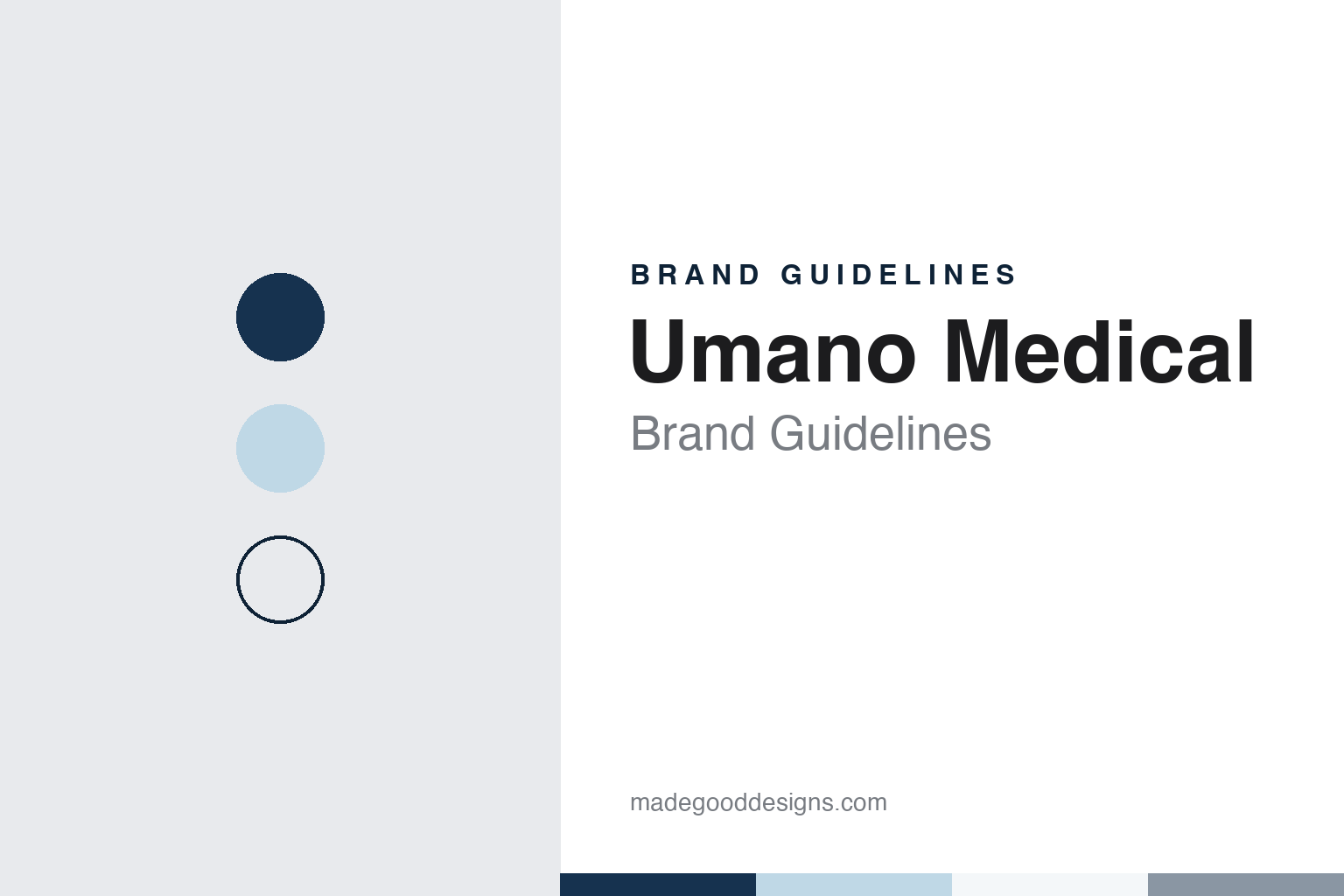
Umano Medical Brand Guidelines
The L’Islet hospital bed maker behind the ook snow.
Aa
Two constants: an Umano Medical navy, ice blue and snow white palette and a clean geometric sans register. Abstract homage — not an Umano Medical product or mark; no bed, logo or nameplate is reproduced.
From welding shop to bed factory
A L’Islet plant, three owners and a restart.
Umano Medical makes hospital beds in L’Islet, Quebec, a town that La Presse placed about a hundred kilometres from Quebec City in 2024. The name dates only from 2015, but the factory is much older. The company’s own timeline begins with Joseph Poitras opening a metal shop in L’Islet, whose work moved from welding to school furniture; Radio-Canada, reporting in 2016, dated the firm’s origins to 1920 as a welding plant and said it won its first contract to repair hospital beds in the 1980s. By 1984, the company says, the factory was making nothing but hospital beds.
Ownership changed after that. Le Soleil reported in July 2015 that the plant had belonged to the American medical company Stryker, which sold it to the contract manufacturer Flextronics; under Stryker, the paper said, it turned out up to 20,000 beds a year. Flextronics then announced it would move bed production to Mexico, putting close to 300 jobs at stake. Umano’s timeline places the closure announcement in 2010, while a 2021 case study by the Business Development Bank of Canada (BDC) dates the closure of the Quebec plant to 2012.
Four former managers — Christian Cariou, Robert Dion, Ghislain Demers and Denis Bourgault — restarted the plant with backing from Investissement Québec, Canada Economic Development and Desjardins, Le Soleil reported. The business first traded as Groupe Bertec, making beds and parts for Stryker under a five-year contract while the team designed products of its own. La Presse gives 2012 as the founding year of the present company. BDC says the four partners bought the equipment, wanted to keep the region’s jobs and expertise, and committed from the start to keeping full control of the business rather than opening its capital to outside investors.
Colour
The ook snow and a new name.
The turning point was a bed. According to Le Soleil, the team spent two years travelling across Canada and the United States to ask hospital managers and nursing staff what they needed, then built its first flagship, the ook snow hospital bed, which went on sale in January 2015. That year Groupe Bertec became Umano Médical; president Christian Cariou told the paper the firm wanted a new image as it began to sell its own products and turn towards international markets. The plan had changed along the way: BDC reports that a multinational had been ready to license the bed, lost interest at the end of 2013, and left the partners to build their own distribution network.
The product name carries the brand’s sense of place. Robert Dion, the company’s co-president, told BDC that “Ook” refers to ookpik, the Inuit word for the snowy owl, a symbol of Quebec, and that “Snow” stands for the firm’s northern outlook. The family has grown under that name. The ook snow ALL, for bariatric, medical-surgical and palliative care, was unveiled on 26 July 2018 after about 30 months of work and some 32 prototypes, the local paper Le Placoteux reported; the company says its width can be extended electrically to take two people lying side by side. The current range also includes the ook snow MH for mental health, the ook cocoon for long-term acute care and the Max-Secure platform bed.
Growth also brought a dispute. In March 2016 the United States International Trade Commission opened an investigation into certain hospital beds with side-rail and braking features, after a complaint filed by Stryker against Umano’s two Quebec companies; BDC reports that the matter was settled in September 2016. The same year Radio-Canada reported that Umano had won a five-year contract to be the exclusive supplier of hospital beds to Quebec’s hospitals, which the company said secured about 90 jobs.
Typography
How bed makers present themselves.
Hospital bed and patient-handling makers sell to buyers who rarely see the product in a showroom. Purchasing teams, nurses and facilities planners meet it in catalogues, on websites and at trade fairs, so the way these companies present themselves leans heavily on photography, diagrams and film rather than on the object in the hand.
The most common image is the bed in a calm ward: a made-up mattress, soft daylight, a tidy bedside cabinet and very little else in the frame. Cutaway views and close-ups take over in technical literature, showing the frame, the castors, the side rails and the handsets and control panels that staff use every day. Hoists and stand-up aids are usually shown in use, in care homes and bathrooms as well as hospitals, with a carer and a resident in a staged transfer.
Trade fairs are a second stage. Large medical exhibitions such as MEDICA in Düsseldorf and Arab Health in Dubai give makers a stand on which beds, lifts and mattresses can be set out as a working room. Product films extend the same idea, often following a nurse at the bedside through a short routine to show how a control, a rail or a lift is meant to be used.
Behind those images sit long ownership histories. Many of the names in this field began as small workshops or furniture makers and passed through larger medical-technology groups, mergers and listings, so the brand on the bed today often carries decades of earlier companies with it. The guides in this round look at that history alongside the way each maker presents itself.
Aa
A clean geometric sans for a northern vocabulary. (Specimen set in Manrope, a sans STAND-IN; NOT the Umano Medical logo.)
Umano Medical
A L’Islet maker with sites across Quebec.
In 2020 the company designed the RESC-U bed, a stackable bed for urgent care, working virtually through March and April, Radio-Canada reported; in 2021 Umano donated more than 600 of them to Malawi, Zambia and Eswatini through the Ontario foundation Hope and Healing. In April 2023 Umano bought IBIOM of Sherbrooke, a medical-equipment maker founded in 1978 that makes examination tables, treatment chairs and adjustable workstations; Radio-Canada put Umano’s workforce at 450 at the time. IBIOM’s products are now sold as “IBIOM by Umano Medical.”
Today Umano Medical has its headquarters and main plant in L’Islet. La Presse reported in November 2024 that the company was adding 31,000 square feet to the L’Islet factory, with loans from the Quebec government and Investissement Québec and investment from the Fonds de solidarité FTQ and Desjardins. The paper said mattresses are made at the company’s Lévis site and other room furniture is assembled in Sherbrooke, and that its beds are exported to markets including the United States, Ireland, the United Kingdom and Australia. The company’s website also names an office in Maryland Heights, Missouri, and another in New South Wales, and presents its service programmes under the UmanoCares and Umano Access names.
For a design guide, Umano Medical shows how an old factory can take on a new name and a northern vocabulary — a snowy owl, snow and a cocoon — that runs through its product names. Compare Stryker, the former owner of the L’Islet plant, and Hillrom, another hospital bed maker, now part of Baxter. For this guide we use snow white, ice blue and a deep northern navy with a sans, an unofficial interpretation; no product or logo is reproduced.
Explore & save
Keep Umano Medical’s identity on hand — save it to a board in the Made Good inspiration library.
Umano Medical identity set
Pin the Umano Medical navy, ice blue and snow white palette and the clean geometric sans register to your own board.