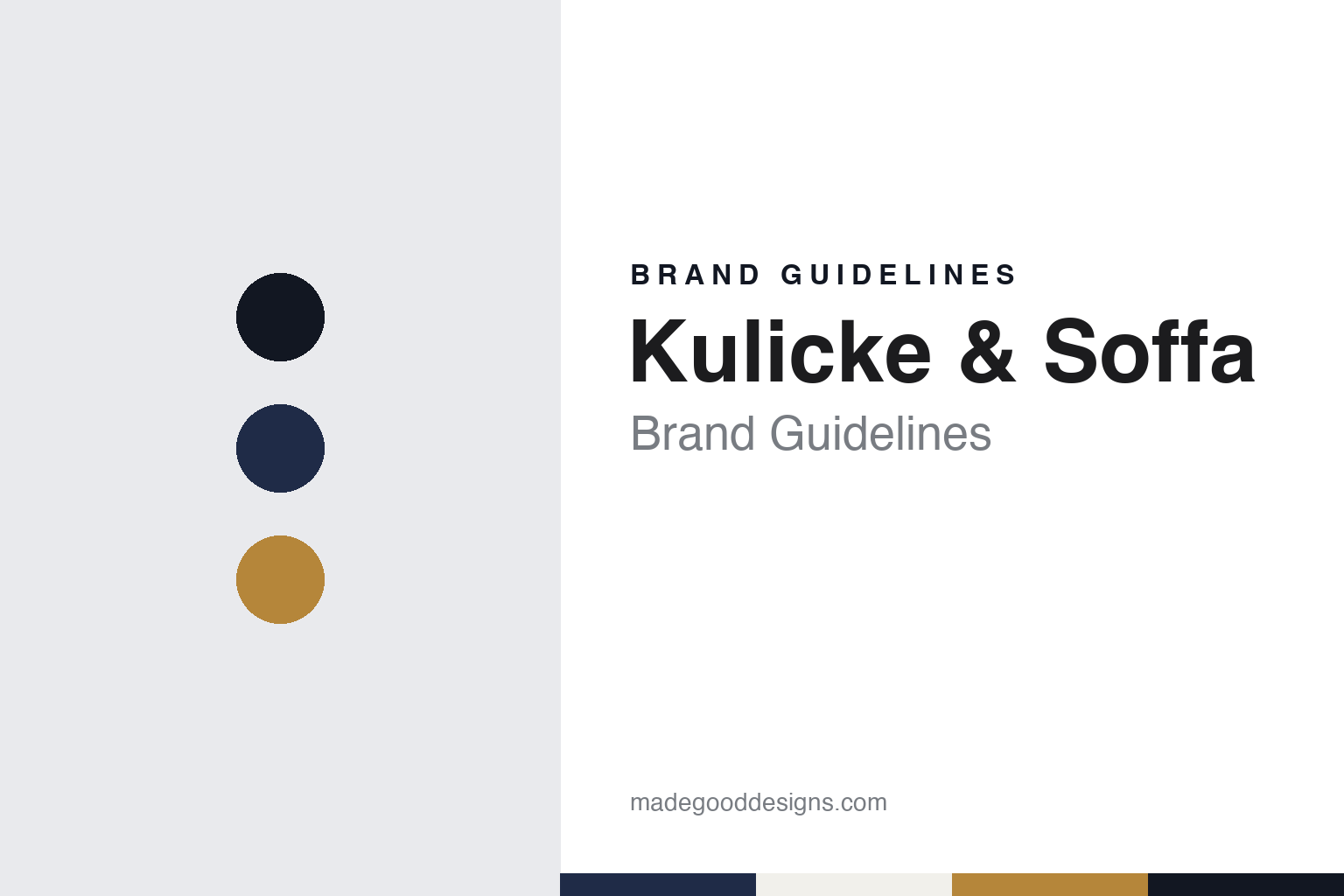
Kulicke & Soffa Brand Guidelines
A 1951 partnership, the wire bonder and a move to Singapore.
Aa
Two constants: a navy, gold and white palette and an engineering sans register. Abstract homage — not a Kulicke & Soffa product or mark; no machine, logo or nameplate is reproduced.
A Partnership in 1951
Two partners, the wire bonder and the Philadelphia suburbs.
Kulicke & Soffa began as a partnership. The company says Frederick W. Kulicke Jr. and Albert Soffa set it up on 18 July 1951, and that it was incorporated in November 1956 as Kulicke and Soffa Manufacturing Company. The Philadelphia trade site Philly Enterprise Tech News described it in August 2010 as a company founded in 1951 by Fred Kulicke and Albert Soffa that had been based in the Philadelphia area for almost 60 years.
Its work sits at the back end of chipmaking: the machines that attach a finished die to its package and connect it with fine wire. The company says it produced an early commercial wire bonder in 1959; Philly Enterprise Tech News wrote in 2010 that the business took off after developing the first wire bonder for semiconductor manufacturing. In 1971, the company says, it listed on Nasdaq as one of the first technology companies to do so, and Nikkei Asia described it in 2021 as one of the earliest tech companies to list there.
For most of its history the head office stayed in the Philadelphia suburbs. In May 2006 Microwave Journal reported that Kulicke & Soffa had moved its corporate headquarters to a new building in Fort Washington, Pennsylvania. By then much of its making had already moved to Asia. The company says it opened a manufacturing facility in Singapore in 2000, when it launched its 8028 S and 8028 PPS wire bonders, and its first manufacturing facility in China in 2003 at Suzhou, where it makes capillaries, one of its bonding consumables.
In August 2010 the company announced that, with the retirement of chief executive Scott Kulicke at the end of September, its headquarters functions would move from Fort Washington to Singapore, and that his successor, Bruno Guilmart, formerly chief executive of Lattice Semiconductor, would be based there, Philly Enterprise Tech News reported. The company dates the relocation to 2010 and says it opened its own headquarters building in Singapore in 2014.
Colour
Ball bonders, wedge bonders and the tools that feed them.
Wire bonding is still at the centre of the range. The company groups its machines into ball bonders, wedge bonders, advanced packaging and advanced dispensing, and lists technologies from ball and wedge bonding to vertical wire bonding and thermo-compression bonding. Alongside the machines it sells consumables, among them capillaries, wedge bond tools and dicing blades.
The range grew partly by acquisition. In November 2006 Microwave Journal reported that Kulicke & Soffa had closed its purchase of Alphasem, a die bonder maker, from Dover Technologies International, a subsidiary of Dover Corporation; Scott Kulicke, then chairman and chief executive, called die bonding “a natural growth path” for the company. The company’s own timeline lists the deal under 2007. It says it bought Orthodyne Electronics, a maker of heavy wire wedge bonding equipment, in 2008 and launched its Power Series of assembly machines that year.
Later steps, as the company tells them, took it into new fields: the GEN-S series of bonders and a demonstration centre in Suzhou in 2018; advanced LED displays in 2020; the purchase of Uniqarta in 2021; and the purchase of Advanced Jet Automation in 2023, which brought it into advanced dispensing. In 2024 it launched the APTURA fluxless thermo-compression bonder, which uses formic acid, and in 2025 the ATPremier MEM Plus vertical bonder and the Asterion PW wedge bonder.
Outside reporting puts the business in a wider frame. In August 2021 Nikkei Asia described Kulicke & Soffa as a leading maker of chip packaging and testing equipment and noted that its wire-bonding equipment is also used to make power semiconductors that go into vehicles. In October 2026 the company announced that it had been selected for the 2026 SEMI Award for North America, for its formic-acid fluxless thermo-compression bonding technology, presented at SEMICON West.
Typography
Equipment and materials.
Semiconductor equipment makers sell to a small circle of customers: the chip manufacturers that run wafer fabs. Their machines deposit, etch, measure, test and package, and they are rarely seen outside a cleanroom. That shapes how these companies present themselves. The product is a large enclosed tool, and what happens inside it takes place at a scale no camera can show directly.
So the pictures tend to repeat. Corporate sites and annual reports show tools standing in rows behind glass, with panelled housings in white, pale grey or blue, and cleanroom staff in full gowns, hoods and gloves. A polished wafer held up to the light in a gloved hand is a familiar image, because it stands in for the chips the machines help to make. Fab interiors, lit evenly and seen down long corridors, give a sense of size and order.
Words do much of the work that pictures cannot. Makers describe their processes by name — atomic layer deposition, epitaxy, metal-organic chemical vapour deposition, wire bonding, wafer inspection — and give their tool ranges short product names and model numbers. Company histories, milestone lists and timelines are common, since many of these firms began as university spin-offs, sales agents or divisions of larger groups, and changed hands or split along the way.
Trade fairs remain a meeting point for this industry. SEMICON West and SEMICON Taiwan are among the shows where equipment makers set up stands, present new tools and meet customers. For a design guide, the pattern is a disciplined, technical register: cool colours, precise product names and photographs of clean, closed machines.
Aa
An engineering sans — a company that shortens its name to K&S. (Specimen set in Archivo, a sans STAND-IN; NOT the Kulicke & Soffa logo.)
Kulicke & Soffa
A Pennsylvania name with its biggest plant in Singapore.
The listed company today is Kulicke and Soffa Industries, Inc., traded on Nasdaq; it writes its name both as “Kulicke and Soffa” and as “Kulicke & Soffa,” and shortens it to K&S. It says it moved its global headquarters to Singapore in 2010, while its press releases, including one in October 2026, still carry a Fort Washington, Pennsylvania, dateline. In 2026 the company marked its 75th anniversary, and in September 2026 Raj Talluri, formerly chief executive of Enovix, became its president and chief executive, the company says.
Where the machines are made is documented by outside reporting. In August 2021 an executive vice president told Nikkei Asia that Singapore would remain the company’s biggest production site for the foreseeable future. The paper reported that K&S planned to keep expanding capacity at its existing sites in Singapore, the Netherlands and Israel, and in China, where it makes consumable parts rather than whole machines, and that it counts the United States and Europe as its main research and development bases. The executive said an equipment maker could ship tools to customers anywhere and saw no urgent need to move production to the United States.
For a design guide, Kulicke & Soffa shows how a company named after its two founders can keep their names while its centre of gravity moves across the world. Compare Besi, another maker of chip-assembly equipment, and Teradyne, which works on the testing side of the back end. For this guide we use a deep navy, a muted gold and a cleanroom white with a sans, an unofficial interpretation; no product or logo is reproduced.
Explore & save
Keep Kulicke & Soffa’s identity on hand — save it to a board in the Made Good inspiration library.
Kulicke & Soffa identity set
Pin the Kulicke & Soffa navy, gold and white palette and the engineering sans register to your own board.