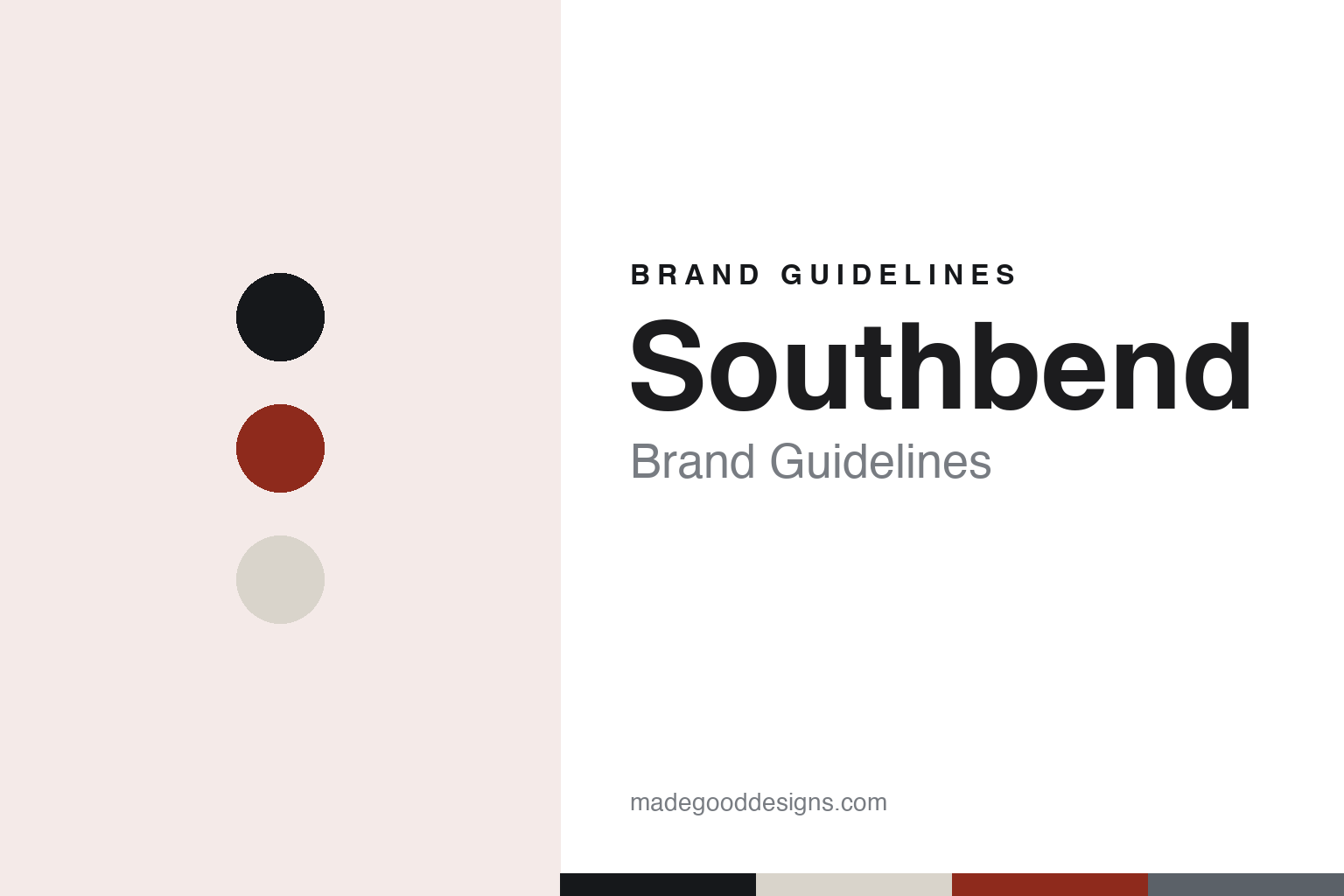
Southbend Brand Guidelines
An 1898 Indiana range maker built in North Carolina.
Aa
Two constants: a range black, rust and steel palette and a heavy-duty sans register. Abstract homage — not a Southbend product or mark; no range, logo or nameplate is reproduced.
Malleable Steel Range
A stove works in South Bend, Indiana.
Southbend takes its name from the city where it started. The company says on its website that the business began in 1898 in South Bend, Indiana, as the Malleable Steel Range Manufacturing Company, and that it was set up by two real-estate agents, Jacob Woolverton and William Kizer. A company profile in the trade magazine Industry Today gives a longer list of founders: Harry Engman, William Kizer, Lew Matthews and Jacob Woolverton. Both accounts agree on the Woolverton name, and the magazine says that about ten years after the start the Woolverton family took the company over.
The first products were for homes, not restaurants. According to Industry Today, the firm made domestic coal- and wood-burning stoves and then added a line of commercial ranges and griddles. As the commercial side grew, the company decided in 1941 to stop making domestic ranges altogether, and from then on it built only for professional kitchens. The brand still uses the line “Creating cooking solutions since 1898” on its website, and the spelling has settled as one word, Southbend, while the city keeps its two.
The move south came in stages. Industry Today reports that a new plant was completed in Fuquay-Varina, North Carolina, in 1977; a limited number of product lines moved there first, and by 1984 all production had left Indiana for the North Carolina factory. In 1987 the Hussmann Corporation bought the company and moved its corporate offices from South Bend to Fuquay-Varina as well. In 1995 the Chicago Tribune, writing about Southbend’s new owner, described the business simply as “South Bend in North Carolina,” a maker of major appliances for restaurants and professional chefs.
Colour
Ranges first, then the whole hot line.
Southbend’s core product is still the heavy-duty commercial range: a steel cooking block with open burners, a griddle or a solid hot top above and an oven or cabinet below. Its current website groups the ranges into the Ultimate range, the S Series, heavy-duty electric ranges and the Platinum sectional ranges. Around them sit broilers, including salamanders, cheesemelters and upright steakhouse broilers; griddles and charbroilers; convection ovens; fryers and pasta cookers; steamers, kettles and braising pans; and refrigerators and freezers.
The line widened in the 1990s. Industry Today says Southbend introduced the Marathoner Gold convection oven in 1993, and that 1996 brought more new products than any earlier year, among them the SilverStar convection oven, the R-2 steamer and the 400 Series range. Countertop steamers and a combination oven followed, along with medium-duty charbroilers, griddles, fryers and ranges.
In a second profile, published in May 2009, Industry Today described the Platinum Series as the flagship of the line: a heavy-duty sectional system in which open-burner ranges, graduated or uniform hot tops, griddle tops, fryers, charbroilers, upright broilers, salamanders and refrigerated bases can be lined up as one cooking suite. The same article introduced the Ultimate series, aimed at the middle of the market, and an online configurator through which a buyer could choose burners, grates, ovens and power levels; the company told the magazine it offered about 1,200 combinations. The president at the time said Southbend kept its engineering, support, offices and manufacturing in one building, a description the magazine reported as the company’s own.
Today the company’s website gives the most attention to its convection ovens, including the TruVection model and ventless full-size and half-size convection ovens, alongside a recipe section it calls the Chef’s Table and listings of in-house factory product training. Its quote form lists market segments from bakeries and catering to schools, hospitality and senior living, and the testimonials on its site come from chefs at a country club, a college culinary programme and a culinary consultancy.
Typography
Fry stations and cooking suites.
Commercial fryer and range makers sell to people who rarely see their products in a showroom. Their buyers are chain operators, dealers and kitchen consultants, and the brands present themselves in the language of the cooking line: the fry station of a quick-service restaurant, a bank of vats with baskets hung above them, and the oil filtration tucked into the cabinet below.
Range and modular-suite makers work at a different scale. Their pictures show hotel and restaurant kitchens laid out as one continuous run of cooking blocks, with burners, solid tops, griddles and fryers set into a single stainless line, and close-ups of the working parts: a flame ring under a pan, the plate of a griddle, a row of control knobs. Much of the trade’s visual record is technical rather than glamorous: specification sheets, catalogue line drawings, cut-away diagrams of heating tubes, and drawing files that kitchen designers drop into their plans.
The industry also meets at its own fairs. HostMilano in Italy and, in the United States, the NAFEM Show and the National Restaurant Association Show are among the events that trade titles such as Foodservice Equipment Reports cover each year in their show reports. Many of the brands in this guide now belong to a few large groups, among them Middleby and Ali Group, which completed its purchase of Welbilt in 2022.
This guide sets out what can be checked about each brand — who founded it, who owns it, and what it says about where its products are made — and marks clearly what rests only on the company’s own word.
Aa
A heavy-duty sans for a steel-block brand. (Specimen set in Archivo, a sans STAND-IN; NOT the Southbend logo.)
Southbend
A Middleby division since 1989.
Southbend has belonged to the same group for more than three decades. Industry Today reports that the Middleby Corporation of Elgin, Illinois, bought Southbend from Hussmann in July 1989. The Chicago Tribune reported in 1995 that Middleby had acquired three companies from Hussmann in 1989 and listed Southbend among its divisions, beside the conveyor-oven maker Middleby Marshall and a refrigeration business in New Jersey. Southbend’s own website now calls it “a division of the Middleby Corporation,” and Middleby lists it among its foodservice and beverage brands, alongside the fryer maker Pitco.
The name has stayed on the products while the owner’s portfolio has grown around it. Middleby’s brand page describes Southbend as a maker of heavy-duty commercial cooking equipment with more than a hundred years of history, and Southbend’s site runs a separate sales, service and parts operation under its own name, with its own catalogue, its own representatives and its own news posts. In Industry Today in 2009 the company described being part of Middleby as a source of resources during that year’s recession.
The visual identity is plain and industrial. The brand’s website is organised around its product families, its dealer and service network and the one-word Southbend name. No official colour codes or typeface are published, so the palette here is our own reading of that steel-and-fire subject matter rather than a copy of any brand material.
For a design guide, Southbend shows how a regional stove works can keep its founding city in its name long after the factory has moved, and present a heavy industrial product through a plain, steel-led catalogue. Compare Pitco, the fryer maker in the same group, and Garland, another American range name. For this guide we use range black, a burner rust and steel grey with a sans, an unofficial interpretation; no product or logo is reproduced.
Explore & save
Keep Southbend’s identity on hand — save it to a board in the Made Good inspiration library.
Southbend identity set
Pin the Southbend range black, rust and steel palette and the heavy-duty sans register to your own board.