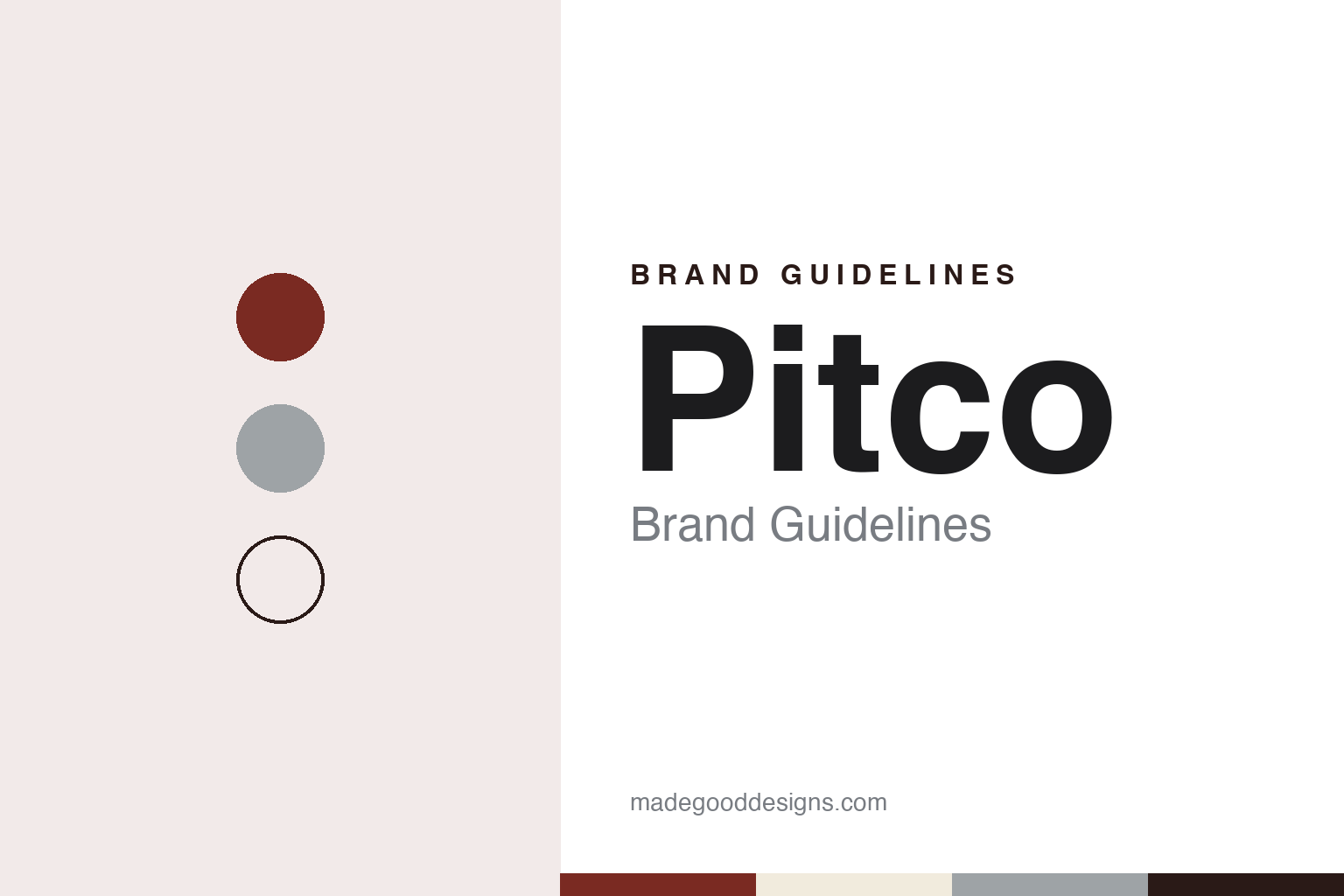
Pitco Brand Guidelines
J.C. Pitman’s 1918 Frialator and a New Hampshire fryer maker.
Aa
Two constants: a brick red, stainless grey and cream palette and a letter serif register. Abstract homage — not a Pitco product or mark; no fryer, logo or nameplate is reproduced.
The Frialator
A tinsmith, a French-fry pot and a cool zone.
Pitco’s story begins in 1918, but its sources tell it two ways. The company says it was founded that year as J.C. Pitman and Sons, hotel and restaurant equipment manufacturers, by J.C. Pitman, whom it describes as a tinsmith from Boston. Gale’s history of the oven maker Blodgett, in the International Directory of Company Histories, instead describes Pitco Frialator as a Blodgett division founded in 1918 in Bow, New Hampshire. Pitco’s own blog says Blodgett acquired the company in 1981, and Foodservice Equipment Reports wrote in 2021 that the fryer maker moved to Bow in 1950.
The idea at the centre of the business is set out in a letter that Pitco reproduces on its website, signed by Pitman and dated 14 January 1946. In it he writes that in 1918 his firm, looking for a better way to fry, found that small particles of food sinking to the bottom of a French-fry pot burned in the intense heat there, and that frying improved if they could be kept away from it. The Pitco Frialator, invented and patented on that principle, heated the fat through tubes running through the centre of the container, so that sediment dropped below the tubes into a cool zone where, the letter says, it could not char and break the fat down.
The same letter is the company’s own record of its early reach: Pitman wrote that thousands of Frialators were by then in use from coast to coast. Pitco’s blog adds that business ties formed in Britain in the 1950s took its products abroad, that distributors in Asia and Europe followed, and that exports grew decisively in the 1970s. Gale’s history lists a British company, Frialator International Limited, among Blodgett’s subsidiaries.
Colour
Blodgett, Maytag, Middleby.
Under Blodgett, Pitco belonged to a Vermont group with nineteenth-century roots. Gale’s history traces Blodgett to Gardner S. Blodgett, a Burlington plumber who built a wood-burning stove for a tavern owner in 1848, and describes its product lines in the early 2000s as Blodgett convection ovens, Blodgett Combi oven-steamers, MagiKitch’n charbroilers and Pitco fryers. The same history says the Patrick family, which had controlled Blodgett since 1892, sold it through a management-led buyout in 1988. By 1997, it adds, the group was making commercial ovens, fryers and charbroilers at four plants in Vermont and one each in New Hampshire and Pennsylvania; in October 1997 the appliance maker Maytag bought Blodgett and set up Blodgett Holdings as its holding company.
Maytag did not keep it long. Gale’s history says Maytag announced in May 2001 that it was exploring a sale to focus on home appliances, agreed in August 2001 to sell Blodgett Holdings and its subsidiaries to The Middleby Corporation of Elgin, Illinois, and closed the deal in December 2001. Middleby, then the maker of Middleby Marshall conveyor ovens, Toastmaster toasters and Southbend ranges, took on the Pitco name with it; Gale’s history says the combined business then looked to the growing fast-casual restaurant sector and to overseas sales for growth. Pitco’s website footer now links to Middleby and to two of the group’s other fryer brands, Ultrafryer and Anets, and its 2020 blog post says that Pitco is part of the Middleby Corporation.
In October 2021 Foodservice Equipment Reports reported that the city of Concord, New Hampshire, had given Pitco Frialator major site-plan approval for a 356,000-square-foot plant to bring together its sites in Bow, Concord and Pembroke, with construction planned to start in 2022 and 400 jobs to be supported. Pitco’s vice president and general manager, Karl Searl, said in the city’s release that the plant would increase production capacity for its global foodservice customers. Pitco’s contact page currently lists locations in Bow and Pembroke.
Typography
The kitchen line.
Commercial fryer and range makers sell to people who rarely see their products in a showroom. Their buyers are chain operators, dealers and kitchen consultants, and the brands present themselves in the language of the cooking line: the fry station of a quick-service restaurant, a bank of vats with baskets hung above them, and the oil filtration tucked into the cabinet below.
Range and modular-suite makers work at a different scale. Their pictures show hotel and restaurant kitchens laid out as one continuous run of cooking blocks, with burners, solid tops, griddles and fryers set into a single stainless line, and close-ups of the working parts: a flame ring under a pan, the plate of a griddle, a row of control knobs. Much of the trade’s visual record is technical rather than glamorous: specification sheets, catalogue line drawings, cut-away diagrams of heating tubes, and drawing files that kitchen designers drop into their plans.
The industry also meets at its own fairs. HostMilano in Italy and, in the United States, the NAFEM Show and the National Restaurant Association Show are among the events that trade titles such as Foodservice Equipment Reports cover each year in their show reports. Many of the brands in this guide now belong to a few large groups, among them Middleby and Ali Group, which completed its purchase of Welbilt in 2022.
This guide sets out what can be checked about each brand — who founded it, who owns it, and what it says about where its products are made — and marks clearly what rests only on the company’s own word.
Aa
A letter serif for a founder’s letter. (Specimen set in Fraunces, a serif STAND-IN; NOT the Pitco logo.)
Pitco
One idea, kept in the name.
Pitco presents itself through the fryer alone. Its About page carries the heading “The First Industrial Fryer Company,” and it names its ranges plainly: the gas Solstice and Solstice Supreme fryers, the ROV, the Megafry and rack fryers, along with filtration units, pasta cookers and rethermalizers. Its newest gas fryer, TorQ, is described by the company as the first gas fryer to combine forced-convection heating with continuous in-line filtration. A 2020 post on its blog says the company takes “the best global parts” and assembles them in Bow, New Hampshire, and calls it proud of its US manufacturing footprint.
The company keeps its founder in view. Its About page reproduces Pitman’s 1946 letter in full and says it strives never to forget his words; its mission statement speaks of “world class cooking solutions” delivered through “empowered people, disruptive innovation and advanced technology.” The Frialator name survives in the company’s formal name, Pitco Frialator, more than a century after the tube-heated pot Pitman described.
For a design guide, Pitco shows a brand built on one patented idea and a founder’s letter, still making fryers after passing through Blodgett, Maytag and Middleby. Compare Middleby, the group that has owned it since 2001, and Lincat, the Lincoln catering-equipment maker in the same group. For this guide we use a deep brick red, a stainless grey and a cream with a serif, an unofficial interpretation; no product or logo is reproduced.
Explore & save
Keep Pitco’s identity on hand — save it to a board in the Made Good inspiration library.
Pitco identity set
Pin the Pitco brick red, stainless grey and cream palette and the letter serif register to your own board.