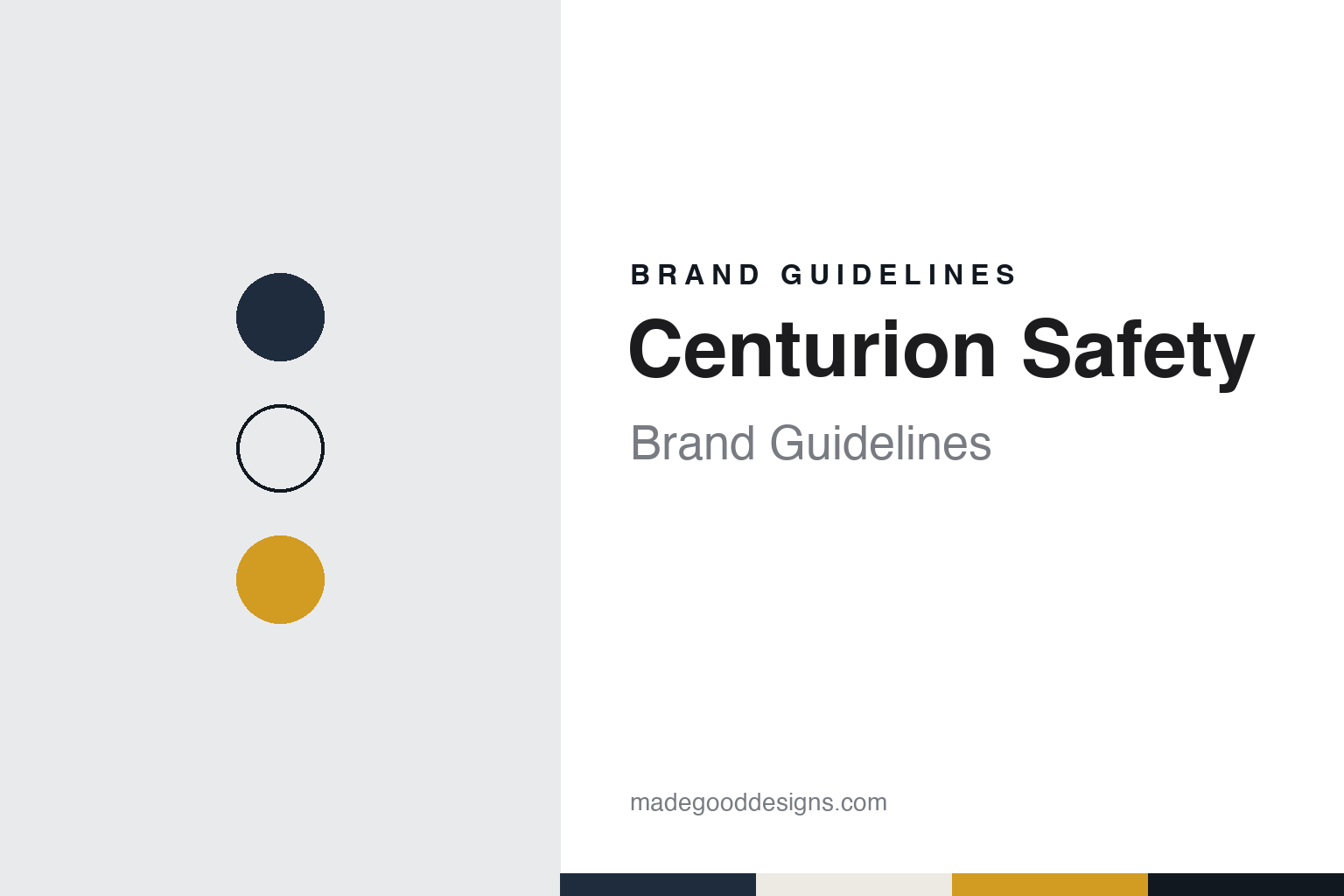
Centurion Safety Brand Guidelines
From pulp-ware basins to hard hats in a Norfolk market town.
Aa
Two constants: a slate navy, stone and amber palette and a narrow sans register. Abstract homage — not a Centurion product or mark; no helmet, logo or label is reproduced.
Patent pulp
A waterproof material, patented in Norfolk.
Centurion Safety began as a maker of household goods rather than helmets. Companies House records the company as incorporated on 16 May 1879; a 2021 profile in Manufacturing Today dates the start to 1878, when the entrepreneurs Edward Charles Vickers and Edwin William Knowles were granted a patent for a waterproof material intended to replace leather, pottery and papier-mâché. The business was called The Patent Pulp Manufacturing Co., and it was based in Thetford, the Norfolk market town where the company still is.
The material was moulded pulp. A collection record at Te Papa, New Zealand’s national museum, describes Thetford pulp-ware as a patented papier-mâché-like product formed from recycled paper, rags such as jute bagging, and wood pulp. The raw materials were blended with lime and shredded in “rag engines,” shaped in formers, pressed to squeeze out water, dried in an oven, given a smooth surface by a stamping machine, then soaked in linseed oil and resin, painted and varnished.
Under a later head, Louis Adler, the company used its pulping methods for basins, tubs and trays, Manufacturing Today reported. Te Papa says pulp-ware was water resistant and considered unbreakable, and that in the 1930s, its heyday, the company made more than 150 different items, from kitchen basins and baby baths to flower troughs and pin boxes.
Helmets came through the army. In 1900, the same profile says, the company won its first government contract, to make pith helmets for soldiers, and the publicity led to hard hats for mines and shipyards. Centurion’s own timeline calls its 1900 miner’s helmet its first mass-produced helmet.
Colour
Mines, wartime and the motorcycle.
By the 1930s the company’s pulp “Hard Hat” was worn by thousands of British miners, Manufacturing Today reported, and it had also become part of the motorcycle trade with its Centurion motorcycle helmets, made of two layers of pulp with a riveted harness and cradle. That is the origin of the name the company now trades under.
The Second World War brought military work. Te Papa’s record says the cheap, light and waterproof pulp-ware suited wartime Britain, and lists aircraft fuel tanks among the company’s products alongside miners’ helmets. The company’s own timeline says its miner’s hat was adapted in 1942 for use by Allied tank crews and by those manning decoy gun emplacements.
After the war the material ran out of road. In the 1950s pulp gave way to polythene, the 2021 profile says, and the company switched from pulping to plastic moulding; its own timeline says motorcycle helmets moved from wood pulp to fibreglass in the same decade. In 1964 the business was renamed Thetford Moulded Products Ltd, and it became a major supplier of safety helmets to the National Coal Board.
Motorcycle helmets carried the Centurion name through the 1970s. Manufacturing Today lists the jet-style XSC of 1970, the company’s first injection-moulded full-face helmet in 1973 and the Sprint of 1978. The company says its Spartan industrial hard hat followed in 1990, the year it moved to larger premises. On 30 April 1997, Companies House shows, the company took the name Centurion Safety Products; the profile says the change reflected a business by then concentrated on its Centurion range of protective equipment.
Typography
Protective equipment and its trade.
Personal protective equipment is sold on sight as much as on specification, and the makers in this guide present themselves in a shared visual language. The strongest signal is colour: fluorescent yellow and orange, the tones of high-visibility vests, jackets and rainwear, appear across catalogues, packaging and trade-show stands, usually set against a dark navy, charcoal or black.
Photography does much of the work. Catalogues and websites show safety glasses, earmuffs and hard hats on workers rather than on a white background alone: a welder behind a visor, a road crew in reflective stripes, a warehouse picker in cut-resistant gloves. Construction sites, factory floors and utility work are the usual settings, and many makers add a second, outdoor register for shooters, hunters and anglers, with camouflage, sunglasses styling and range photography.
Product pages lean on order. Gloves are shown in grids by coating, cuff and size; glasses in rows by lens tint; earplugs and earmuffs by type. Standards and ratings are printed as part of the design, in badges and code numbers, and ranges are often organised by the hazard or the trade they are sold for rather than by style alone.
The trade meets at fairs. A+A in Düsseldorf, the international trade fair for safety and health at work, gathers makers and distributors from around the world, and in the United States the National Safety Council’s Safety Congress & Expo serves a similar role. Many makers also sell through distributor networks and buying groups, so brochures, counter displays and sell sheets carry as much of the identity as the logo itself. This guide sets out what can be checked about each brand — who founded it, who owns it and where it is based — and attributes claims to the company where they rest on its own word.
Aa
A narrow industrial sans for a helmet maker. (Specimen set in Archivo Narrow, a sans STAND-IN; NOT the Centurion logo.)
Centurion Safety
Total above the neck.
Today the company describes its field as protection “above the neck”: safety helmets, bump caps, face screens and visors, hearing protection and respiratory equipment. Its range names include the Concept helmet of 2004, the Nexus of 2016 and the Nexus E:Protect of 2023, which it says is made from a sustainably sourced polymer containing renewables. In 2025 it introduced Armis, a helmet family whose shells it says use recyclable HDPE and HDPP plastics: the entry-level Potentia, the Extol and the T2 Elite, which the company says was designed for the US market.
Speaking to Manufacturing Today in January 2021, the chief executive, Nick Hurt, said Centurion was a founder member of the British Safety Industry Federation, that it had opened a training facility at its headquarters in 2017, and that it had two production facilities, one in Thetford and one in the Middle East. In September 2026 the company announced that it had been named Breckland Business of the Year 2026, an award from its home region. It remains a private limited company registered in Thetford.
The company does not publish brand colours or a typeface. Its website leads with the line “Total above the neck” and the phrase “Keeping you safe since 1879,” and it offers helmets carrying customers’ own corporate branding.
For a design guide, Centurion Safety shows how a long-lived maker can carry a product name, taken from a 1930s motorcycle helmet, through changes of material from pulp to plastics. Compare JSP, another British maker of safety helmets, and Portwest, a family workwear group that traces its roots to a 1904 drapery in Ireland. For this guide we use a slate navy, a pulp stone and a hard-hat amber with a sans, an unofficial interpretation; no product or logo is reproduced.
Explore & save
Keep Centurion Safety’s identity on hand — save it to a board in the Made Good inspiration library.
Centurion Safety identity set
Pin the Centurion slate navy, stone and amber palette and the narrow sans register to your own board.