Eargo Brand Guidelines
The fishing-fly hearing aid, from Nasdaq to a 2026 wind-down.
Aa
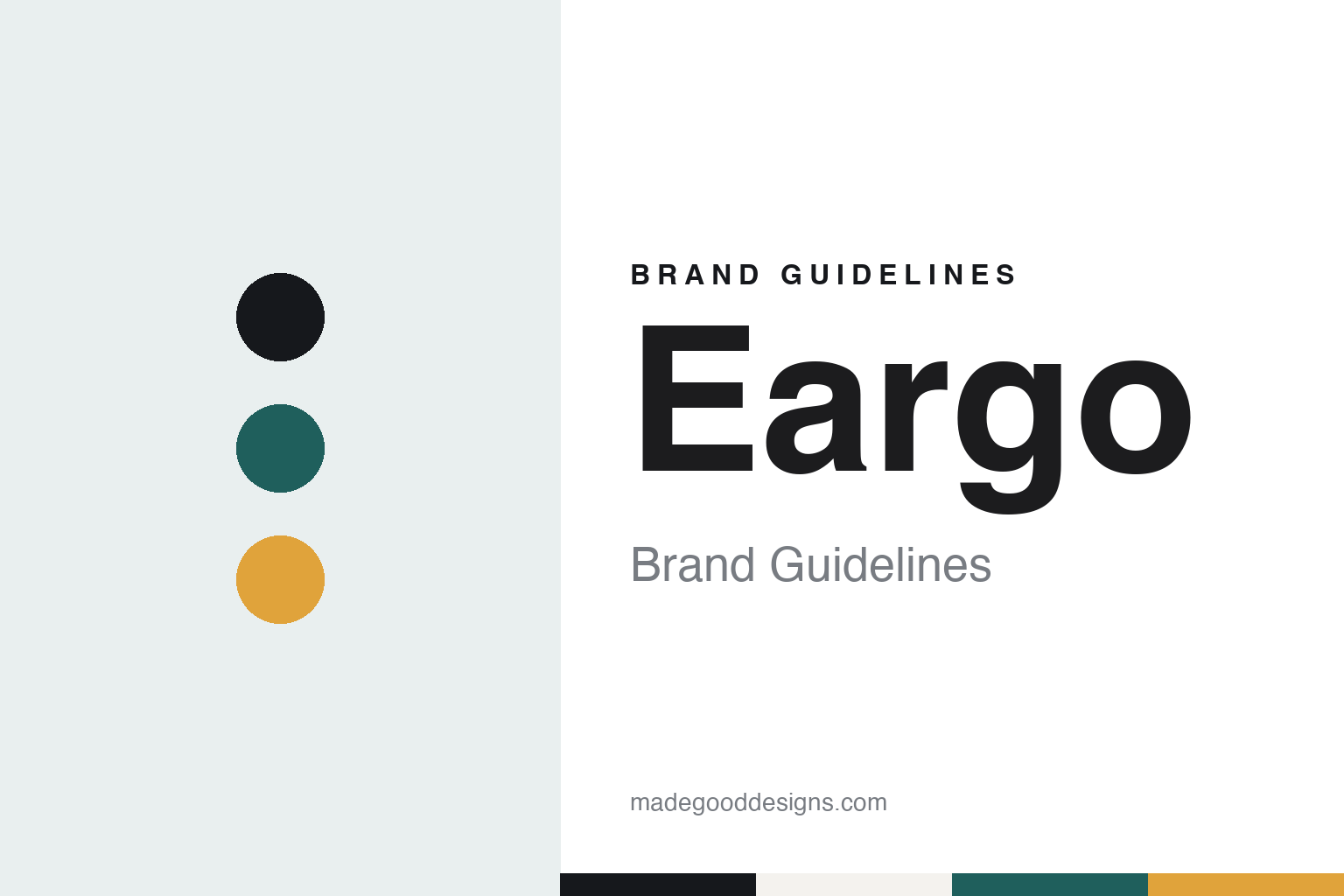
Two constants: a black, teal and amber palette and a consumer-tech sans register. Abstract homage — not an Eargo product or mark; no hearing aid, logo or nameplate is reproduced.
Mountain View
A surgeon’s fibres and a fishing fly.
Eargo was an American maker of small, rechargeable hearing aids sold directly to consumers. English Wikipedia gives its founding as 2010, by Florent Michel, an ear, nose and throat surgeon who served as designer and inventor, with Raphael Michel, the company’s first chief executive, and Daniel Shen, its chief science and clinical officer. The brand no longer trades: its parent company began winding down its US operations in July 2026, as set out below.
The idea that set Eargo apart was mechanical. Wikipedia says the design was modelled on a fishing fly: a small speaker held in the ear canal by soft medical-grade silicone fibres, which the company trademarked as Flexi Fibers. The Hearing Review, reporting in December 2015 on a funding round led by New Enterprise Associates, described the fibres as patented and invented by Michel, suspending the device in the canal so that it was “virtually invisible,” and leaving the canal open so that natural bass sounds could pass through. At that point Eargo was based in Mountain View, California. Its devices came with four preset sound profiles and a portable charger that fitted in a pocket or purse, were sold online from the company’s website, and had been named one of Popular Science’s Best of What’s New for 2015, the trade journal reported.
Wikipedia says the first devices became available to order in June 2015, after seed funding in 2013. Wearers changed sound profiles by double-tapping the ear, and could send an audiogram to Eargo’s licensed hearing professionals for custom programming. Christian Gormsen became chief executive in the summer of 2016 and stayed until June 2023. The company listed on Nasdaq on 16 October 2020, Wikipedia says, and by 2023 it gave its headquarters as San Jose, California.
Colour
Plus, Max, Neo and the over-the-counter years.
Eargo’s products came in generations. Wikipedia lists the Eargo Plus in 2017, the Eargo Max in 2018, the Eargo Neo in 2019 and the Neo HiFi in 2020. The Hearing Review described the Neo in January 2019 as an all-new design, with soft medical-grade silicone “Flexi Palms,” stainless steel charging contacts flush with the side of the casing, a portable charging cradle that was itself rechargeable, and, for the first time, a companion app that linked through the cradle to Eargo’s team of hearing professionals. Customers could also try the Neo at b8ta stores in six US cities.
The rules of the market then changed. The US Food and Drug Administration established an over-the-counter hearing aid category in 2022, Hearing Health & Technology Matters noted in 2025, and Eargo moved into it. HearingTracker reported in November 2023 that the Eargo 7, released at the Consumer Electronics Show in January 2023, was a rechargeable completely-in-canal aid with customised sound settings, sold online and in shops including Best Buy, and that a partnership with Victra, a Verizon authorised reseller, had brought Eargo into a reported 1,500 retail outlets. In May 2025 the company announced the Eargo 8, a self-fitting over-the-counter model it described as FDA-cleared, alongside the Eargo SE and LINK by Eargo, sold on its own website and through Best Buy and Amazon.
Across these generations the company described its devices in the same words. Its corporate boilerplate in 2023 and 2025 called them “virtually invisible,” rechargeable, in-canal and FDA-regulated devices for mild to moderate hearing loss, sold with support from hearing professionals by phone, text, email or video chat.
Typography
How hearing care presents itself.
Hearing-aid makers sell a product that is meant to be hard to see, and much of their imagery works around that. Devices are shown balanced on a fingertip to make their size clear, or in close-ups of the ear, where a behind-the-ear case and its thin tube or wire are the only visible trace. The Bern newspaper Der Bund noted in 2012 that hearing aids, unlike glasses, still had an image problem, and that makers were trying both to shrink them and to give them designed housings in a choice of colours.
Colour tends to follow the body rather than fashion. Many ranges come in skin tones, greys and silvers meant to blend with hair and skin, with brighter shells offered as options. Around the device sit the settings of professional care: the audiology booth, the fitting session and, more recently, the phone app used to stream sound or adjust a program.
The industry is concentrated and old. In 2007 Germany’s competition authority, the Bundeskartellamt, named Siemens, Phonak and Oticon as the main producers in the German market, with GN ReSound and Widex as the next-largest. Several of today’s brands began inside telephone and telegraph companies: Bernafon at a Swiss telephone maker in 1946, and GN Hearing’s forerunner Danavox in a Danish group that started with telegraph cables. Most are now part of a few groups that each run several brands side by side.
The trade meets at its own congresses. In Germany the annual EUHA congress of hearing-aid acousticians is where makers show new ranges to the trade; in the United States the American Academy of Audiology’s convention, long known as AudiologyNOW!, plays a similar role. This guide sets out what can be checked about each brand — who founded it, who owns it and where its products are made — and marks clearly what rests on the company’s own word.
Aa
A consumer-tech sans — closer to a gadget box than a clinic. (Specimen set in Manrope, a sans STAND-IN; NOT the Eargo logo.)
Eargo
Listed, taken private, merged, wound down.
Eargo’s later years were turbulent. In April 2022 it settled allegations by the US Department of Justice that claims it submitted to the Federal Employees Health Benefits Program, and invoices it gave the program’s members, carried unsupported hearing-loss diagnosis codes between 2017 and 2021, The Hearing Review reported in May 2022. Eargo denied the allegations and said the settlement was not an admission of liability and that the allegations did not concern the quality or performance of its product; the Justice Department said the claims were allegations only, with no determination of liability. The company had stopped accepting insurance as a direct method of payment in December 2021.
Patient Square Capital, a health care investment firm, became the majority shareholder in November 2022, HearingTracker reported, and in October 2023 agreed to buy the remaining shares in a deal expected to close in the first quarter of 2024; Wikipedia says Eargo was then taken private and delisted from Nasdaq. In 2025 Eargo merged with hearX, the maker of Lexie hearing aids, to form LXE Hearing, with hearX co-founder Nic Klopper as chief executive and Eargo’s Bill Brownie as chief operating officer. Hearing Health & Technology Matters reported the completed merger on 2 April 2025, and Audiology Worldnews said the combined company would run Eargo and Lexie as two brands.
It did not last. On 15 July 2026 LXE Hearing and four related US companies each entered an assignment for the benefit of creditors under California law and began winding down their US operations, notices on the Eargo and LXE Hearing websites say. The Hearing Review reported the wind-down on 17 July 2026, quoting the company that it had been “unable to identify a viable path forward.” The notices said the Eargo app would leave app stores and its cloud service would end on 22 October 2026, while the hearing aids were expected to keep working with on-device controls and saved settings.
For a design guide, Eargo shows how a hearing aid could be sold like a consumer gadget, with the device itself, a fibre-tufted capsule meant to vanish in the ear, doing the branding. Compare Nuheara, another consumer-led hearing brand, and ReSound, a maker in the professional channel. For this guide we use a canal black, a fibre teal and a signal amber with a sans, an unofficial interpretation; no product or logo is reproduced.
Explore & save
Keep Eargo’s identity on hand — save it to a board in the Made Good inspiration library.
Eargo identity set
Pin the Eargo black, teal and amber palette and the consumer-tech sans register to your own board.