Wexiödisk Brand Guidelines
The Växjö maker of professional dishwashers, built in Småland since 1972.
Aa
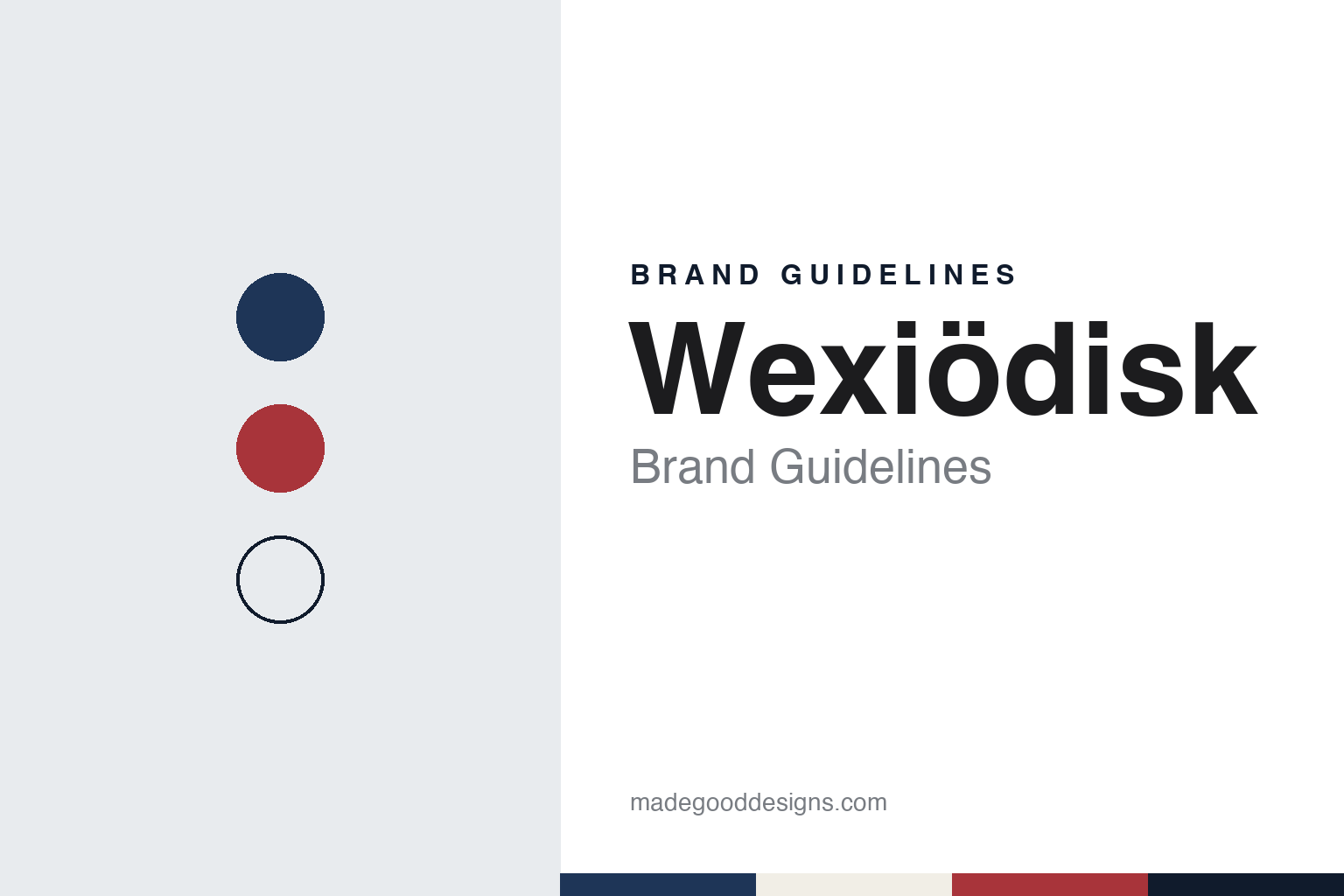
Two constants: a navy, birch and lingonberry palette and a Nordic sans register. Abstract homage — not a Wexiödisk product or mark; no machine, logo or nameplate is reproduced.
Växjö, 1972
A dishwasher maker in Småland.
Wexiödisk makes professional dishwashers in Växjö, a town in the province of Småland in southern Sweden. The company dates itself to 1972, and the British trade magazine Public Sector Catering gave the same founding year in a profile published in December 2017, describing a company that started out with “an ambition to offer a really good range of quality machines.”
Production has stayed in the town. The company says that since 1972 it has developed and manufactured its dishwashers in Växjö, in factories that it says give it control over quality, flexibility in production and a close link between development and manufacturing. Public Sector Catering visited in 2017 and reported an 11,000-square-metre factory where a workforce of 170 handcrafted the whole production. In September 2024 the magazine quoted chief executive Magnus Titusson crediting the company’s results to “maintaining our production locally in Sweden” and to new production space, and reported that it had built a new exhibition hall during the pandemic, when trade fairs could not be visited, to train customers and launch products.
The company’s tag line, the 2017 profile said, was “Swedish Brilliance,” and Titusson, then managing director, summed up its approach: “Wexiödisk machines aren’t complicated – they’re simple and easy to use but work incredibly well.” The magazine also reported that the company described itself as relatively small beside its larger international rivals. Its website today makes the same case in plainer terms, calling its machines “developed and manufactured in Småland” and built for long service life.
Colour
Part of Ali Group since 2004.
Wexiödisk is not independent. Public Sector Catering reported in 2017 that it was acquired by Ali Group in 2004, the Italian foodservice-equipment group, and that it had since “fought to maintain its own identity.” Ali Group’s own history records 2004 as the year it bought Metos of Finland, and names Hackman-Metos from Scandinavia among its key acquisitions of the 2000s. On its brand page, Ali Group says Wexiödisk machines are sold under both the Metos and Wexiödisk names.
Inside the group, the Swedish maker is listed under washing and waste management, beside Italian dishwasher brands. Ali Group calls Wexiödisk the market leader in Scandinavia; Public Sector Catering described it in 2017 as the largest dishwasher supplier in Scandinavia. The company’s website today claims a 65 per cent market share in Sweden, says 57 per cent of its output is exported, and gives 6,136 machines delivered in 2025.
Its customers, as the 2017 profile listed them, ranged from Ikea and Växjö’s hospital to the Vida Arena, home of the Växjö Lakers ice hockey team, and the flight kitchens of TFK Corporation at Tokyo’s Narita airport. The magazine reported that most orders came from Sweden, that the company also supplied hotels, schools, military sites and flight kitchens abroad, and that it had entered the British market in 2004.
Typography
Design and documentation.
Commercial dishwasher makers sell to professional kitchens rather than households. Their catalogues are sorted by how the ware moves: undercounter machines and glasswashers that sit beneath a bar or counter, hood-type or door-type machines that wash one rack at a time, rack conveyors for bigger runs of baskets, and flight-type machines that carry plates on a continuous belt. Hobart and Comenda both organise their ranges in this way on their websites.
The customer lists read like a map of institutional eating. Hobart names restaurants, hotels, hospitals, long-term care, schools and grocery retailers; Comenda adds pastry shops, ships, central kitchens and airline caterers, and says its flight-type machines are built for large canteens, hospitals and inflight catering. The baskets themselves come in standard sizes: Comenda quotes racks of 400 by 400 and 500 by 500 millimetres.
The trade meets at fairs rather than in shops. INTERNORGA, held every year in Hamburg, describes itself as a platform for hospitality and foodservice, with a hall area for kitchen technology and equipment, and plans its 100th edition for March 2027. In Milan, HostMilano is another fixed date; the American trade magazine Foodservice Equipment Reports keeps photo galleries from its 2023 and 2025 editions. Comenda’s own awards page lists an innovation prize from the Rest’Hotel fair in Caen.
Ownership in this sector often runs through large groups. Hobart is a brand of Illinois Tool Works’ food-equipment group; Comenda was the first company of Italy’s Ali Group, which has since gathered further warewashing names. This guide sets out what can be checked about each brand and marks what rests on the company’s own word.
Aa
A clean Nordic sans for a name with a Swedish ö. (Specimen set in Work Sans, a sans STAND-IN; NOT the Wexiödisk logo.)
Wexiödisk
Racks, conveyors and a pre-rinse machine.
Wexiödisk’s range runs from undercounter and hood-type dishwashers and glasswashers to pot washers, rack conveyor and flight-type machines, cart washers, tray and cutlery washers and cutlery sorting machines, according to its website. Ali Group credits it with a series of developments, among them the WD-90 DUO granule washer, the DUPLUS system that recirculates the final rinse in single-tank machines, the WD-18CW trolley washer, which uses spin drying, and the ACS cutlery sorting system. Ali Group also names the WEB Tool, a web-based system for HACCP records and inspections.
Large installations feature heavily in how the company is described. Public Sector Catering reported in 2017 that the Vida Arena used a Pre-Rinse Machine with a rack conveyor dishwasher, its only warewashing system on site, run by a single kitchen porter while caterers served up to 5,700 fans; that Växjö’s hospital had used a system of rack belt, trolley washer and flight-type machine since 2005 or 2006; and that the company tested every machine before it left the factory. The company’s own website lists reference cases including the ICC convention centre in Birmingham and a Michelin-starred restaurant.
The product the company has pushed hardest is the Pre-Rinse Machine, which Public Sector Catering reported in 2017 was patented and called by the company its biggest launch to date: it uses water from the dishwasher to rinse dishes in place of a hand-held overhead spray. A more recent addition is the WD-10S pot washer, which Ali Group’s magazine Aliworld profiled in July 2026 at an ICA supermarket in Borgholm, on the island of Öland; Wexiödisk says the machine is made from 98 per cent recycled steel. The article described a machine without a hood, with a loading height of 820 millimetres for bulkier items, a two-pump system, four wash programs and granule-free washing; the company’s international area sales manager, Henrik Florentzson, said the higher loading height opened a new market among shops.
For a design guide, Wexiödisk shows how a provincial factory brand builds its identity around where its machines are made, with a Swedish tag line and a town at the centre of its story. Compare Electrolux Professional, another Swedish name in professional kitchen equipment, and Comenda. For this guide we use a deep navy, a birch white and a lingonberry red with a sans, an unofficial interpretation; no product or logo is reproduced.
Explore & save
Keep Wexiödisk’s identity on hand — save it to a board in the Made Good inspiration library.
Wexiödisk identity set
Pin the Wexiödisk navy, birch and lingonberry palette and the Nordic sans register to your own board.