Neodent Brand Guidelines
Curitiba’s implant maker inside a Swiss group.
Aa
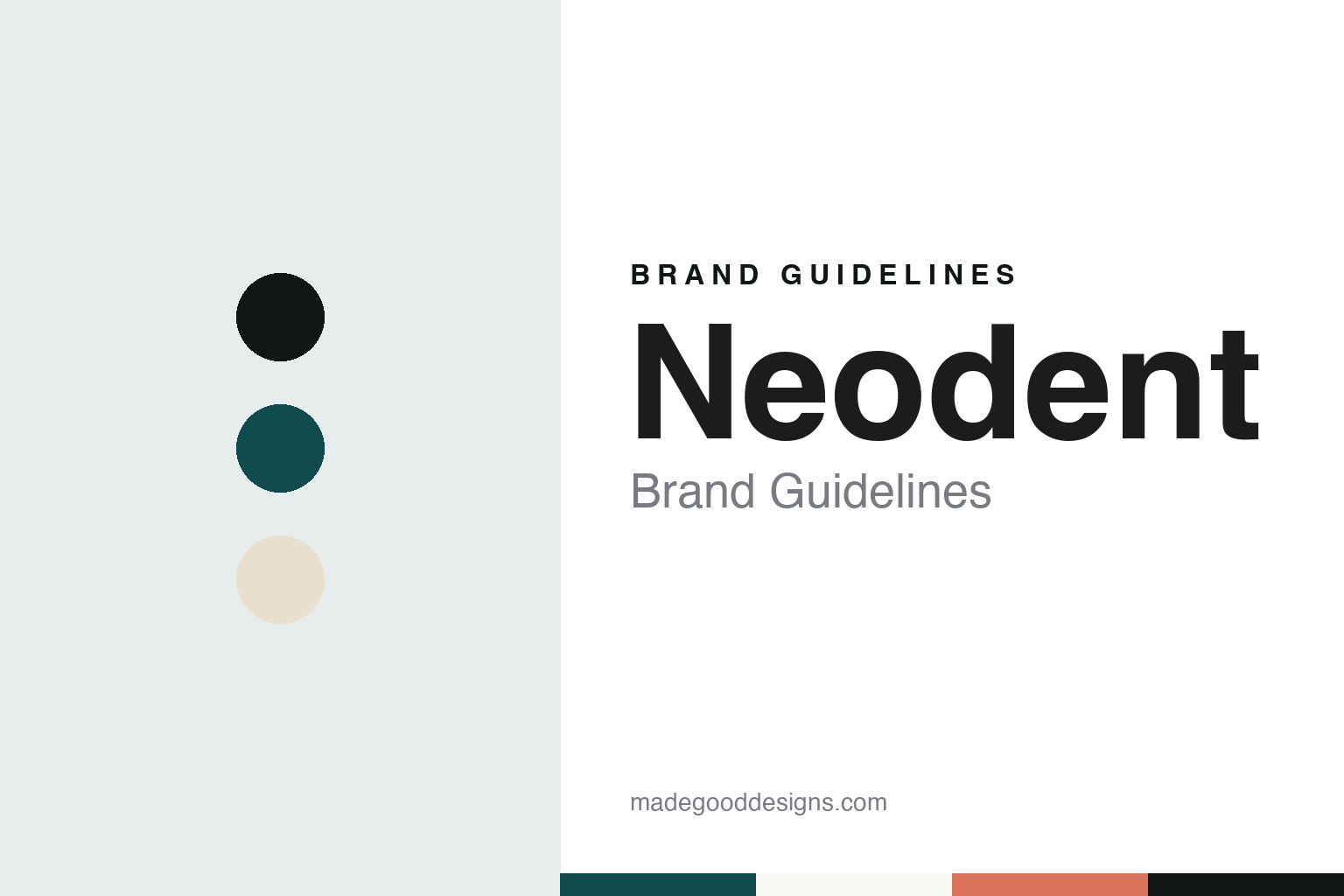
Two constants: a Neodent teal, sand and coral palette and a humanist sans register. Abstract homage — not a Neodent product or mark; no implant, logo or package is reproduced.
Curitiba, 1993
Two founders and one production employee.
Neodent was founded in 1993 in Curitiba, in the Brazilian state of Paraná, as JJGC Indústria e Comércio de Materiais Dentários. Its founding owners were Drs Geninho Thomé and Clemilda de Paula Thomé, according to Straumann’s May 2012 announcement, reprinted in full by the Dutch trade title Tandtechnisch Magazine. The company profile in that announcement says Neodent started making dental implants and related instruments with a single production employee, moved into its own premises in Curitiba in 1998, and was the first Brazilian company in the implant sector to receive certification from the Ministry of Health.
Neodent grew quickly at home. By 2012 it had more than 700 employees, over ten branches in Brazil and subsidiaries in Portugal and Mexico, and held roughly a third of the Brazilian implant market, the announcement said. It described the company’s approach as making tested implant solutions more affordable to a broader population. Three years later the Swiss news agency Keystone-SDA, in a report carried by swissinfo.ch, called Neodent the market leader in Brazil, with 970 staff in 2014.
Training has been part of the model throughout. Neodent runs courses through ILAPEO, the Instituto Latino Americano de Pesquisa e Ensino Odontológico, which the 2012 announcement described as one of the largest dedicated implant training centres in the world, with thousands of participants a year. Geninho Thomé, as co-founder and chief executive, led the company through this period.
Colour
Straumann’s second brand.
On 16 May 2012 the Basel implant maker Straumann announced that it had agreed to buy 49% of Neodent, with options to reach full ownership within six years. Straumann presented the deal as a dual-brand strategy: the two companies would keep operating as separate businesses and brands aimed at different customers in Brazil and Latin America, Straumann as a premium global provider and Neodent as a regional leader with solutions tailored to local needs. Thomé was expected to stay on as chief executive, and the announcement quoted him calling Straumann’s investment important for Brazil and a recognition of what Neodent’s staff had achieved over the previous ten years. Beat Spalinger, then Straumann’s chief executive, called Neodent a leading brand in one of the world’s most attractive and dynamic tooth-replacement markets.
Straumann then moved faster than planned. On 7 April 2015 it announced that it would take the remaining 51% straight away rather than in 2018, swissinfo.ch reported. Straumann’s Brazilian organisation was folded into Neodent’s headquarters in Curitiba, and Matthias Schupp, who kept responsibility for Latin America at Straumann, became Neodent’s chief executive. Thomé stayed as chairman of the board and took the new title of scientific president.
The agency noted that the first stake in 2012 had marked a change of course for Straumann, which until then had concentrated only on the premium end of the market. By 2015 Neodent had been introduced in Spain, Portugal, Italy and the United States, and Straumann planned to take it further abroad through Instradent, its platform for value brands, the report said. The Curitiba daily Gazeta do Povo still described Neodent in 2018 as a maker of dental implants that is part of the Swiss Straumann group.
Typography
Titanium, screens and congresses.
Dental implant and digital-dentistry companies sell to a narrow, expert audience, and their pictures show it. The typical product image is a small titanium screw shot on a white or pale grey ground, often beside its abutment and the driver that seats it, and lit to show the thread and the surface. Packaging tends to follow the same order: clean white boxes, colour codes for sizes, and the product line’s name set larger than the company’s.
Digital dentistry adds a second set of images. Intraoral scanners appear as slim wands next to a laptop or a cart, and the screen matters as much as the hardware: a coloured three-dimensional render of an arch, a planned implant position inside a CT slice, or a crown being shaped in design software. Milling machines and printers are shown with the blocks and discs they cut, and finished work is usually photographed as a single milled crown or bridge on a neutral surface.
The third subject is the clinician. Implant makers run training courses, symposia and hands-on sessions, and their brochures and press releases often show lecture halls and dentists at practice models rather than patients. Trade fairs carry much of that presentation: IDS, the International Dental Show in Cologne, and the congresses of the European Association for Osseointegration are where companies set up large stands, launch product lines and gather speakers.
The result is a category that looks clinical and orderly, with white space, steel greys and one or two accent colours carrying most of the identity. The companies in this guide include implant makers from South Korea, Europe, Brazil and the United States, alongside firms in intraoral scanners, lasers and CAD/CAM software. Each guide sets out who founded the company, who owns it now and what it says about where its products are made, separating documented facts from the company’s own claims.
Aa
A humanist sans for a Brazilian maker with Swiss owners. (Specimen set in Figtree, a sans STAND-IN; NOT the Neodent logo.)
Neodent
Grand Morse and a bigger factory.
The product line most associated with the Straumann years is Grand Morse. Neodent launched it on 23 August 2017 at a corporate session of the IN 2017 Latin American Osseointegration Congress in São Paulo, the Brazilian trade site Dental Press reported, describing it as the biggest launch in Neodent’s history. The system was conceived by Geninho Thomé and is built on what the maker calls an “inside out” concept, working from the internal connection to the external design. Its lead implant, Helix GM, is intended for all bone densities, the maker says, with progressive threads, smooth apexes and helical chambers.
The launch came with more capacity. In 2017 Neodent enlarged its factory in Curitiba’s Cidade Industrial district from 10,000 to 15,000 square metres, added a production line for Grand Morse and built a new automated distribution centre beside it, Gazeta do Povo reported in February 2018. The paper said 30 new machines from Germany were arriving through 2018, most of them for the Grand Morse line. Before it, the paper explained, Neodent had developed a separate line for each type of bone. It added that Neodent was then present in 25 countries with the United States as its main export target, and that the chief executive spoke of plans for a further unit in Curitiba, which he called the company’s home. The stated aim was for at least half of production to be exported by 2022.
For a design guide, Neodent shows a brand that was built in one Brazilian city and kept its own name, range and training institute after joining a Swiss group, with its founders, its classrooms and its factory all in Curitiba. Compare it with Straumann, its owner, and with Nobel Biocare. For this guide we use a deep teal, a warm sand and a soft coral with a humanist sans, an unofficial interpretation; no product or logo is reproduced.
Explore & save
Keep Neodent’s identity on hand — save it to a board in the Made Good inspiration library.
Neodent identity set
Pin the Neodent teal, sand and coral palette and the humanist sans register to your own board.