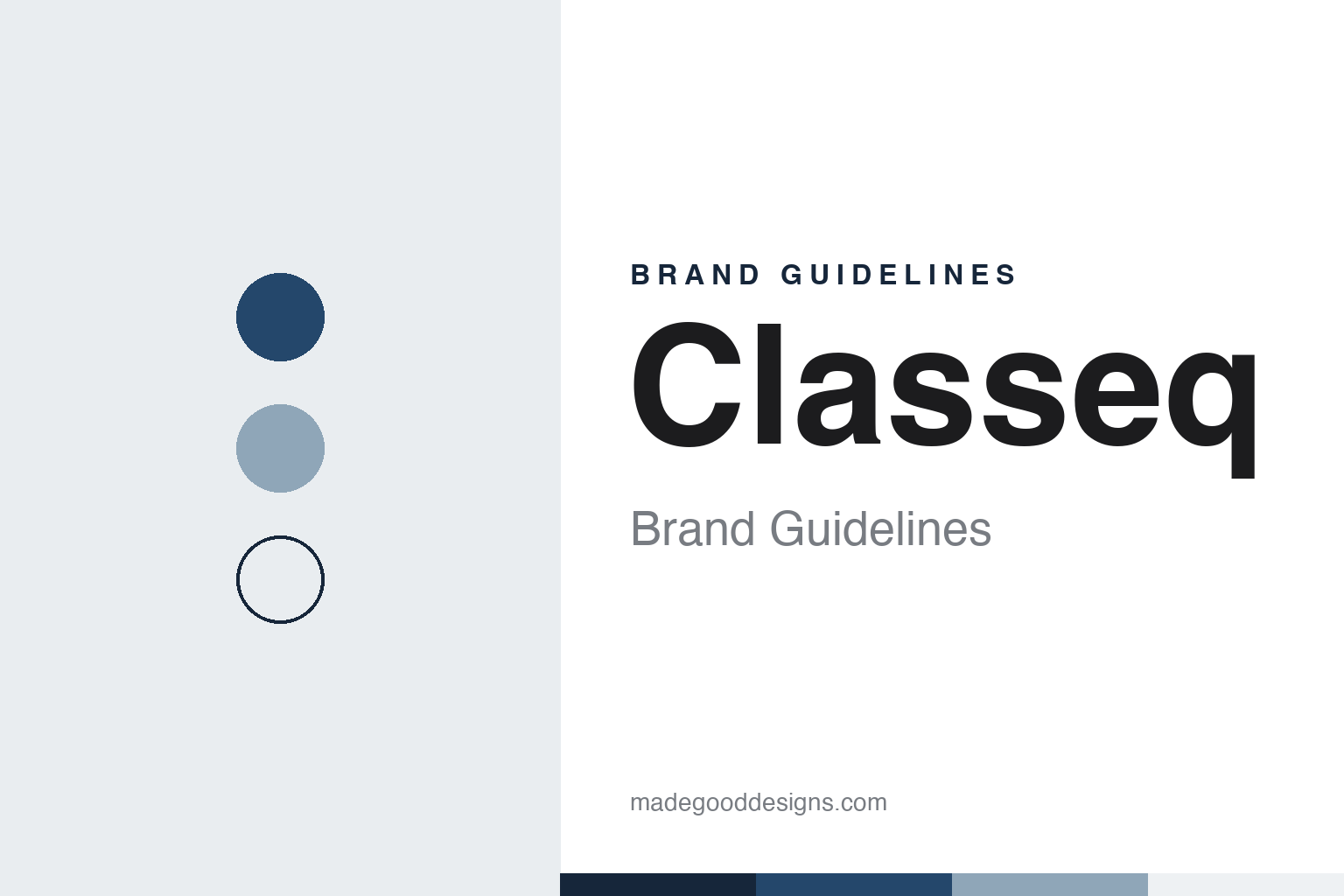
Classeq Brand Guidelines
The Staffordshire warewasher maker built around the idea of simple.
Aa
Two constants: a slate blue, grey-blue and white palette and a plain grotesque sans register. Abstract homage — not a Classeq product or mark; no machine, logo or nameplate is reproduced.
Classeq
A British maker of glass and dishwashers since 1977.
Classeq is a British maker of commercial glasswashers and dishwashers for pubs, restaurants, hotels, cafés and other catering kitchens. Its own dating goes back to 1977. When the company moved into a new factory in 2017, The Caterer reported that it had started production in the UK in 1977, and FCSI, the magazine of the Foodservice Consultants Society International, wrote that Classeq was marking forty years since it first started making dishwashers for commercial kitchens in the pub, restaurant, hotel and café trades. German Wikipedia gives the same founding year. The company itself says it has spent “over 40 years” developing glass and dishwashing equipment.
The legal history is a little more tangled than the brand’s. Companies House records show that the company now called Classeq Limited was incorporated in October 1980 and traded under other names for most of its life: Classic Cash Registers Limited through the 1980s, and Classic Glass & Dishwashing Systems Limited from 1990. It took the Classeq name only in 2014, when a separate company that had been registered as Classeq Ltd since 2006 swapped names with it; that second company was dormant and was dissolved in 2021. The trading brand, in other words, is older than the name on the register.
Before 2017 Classeq’s factory was at Hixon, in Staffordshire, FCSI reported. Companies House now lists its registered office in Stafford.
Classeq’s ownership changed in 2004, when it was bought by Winterhalter, the owner-managed German warewashing specialist based at Meckenbeuren near Lake Constance. German Wikipedia describes the deal as Winterhalter taking over a British competitor, and Classeq’s own site says it was “purchased by Winterhalter in 2004” and remains part of the group. Winterhalter itself was founded in 1947 by Karl Winterhalter in Friedrichshafen and moved to Meckenbeuren in 1959, German Wikipedia says. Companies House lists Winterhalter Ltd, the group’s British company, as holding more than three-quarters of Classeq’s shares.
Colour
A purpose-built factory in Stafford.
Two years after the takeover, Classeq says, it launched a new range of warewashers in 2006. The bigger step came in October 2017, when it opened a purpose-built factory on Beacon Business Park in Stafford. The factory was officially opened on 18 October 2017, according to FCSI and The Caterer, with the Winterhalter family present; the company’s workforce of about forty moved across from Hixon. The two trade titles gave slightly different figures for capacity: FCSI reported room for 15,000 machines a year, The Caterer up to 16,000. The company describes the building as a 3,000-square-metre manufacturing facility.
The new site combined production with a showroom and a call centre for spare parts, orders and technical questions, FCSI reported, and every machine went through at least 45 minutes of testing before leaving. That year Classeq had also launched a new undercounter range, DUO. Machines were shipped abroad as well as across Britain, with South Africa and Australia named as markets in that report.
Today the company presents two families. The Undercounter Range covers the C400 and C500 glass and dishwashers and the C500 Utensil; the Pass Through Range covers the CP500 and CP500 SR, which the company pitches at high-volume kitchens such as schools and universities. A Bluetooth app supports users and engineers, and the company says Wi-Fi connectivity is available on UK machines made after 1 February 2026.
Classeq says its research and development team and its production line are both based in Staffordshire, and that its machines are “designed, built and tested” there. It also says it has a UK technical team and a national network of directly employed service technicians. It says it sells through distributor partners, and it lists membership of two British trade bodies: the Foodservice Equipment Association and CEDA, the catering equipment distributors’ association.
Typography
Warewashing and its trade.
Commercial dishwasher makers sell to professional kitchens rather than households. Their catalogues are sorted by how the ware moves: undercounter machines and glasswashers that sit beneath a bar or counter, hood-type or door-type machines that wash one rack at a time, rack conveyors for bigger runs of baskets, and flight-type machines that carry plates on a continuous belt. Hobart and Comenda both organise their ranges in this way on their websites.
The customer lists read like a map of institutional eating. Hobart names restaurants, hotels, hospitals, long-term care, schools and grocery retailers; Comenda adds pastry shops, ships, central kitchens and airline caterers, and says its flight-type machines are built for large canteens, hospitals and inflight catering. The baskets themselves come in standard sizes: Comenda quotes racks of 400 by 400 and 500 by 500 millimetres.
The trade meets at fairs rather than in shops. INTERNORGA, held every year in Hamburg, describes itself as a platform for hospitality and foodservice, with a hall area for kitchen technology and equipment, and plans its 100th edition for March 2027. In Milan, HostMilano is another fixed date; the American trade magazine Foodservice Equipment Reports keeps photo galleries from its 2023 and 2025 editions. Comenda’s own awards page lists an innovation prize from the Rest’Hotel fair in Caen.
Ownership in this sector often runs through large groups. Hobart is a brand of Illinois Tool Works’ food-equipment group; Comenda was the first company of Italy’s Ali Group, which has since gathered further warewashing names. This guide sets out what can be checked about each brand and marks what rests on the company’s own word.
Aa
A plain grotesque sans for a brand that sells simplicity. (Specimen set in Archivo, a sans STAND-IN; NOT the Classeq logo.)
The Power of Simple
A brand that sells simplicity.
Classeq’s brand rests on one word. Its current campaign line is “The Power of Simple”, extended to “The Power of Simple. Multiplied.” for the pass-through range, and its company page states the vision outright: “Classeq stands for simplicity.” The same page sets out three values, Simplicity, Trust and Customer First, and describes the brand’s promise as machines that are simple to choose, install, use and maintain. Another line on the site, “It’s complicated making things simple,” puts the same idea another way.
The second strand is national. The website carries a “Made in Britain” heading over the Stafford factory, and when the factory opened in 2017 Jürgen Winterhalter, of the parent company, told FCSI that Classeq was “the only UK manufacturer of dishwashers”; that is his description, given in 2017. Classeq presents itself as a British maker with its own factory, team and service network, while naming Winterhalter as its parent.
For a design guide, Classeq shows how a warewashing brand can build an identity from one plain idea, simplicity, and a place of manufacture, and how a subsidiary can keep its own voice inside a larger family-owned group. Compare its parent, Winterhalter, and another family of warewashing makers, MEIKO. For this guide we use a slate blue, a grey-blue and a rinse white with a sans, an unofficial interpretation; no product or logo is reproduced.
Explore & save
Keep Classeq’s identity on hand — save it to a board in the Made Good inspiration library.
Classeq identity set
Pin the Classeq slate blue, grey-blue and white palette and the plain grotesque sans register to your own board.