Arthrex Brand Guidelines
A Munich drafting board that grew into a Florida teaching company.
Aa
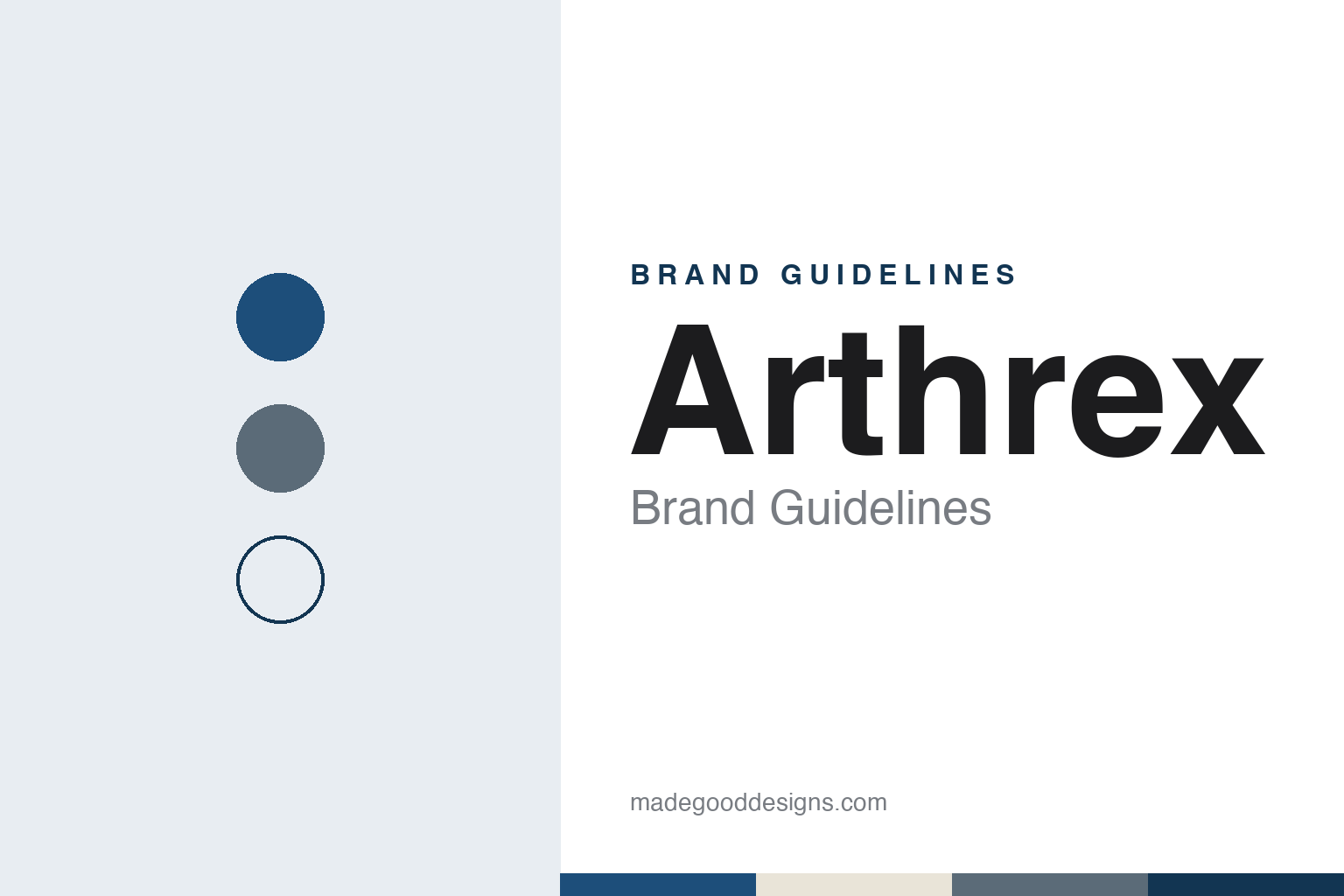
Two constants: a blue, slate and bone palette and a technical sans register. Abstract homage — not an Arthrex product or mark; no implant, instrument or logo is reproduced.
Munich, 1981
A drafting board in the Olympic Village.
Arthrex is an American company that began in Germany. German Wikipedia says the American Reinhold Schmieding founded it in Munich in 1981 under the name Arthroscopy Excision Instruments Inc.; English Wikipedia adds that it was later renamed Arthrex. Florida Trend, in an August 2016 profile, describes how Schmieding, a Michigan State University graduate who had moved to Germany after 1977 to work in orthopaedic implants, set up in an apartment in Munich’s Olympic Village, where he created the company logo and designed some of its first instruments for arthroscopic knee surgery on a simple drafting board.
Arthroscopic surgery, carried out through tiny incisions, was then in its infancy, and Florida Trend says surgeons lacked specialised tools for it. Schmieding designed the instruments himself, had German instrument craftsmen make them and staffed his own booth at medical conferences, the magazine reported, drawing on a 170-page book he wrote in 2006 for the company’s 25th anniversary. An idea that became central to the business came early: facilities where surgeons could practise arthroscopic surgery with the company’s instruments on anatomical models.
In the summer of 1991, after a decade in Germany, Schmieding moved the business to Naples, Florida, a place he chose, Florida Trend wrote, as a “resort environment” that would suit visiting physicians and potential employees. In its early years in Collier County, Arthrex designed instruments and taught surgeons to use them but did little manufacturing; the head of the county’s economic development council, Schmieding later said, “inspired us to hire an engineer and actually start manufacturing.” In 2003 the company opened an office complex in Naples with laboratories where doctors could train on cadaveric joints.
Colour
Private, and built around surgical teaching.
Arthrex has stayed privately held, with Schmieding as founder and owner, according to German and English Wikipedia. German Wikipedia counts more than 6,000 employees in 2022 across 29 locations in countries including Germany, Japan, Mexico and Singapore, with its European, Middle Eastern and African headquarters, Arthrex GmbH, in Munich and further German sites in Odelzhausen and Frechen. It lists more than 18,000 products for arthroscopy, sports medicine and trauma, joint replacement, orthobiologics, aesthetics and imaging, plus a veterinary line.
The company’s own figures have grown since. Its website says it develops more than 1,000 new products and related procedures a year, offers more than 25,000 products, runs more than 160 surgical training labs across North America and Europe, and sells through subsidiaries and distributors in more than 80 countries; it says it has “pioneered the field of arthroscopy and sports medicine” and sets out its motto, “Helping Surgeons Treat Their Patients Better,” under the heading “Our Mission.” It also names fields beyond orthopaedics, including spine and cardiothoracic surgery and 4K surgical visualisation. In 2016 a company spokeswoman told Florida Trend that Arthrex made 70 percent of its products in Florida and exported them from a logistics centre in Fort Myers, and the magazine cited the industry publication Orthoworld as estimating that Arthrex held the largest share of the arthroscopy and soft-tissue market.
Teaching remains at the centre of how Arthrex presents itself. Florida Trend reported the company’s statement that its training brought about 10,000 visitors a year to southwest Florida, 6,000 of them doctors, and that it ran surgical education seminars worldwide; the website now cites 62,000 training days a year. In Germany the company set up the Arthrex Stiftung in 2005 under the umbrella of Plan International Deutschland to fund children’s projects, chiefly in Asia and Africa, German Wikipedia says.
Typography
How orthopaedic makers present themselves.
Orthopaedic device makers sell to a narrow, expert audience: surgeons, theatre teams, hospital buyers and the distributors who serve them. Their brand material is shaped by that audience. Product imagery tends to be precise and technical, with implants rendered as clean metallic objects, often lit against dark or neutral backgrounds so that the form of a stem, a plate or a screw reads clearly.
Clinical imagery sits alongside the renders. X-rays, bone models, anatomical cut-aways and diagrams of a joint or a spinal segment show where a device goes and how it is meant to fit. Many makers also photograph surgeons in theatre, in gowns and masks under surgical lights, and show the trays of instruments that accompany an implant system, laid out in rows that suggest order and completeness.
Education is a large part of the picture. Device makers run training courses, cadaver labs and online technique guides, and much of their visual output is instructional: step-by-step surgical technique documents, animations and videos. Congresses matter too. Large meetings such as the annual meeting of the American Academy of Orthopaedic Surgeons (AAOS) and the congress of the European Federation of National Associations of Orthopaedics and Traumatology (EFORT) are where new systems are often shown, on stands designed to carry a brand at scale.
Corporate identities in the field are usually restrained: sans-serif wordmarks, a small set of brand colours and a great deal of white space, with the visual drama left to the product and the clinical image. Many brands also sit inside larger groups, so a single name may appear alongside a parent company’s mark. That makes the typeface, the palette and the treatment of imagery the main tools a maker has for being recognised.
Aa
A technical sans for an instrument maker. (Specimen set in Archivo, a sans STAND-IN; NOT the Arthrex logo.)
Arthrex
A logo drawn by the founder.
Arthrex also gave its name to a Supreme Court case. In a dispute with Smith & Nephew and ArthroCare over an Arthrex patent, the Patent Trial and Appeal Board found the patent invalid; Arthrex then challenged how the board’s judges were appointed. In United States v. Arthrex, Inc., decided on June 21, 2021, the Supreme Court ruled by five votes to four that the judges’ unreviewable authority was incompatible with the way they were appointed, and resolved the problem by making their decisions open to review by the Director of the Patent Office, English Wikipedia records. Florida Trend reported in 2016 that Arthrex had earlier lost a separate patent infringement case brought by Smith & Nephew, which it had appealed as far as the Supreme Court.
The origin of the Arthrex mark is recorded: Florida Trend says Schmieding created the company logo himself, in the Munich apartment where the business began, alongside his first instrument drawings. Today the company’s website opens its About page with the mission line, followed by figures for products, research collaborations and training labs.
For a design guide, Arthrex shows a founder-drawn mark and a brand built on teaching surgeons as well as selling to them. Compare Smith+Nephew, the other party in its Supreme Court patent dispute, and Stryker, another American orthopaedic maker. For this guide we use a deep blue, slate and a pale bone with a sans, an unofficial interpretation; no product or logo is reproduced.
Explore & save
Keep Arthrex’s identity on hand — save it to a board in the Made Good inspiration library.
Arthrex identity set
Pin the Arthrex blue, slate and bone palette and the technical sans register to your own board.