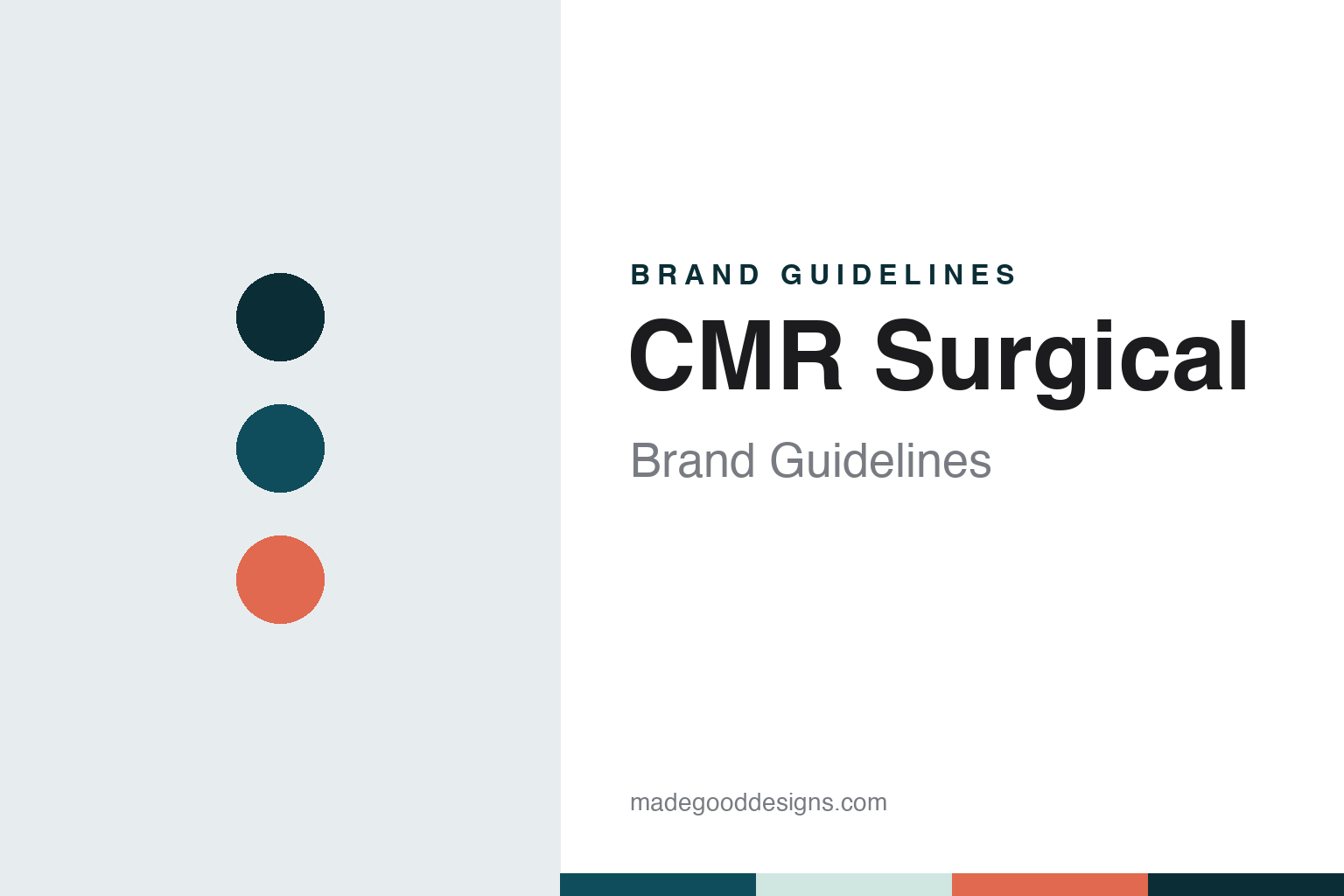
CMR Surgical Brand Guidelines
Cambridge’s 2014 robot maker and the modular Versius.
Aa
Two constants: a teal, mint and coral palette and a clean modular sans register. Abstract homage — not a CMR Surgical product or mark; no robot, logo or interface is reproduced.
Cambridge Medical Robotics
Five founders and a question about keyhole surgery.
CMR Surgical began in Cambridge, England, in 2014. The company says its five founders started with a question: why were so many people still not getting minimal access, or keyhole, surgery? Its own releases name three of them. Martin Frost, who co-founded the business in 2014 and later served as chief executive, had earlier been involved in starting and leading technology companies including the Cambridge consultancy Sagentia, the company says. Luke Hares built and led its technology team as chief technology officer, and Mark Slack, described by the BBC in 2018 as a surgeon at Addenbrooke’s Hospital, became its chief medical officer.
The business was first called Cambridge Medical Robotics and changed its name to CMR Surgical in March 2018, English Wikipedia says, keeping the initials of the old name. In September 2018 the BBC reported the unveiling of its robot, Versius, which it described as “designed and built in Cambridge” and as a rival to the American da Vinci system. The BBC explained that each arm had flexible joints like a human arm and was controlled by a surgeon sitting at a console, using two joysticks and a 3D screen.
The company raised money in a series of private rounds. In 2021 the company completed what it called the largest private financing round in medical technology worldwide, citing PitchBook data, according to English Wikipedia and the company’s own release. Later that year it announced a large manufacturing facility at Ely, close to its Cambridge headquarters, to house up to 200 staff at first in production, quality, supply and logistics; the company then had more than 700 employees. English Wikipedia records that in April 2023 about 350 staff were made redundant, and that in October 2023 the company announced a new UK manufacturing facility able to produce up to 500 Versius systems a year.
Colour
Small arms, an open console.
Versius is built around separate, modular arms rather than one large machine. The company describes it as “small, modular & portable” and says it fits into virtually any operating room and can be moved between departments. Each arm ends in what the company calls its patented V-Wrist, which it says allows 360 degrees of wrist rotation and small instruments. The surgeon works at an open console with 3D HD vision, which the company says allows clear communication with the rest of the team, and can choose between ergonomic working positions.
The robot reached hospitals outside Britain first. English Wikipedia says Macquarie University Hospital in Sydney introduced Versius in 2021 after approval by Australia’s Therapeutic Goods Administration, and the company’s website says the system is approved for use across Europe, Australia and Brazil. In Britain, English Wikipedia lists partnerships with NHS hospitals including Guy’s and St Thomas’ in London, Royal Papworth in Cambridge and the Western General in Edinburgh.
The United States came later. On 15 October 2024 CMR announced that the US Food and Drug Administration had granted marketing authorisation for Versius through its De Novo process, for gallbladder removal in adults. On 16 December 2025 it announced 510(k) clearance for Versius Plus, its second-generation system, for the same procedure; Versius Plus adds an integrated fluorescence imaging system the company calls vLimeLite. In January 2026 the company announced a CE mark for use of Versius in paediatric surgery, and in April 2026 it said it had applied to the FDA to extend Versius Plus to gynaecology. By December 2025 the company said its platforms had been used in more than 40,000 procedures outside the United States.
Public recognition has followed the product. In April 2023 CMR was among the first winners of the newly renamed King’s Award for Enterprise, in the innovation category, for Versius. In June 2023 the Science Museum in London opened its Engineers gallery with a Versius arm among the object highlights, the museum’s press release says; English Wikipedia adds that a prototype is shown too.
Typography
How the category presents itself.
Surgical robotics companies sell machines that most people will never see in use, so their public image is built from a small set of scenes. The commonest is the operating theatre itself: robot arms draped and angled over a table, a console set a few steps away, and a surgical team in scrubs around them. When the BBC reported a new British surgical robot in 2018, one of its pictures showed a surgeon steering a robot from a console.
The second scene is the surgeon’s own view. Many systems give the surgeon a 3D screen or viewer and hand controls, and company photographs often show a surgeon leaning into that viewer or working the controls, sometimes beside a screen showing the magnified view inside the body. Close-ups of instruments follow: slim shafts, small jaws and wristed tips that bend and turn, shown at a scale no visitor to a hospital would normally see.
Clean product renders do much of the remaining work. Arms, carts and consoles are shown against plain white or soft grey grounds, with a restrained palette of whites, greys and a single brand colour, so that the machine reads as precise and calm. Museums have started to collect the results; in 2023 the Science Museum in London put a surgical robot arm on show in its Engineers gallery.
The industry meets at its own congresses. In North America, the annual meeting of SAGES, the Society of American Gastrointestinal and Endoscopic Surgeons, is a regular venue for new systems; in Europe there is the annual congress of the EAES, the European Association for Endoscopic Surgery; and in London the Hamlyn Symposium on Medical Robotics brings engineers and surgeons together. The companies in this guide range from established makers to closed ventures, and each guide sets out what can be checked about them.
Aa
A clean modular sans — initials kept from Cambridge Medical Robotics. (Specimen set in Manrope, a sans STAND-IN; NOT the CMR Surgical logo.)
CMR Surgical
From a Cambridge start-up to a Stryker alliance.
Leadership has changed as the company has grown. In January 2025 CMR announced Massimiliano Colella as chief executive, and in April 2025 it said it had secured further funding to accelerate growth. In July 2026 the company said two of its co-founders were moving into advisory roles: Mark Slack from chief medical officer to clinical ambassador and surgical advisor to the chief executive, and Luke Hares, by then chief innovation officer, to a technical and strategic advisory role. It has also announced work with the chip maker NVIDIA on computing for future versions of Versius.
The largest change came on 12 October 2026, when Stryker, the medical technology group based in Portage, Michigan, and CMR Surgical announced a strategic alliance. Under it Stryker is to make a preferred equity investment in CMR, which also gives Stryker an exclusive option to acquire all of CMR’s equity in the future, on the terms of the agreement; Stryker becomes the exclusive US sales agent for the Versius portfolio, while CMR continues to lead development and sales outside the United States. The investment was announced subject to customary closing conditions, and the announcement, also published by the Cambridge Network, set no date for the option. Stryker’s Andy Pierce called soft-tissue robotics “a natural extension” of the group’s strengths in endoscopy and visualisation.
CMR’s public identity rests on a few plain elements: initials carried over from its first name, a single product name, and a short line, “Transforming surgery. For good.”, that closes its website.
For a design guide, CMR Surgical shows how a young engineering company can build a brand around one modular product and a set of initials. Compare Stryker, its new alliance partner, and Intuitive, the maker of the da Vinci system the BBC set it against. For this guide we use a deep teal, a pale mint and a coral with a sans, an unofficial interpretation; no product or logo is reproduced.
Explore & save
Keep CMR Surgical’s identity on hand — save it to a board in the Made Good inspiration library.
CMR Surgical identity set
Pin the CMR Surgical teal, mint and coral palette and the clean modular sans register to your own board.


