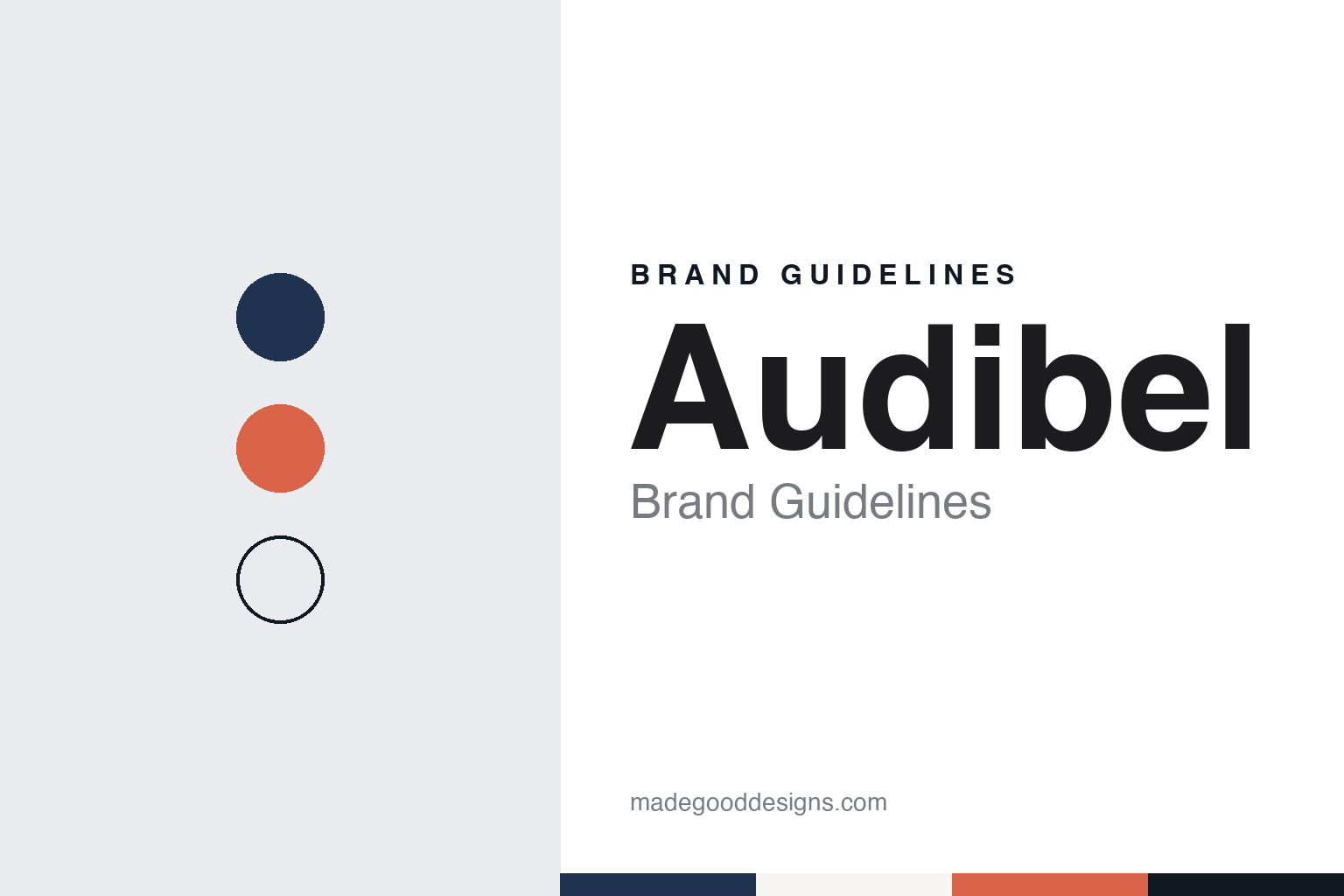
Audibel Brand Guidelines
Starkey’s hearing care network, founded in October 2000.
Aa
Two constants: a navy, white and coral palette and a friendly sans register. Abstract homage — not an Audibel product or mark; no hearing aid, logo or nameplate is reproduced.
A Meeting in 2000
A network that dates itself to one evening.
Audibel is a name on hearing aids and on clinic doors. It belongs to Starkey Hearing Technologies of Eden Prairie, Minnesota, and its own website calls it “the premier hearing centers network” of that company. The brand dates its start precisely. On 19 October 2000, according to an Audibel announcement carried by Hearing Health & Technology Matters and The Hearing Review in October 2020, “the first unofficial meeting was held, establishing the Audibel brand.” Over the next twenty years, the same announcement said, it grew from a fledgling organisation into a national network.
The timing sits inside a larger change in the American hearing aid trade. In 2000 the Danish group GN bought Beltone Electronics, an American maker that sold through its own family of dealers, Hearing Health & Technology Matters recorded in a January 2016 timeline by the audiologist Holly Hosford-Dunn. The same timeline, built from the accounts of industry insiders, describes a period it dates “2001-ish” that one insider called “The Revolt,” when large groups of Beltone dealers left to form joint-venture chains with other dispensers and manufacturers. It names two such chains: Audibel, with Starkey and its founder Bill Austin “at the helm,” and Avada, with William Demant Holding.
Starkey itself is older than its network. Audibel’s website traces the story to 1967, when Austin “found his niche skillfully crafting hearing aids” and built a reputation for custom hearing molds. HearingTracker, in an April 2025 review written by an audiologist, says he established Starkey in 1971 by buying Starkey Laboratories, a small earmold maker in Minneapolis, and that the company soon began making hearing aids. The two dates describe different starting points. HearingTracker counts Audibel among several Starkey-owned hearing aid brands, with NuEar and Microtech, and describes Starkey as privately owned.
Colour
Starkey inside, Audibel on the label.
Audibel does not run a separate factory. HearingTracker reported in April 2025 that Starkey private-labels its hearing aids for Audibel, and that most Audibel models share the technology of Starkey’s own ranges. The Vitality AI, introduced in the autumn of 2024, is based on Starkey’s Edge AI; the Intrigue AI uses the Genesis AI platform Starkey introduced in February 2023; and the Arc AI draws on Evolv AI, which Starkey introduced in August 2021. A fourth line, the Signature Series-Enhanced, covers small custom in-ear instruments without wireless links. The ranges come in receiver-in-canal, behind-the-ear and custom styles across several technology levels, and some Audibel offices, the review added, simply sell Starkey-branded products instead.
The newest range on Audibel’s website in November 2026 is Aris AI. A January 2026 article on the site, written by an executive of Starkey’s retail clinics, describes it as built on the company’s G3 Gen AI Neuro Processor and a directional system the company calls DNN 360, with Bluetooth Low Energy audio and compatibility with Auracast broadcasts; the home page now promotes the range as Aris AI+. A companion app, My Audibel, handles streaming, settings, a voice assistant and the step-counting and activity features the company lists. Its TeleHear service, HearingTracker reported, lets wearers video-call a provider and have their aids adjusted remotely.
The clinics are the other half of the brand. Audibel describes itself as a national network of hearing care professionals with more than 1,000 US locations, a figure it gave in 2020 and still gives on its website. HearingTracker counted more than 1,000 corporately and independently owned stores and over 3,700 professionals in 2025, and noted that Starkey and Audibel products appear in more than 70 differently named stores, among them U.S. Hearing Aid Centers and U.S. Hearing Solutions. The same review said Audibel offices can fit other makers’ aids when a customer asks, and that Starkey sells its hearing aids only through professional channels.
Typography
How hearing care presents itself.
Hearing-aid makers sell a product that is meant to be hard to see, and much of their imagery works around that. Devices are shown balanced on a fingertip to make their size clear, or in close-ups of the ear, where a behind-the-ear case and its thin tube or wire are the only visible trace. The Bern newspaper Der Bund noted in 2012 that hearing aids, unlike glasses, still had an image problem, and that makers were trying both to shrink them and to give them designed housings in a choice of colours.
Colour tends to follow the body rather than fashion. Many ranges come in skin tones, greys and silvers meant to blend with hair and skin, with brighter shells offered as options. Around the device sit the settings of professional care: the audiology booth, the fitting session and, more recently, the phone app used to stream sound or adjust a program.
The industry is concentrated and old. In 2007 Germany’s competition authority, the Bundeskartellamt, named Siemens, Phonak and Oticon as the main producers in the German market, with GN ReSound and Widex as the next-largest. Several of today’s brands began inside telephone and telegraph companies: Bernafon at a Swiss telephone maker in 1946, and GN Hearing’s forerunner Danavox in a Danish group that started with telegraph cables. Most are now part of a few groups that each run several brands side by side.
The trade meets at its own congresses. In Germany the annual EUHA congress of hearing-aid acousticians is where makers show new ranges to the trade; in the United States the American Academy of Audiology’s convention, long known as AudiologyNOW!, plays a similar role. This guide sets out what can be checked about each brand — who founded it, who owns it and where its products are made — and marks clearly what rests on the company’s own word.
Aa
A friendly sans — a clinic sign more than a tech logo. (Specimen set in Figtree, a sans STAND-IN; NOT the Audibel logo.)
Audibel
One maker, many storefronts.
Audibel marked its twentieth year in October 2020 with a virtual event. The speakers, as the announcement listed them, included Austin as Starkey’s owner and chairman, Brandon Sawalich as its president and chief executive, and Audibel’s managing director; Sawalich called the network “a success story founded on a promise and strengthened over time by mutual trust.” The brand’s present voice is warmer than technical. Its website runs under the line “The Joy of Hearing,” with the slogan “Hear Today. Happy Tomorrow.”.
Its awards page lists honours for the technology it shares with Starkey, from product awards for the Intrigue AI to a Good Design Award it lists for the Via Edge AI. HearingTracker noted in 2025 that some awards shown on the site had been won by Starkey rather than by Audibel specifically, a reminder that the two names share one engineering base. The network itself is a mix: some offices are owned by the company and others are independent practices that join it, and the site invites practice owners to join or sell.
For a design guide, Audibel shows how a manufacturer can give its technology a second, local-facing name, so that a clinic on a high street carries its own sign while the aids inside come from one factory. Compare Starkey, the parent brand, and GN Hearing, the group that bought Beltone in 2000. For this guide we use a prairie navy, a clinic white and a warm coral with a sans, an unofficial interpretation; no product or logo is reproduced.
Explore & save
Keep Audibel’s identity on hand — save it to a board in the Made Good inspiration library.
Audibel identity set
Pin the Audibel navy, white and coral palette and the friendly sans register to your own board.