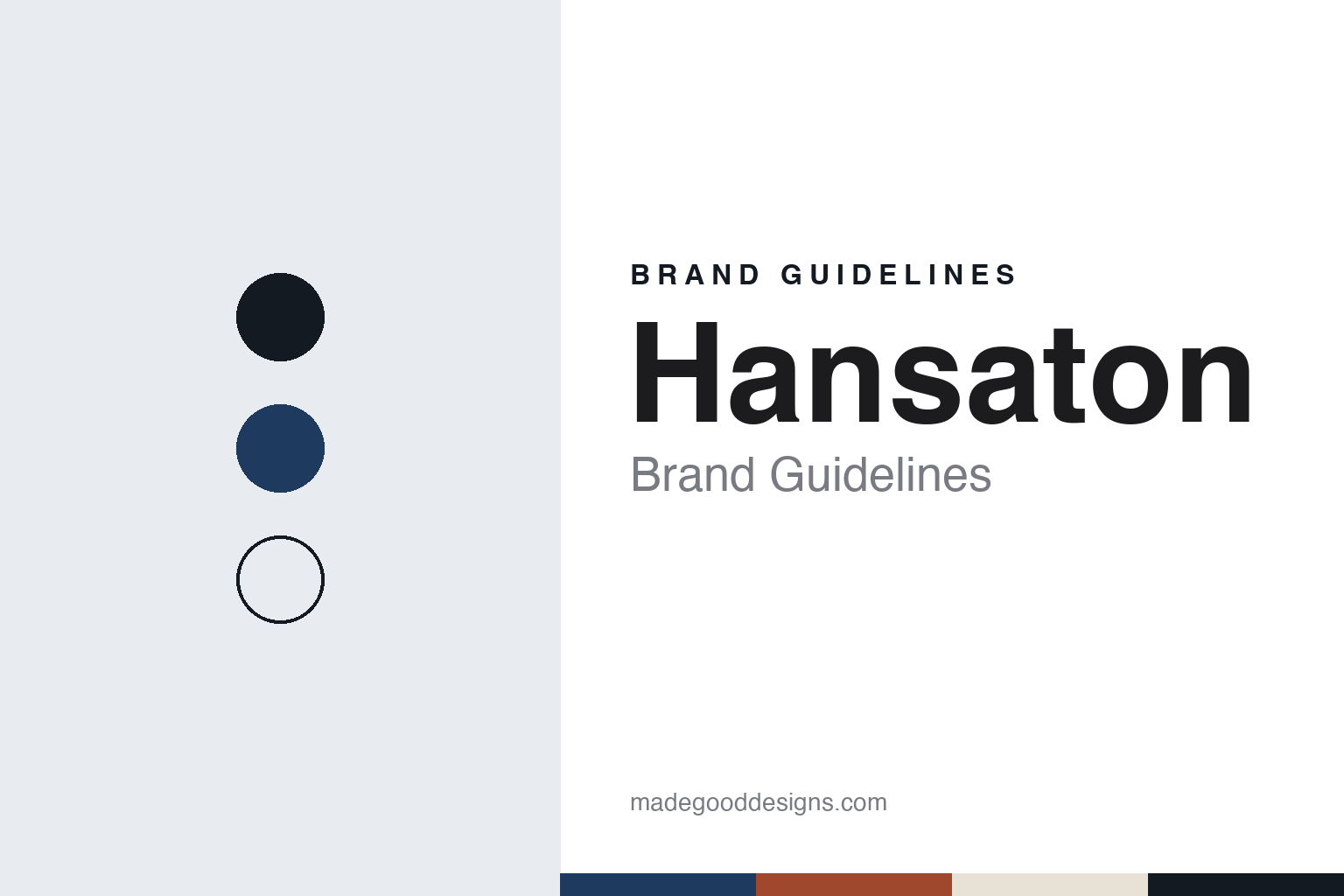
Hansaton Brand Guidelines
A Hamburg family firm from 1957, now with Sonova.
Aa
Two constants: a harbour blue, brick and sand palette and a Hanseatic serif register. Abstract homage — not a Hansaton product or mark; no hearing aid, logo or packaging is reproduced.
Hamburg, 1957
An importer that became a maker.
Hansaton was founded in 1957 by Rudolf G. E. Fischer, the company says, and began by bringing the hearing aids of an American manufacturer to the German market. Its home was Hamburg, and the brand now describes its background as a “German heritage.” The founding year is confirmed by Sonova’s 2015 announcement of the takeover and by The Hearing Review, which reported the deal in March 2015.
The move from importer to maker came with the next generation. A development department set up by Uwe Fischer, the company says, began designing Hansaton’s own hearing aids. A third generation followed: Andreas Fischer joined as operations manager after studying engineering, and Johannes Fischer later took charge of expanding the international sales network. When Sonova bought the firm, The Hearing Review described it as a family-owned hearing-aid maker and quoted Uwe Fischer as managing director.
The Hamburg business also put down roots in Austria. German Wikipedia says that in 1961 Hansaton opened its first hearing-aid shop in Innsbruck as a foreign branch of the Rudolf Fischer company of Hamburg. That Austrian business went its own way: it merged with the Siemens Reiniger works in Vienna in 1969, came under Siemens, was sold to its managers in 1993, was taken over by Phonak Holding in 2001 and has traded as Sonova Audiological Care Austria since January 2019. Along the way it bought the Vienna hearing-aid business Viennatone in 2004 and the Hungarian chain DeMax in 2011, German Wikipedia says.
Colour
Two hundred staff, then a sale to Sonova.
In March 2015 The Hearing Review reported that it employed about 200 people, with major centres in Germany, France and the United States and distribution in more than 70 countries, and that it developed and manufactured a wide range of hearing aids. The magazine added that Hansaton was “perhaps best known in North America” for its rechargeable hearing aid technology.
That reputation rested on a line called AQ. In a January 2012 article for The Hearing Review, written by audiologists and an engineer from Hansaton’s American arm in Plymouth, Minnesota, and from Hansaton in Germany, the company set out its case for bringing rechargeable hearing aids out of a niche, noting that in roughly 30 years they had not become the choice of most wearers. It dated the latest AQ Custom Rechargeable in-the-ear model to spring 2010 and the AQ X-Mini rechargeable receiver-in-canal model to July 2011, and showed the X-Mini in some of its eight colour options; the authors also pointed to the clean look of a custom shell with no battery door.
The same report called Hansaton one of the best-known hearing-aid makers outside the industry’s six largest groups. On 2 March 2015 Sonova, the Swiss parent of Phonak and Unitron, announced an agreement to buy all of the shares of Hansaton Akustik GmbH, and on 16 April 2015 it said the acquisition was complete after regulatory approvals.
Sonova presented the deal as part of a multi-brand strategy, adding Hansaton to its Phonak and Unitron hearing-aid brands, and said Hansaton would remain an independent wholesale company with its headquarters in Hamburg, with Sonova as its new technology partner. The first results came quickly: Sonova said Hansaton had already shown three new product families at the AudiologyNOW! congress in San Antonio, Texas, at the end of March 2015.
Typography
Design and documentation.
Hearing-aid makers sell a product that is meant to be hard to see, and much of their imagery works around that. Devices are shown balanced on a fingertip to make their size clear, or in close-ups of the ear, where a behind-the-ear case and its thin tube or wire are the only visible trace. The Bern newspaper Der Bund noted in 2012 that hearing aids, unlike glasses, still had an image problem, and that makers were trying both to shrink them and to give them designed housings in a choice of colours.
Colour tends to follow the body rather than fashion. Many ranges come in skin tones, greys and silvers meant to blend with hair and skin, with brighter shells offered as options. Around the device sit the settings of professional care: the audiology booth, the fitting session and, more recently, the phone app used to stream sound or adjust a program.
The industry is concentrated and old. In 2007 Germany’s competition authority, the Bundeskartellamt, named Siemens, Phonak and Oticon as the main producers in the German market, with GN ReSound and Widex as the next-largest. Several of today’s brands began inside telephone and telegraph companies: Bernafon at a Swiss telephone maker in 1946, and GN Hearing’s forerunner Danavox in a Danish group that started with telegraph cables. Most are now part of a few groups that each run several brands side by side.
The trade meets at its own congresses. In Germany the annual EUHA congress of hearing-aid acousticians is where makers show new ranges to the trade; in the United States the American Academy of Audiology’s convention, long known as AudiologyNOW!, plays a similar role. This guide sets out what can be checked about each brand — who founded it, who owns it and where its products are made — and marks clearly what rests on the company’s own word.
Aa
A calm, bookish serif for a family firm from a Hanseatic port. (Specimen set in Fraunces, a serif STAND-IN; NOT the Hansaton logo.)
Hansaton
Design with a purpose.
The independence did not last in full. Hansaton describes the 2015 deal as a strategic partnership with Sonova, entered into to strengthen the brand and support its growth ambitions, and says that by 2019 it was fully integrated, to draw on Sonova’s technology. Its website now carries a Sonova copyright line and says its hearing aids are sold in more than 60 countries on six continents.
Design is part of how the brand presents itself. Hansaton says it is driven by a “passion for people, design, and innovation,” and under the heading “Design with a purpose” it says that great design “pairs together remarkable beauty with outstanding functionality.” It also says it aims for hearing aids that clients can use easily and be proud of; its stated goal is that people can wear them comfortably “both physically and socially.” Those are the company’s own words.
The current range is sold as Hansaton Essenz. The website describes Essenz sound E-RX as rechargeable hearing aids with AI-based processing, offers rechargeable in-the-ear models with a snap-and-charge charger, and names a sound-processing system called HearIntelligence 6.0, alongside an app and accessories. Its technology page gives features their own short names, such as StereoBeam and Dynamic SpeechBeam, grouped under the heading Hansaton Fokus, and pairs them with everyday scenes: a party, a car ride, a conversation with grandchildren.
For a design guide, Hansaton shows how a family company can keep its own name and founding story after joining a much larger group. Compare Sonova, its owner since 2015, and Phonak, Sonova’s founding brand. For this guide we use harbour blue, brick and sand with a serif, an unofficial interpretation; no product or logo is reproduced.
Explore & save
Keep Hansaton’s identity on hand — save it to a board in the Made Good inspiration library.
Hansaton identity set
Pin the Hansaton harbour blue, brick and sand palette and the Hanseatic serif register to your own board.