OCP Group Brand Guidelines
Morocco’s phosphate office of 1920, from mine to fertiliser.
Aa
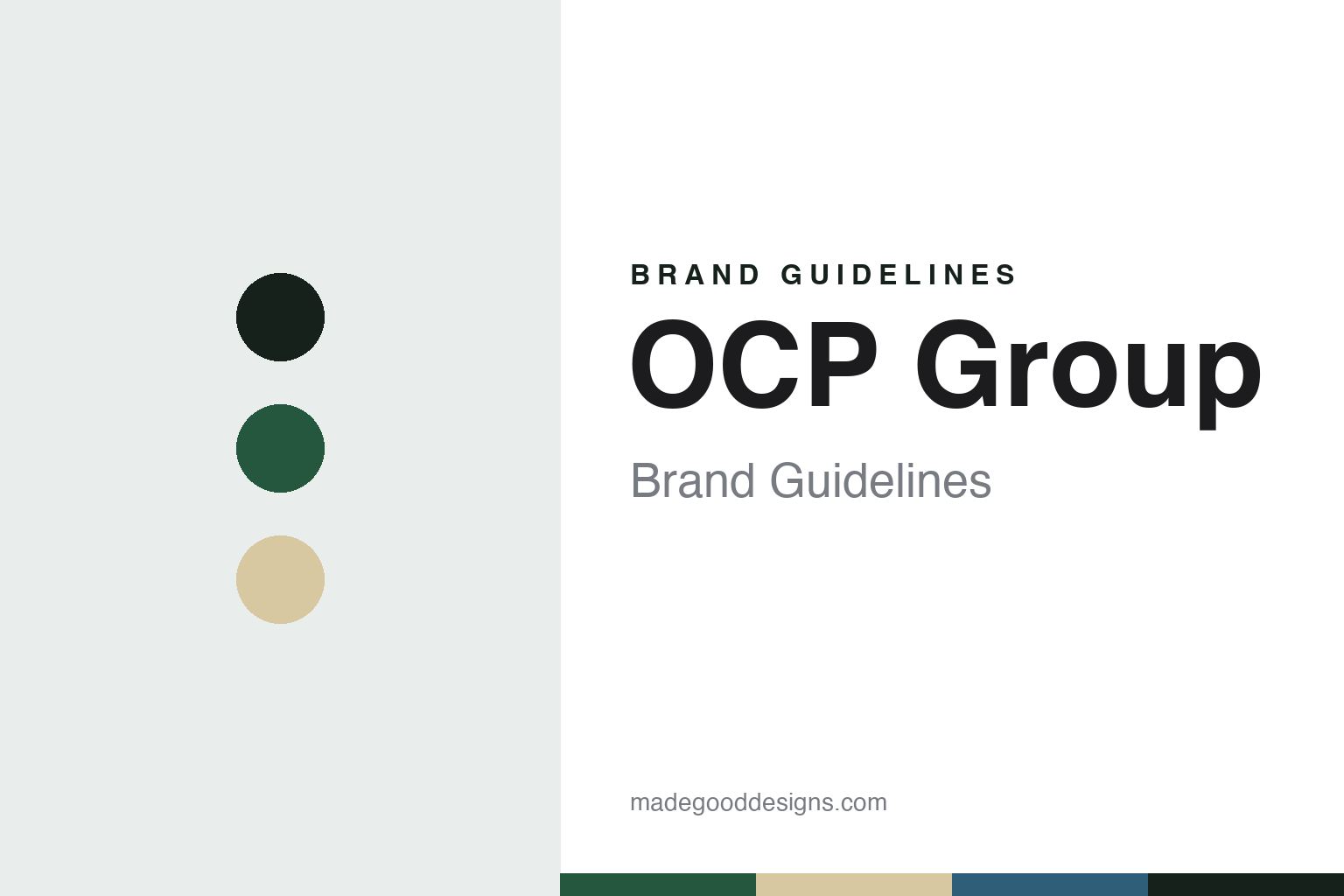
Two constants: an OCP Group green, sand and Atlantic blue palette and an Institutional serif register. Abstract homage — not an OCP Group product or mark; no sack, logo or label is reproduced.
Office Chérifien des Phosphates
A royal decree, a mine at Khouribga, a railway to Casablanca.
OCP Group began on 7 August 1920 as the Office Chérifien des Phosphates, created by royal decree in Morocco, which was then a French protectorate. It was a state body rather than a company with founders. French Wikipedia says the office began extracting and shipping phosphate on 1 March 1921 from its first mine at M’fassis, in the Khouribga basin; the rock went by rail to the port of Casablanca, and the first export left on 27 July 1921.
The colonial years are part of the record. English Wikipedia, citing the historian Susan Gilson Miller’s 2013 history of modern Morocco, says the office was created to mine the phosphates of Khouribga, linked to Casablanca by a direct rail line; that output rose from 39,000 tons in 1921 to almost two million tons in 1930; and that the Moroccan labourers in the mines had no social protections, were forbidden to unionise and earned a small fraction of what Europeans were paid. A second mining centre opened at Youssoufia in 1931. The protectorate ended in March 1956, and OCP has remained under the control of the Moroccan state.
Growth came in stages. French Wikipedia records output of five million tonnes in 1954, more than ten million in 1964 and more than twenty million in 1979, and the first open-pit mine in 1952. It adds that drying and calcination plants were built around Khouribga and Youssoufia between 1951 and 1961, and that in 1962 the office formed a team of engineers and technicians who travelled to follow how customers used the phosphate it shipped. In 1965 OCP moved from rock into chemistry: it set up Maroc Chimie at Safi to turn phosphate into derived products, and the first exports of those products began that year. Mining at Benguerir followed in 1980, and the Jorf Lasfar chemical complex on the Atlantic coast was built through the 1980s — English Wikipedia dates its start to 1984, while French Wikipedia says construction began in 1982, with acid units running from 1986 and fertiliser lines from 1987.
Colour
From rock to acid to tailored fertilisers.
OCP’s business runs along a single chain, from mine to fertiliser, both Wikipedias say. Its products start with phosphate rock and phosphoric acid and run to granular fertilisers such as MAP, DAP and TSP, along with what the group calls fortified fertilisers, the NP+ and NPK+ ranges, enriched with secondary nutrients and micronutrients. English Wikipedia says the Jorf Lasfar complex made more than 30 types of fertiliser in 2016, and that Safi, the first chemical site, also has a sulphuric acid plant and a phosphate washing unit.
Logistics are part of the story. Since 2014 a slurry pipeline has carried phosphate from Khouribga to Jorf Lasfar; French Wikipedia says the group announced it as the longest phosphate pipeline in the world. Rock from Benguerir goes to Safi by rail on ONCF, the national railway. The name changed with the structure: French Wikipedia says the office became “groupe OCP” in 1975, English Wikipedia’s timeline dates the switch to the OCP name to 2006, and both agree that in 2008 it became a limited company, OCP S.A.
Recent years added new branches. OCP formed the engineering joint venture JESA with Jacobs in 2011, created OCP Africa in February 2016 to develop its fertiliser business in African markets, and opened Mohammed VI Polytechnic University in 2017, English Wikipedia says. On 2 April 2024 the Moroccan business weekly Finances News Hebdo reported the launch of OCP Nutricrops, a subsidiary meant to move the group towards plant nutrition made to suit particular crops, climates and soils, quoting its chief executive, Soufiyane El Kassi. French Wikipedia adds that in March 2025 OCP Nutricrops announced plans for two new mining and industrial sites, at Mzinda and Meskala.
Typography
Design and documentation.
Fertiliser companies sell something most people never see up close: granules, prills and crystals that leave a mine or a chemical plant in bulk and end up spread across fields. Their visual language tries to bridge that distance. A familiar image is a handful of granules held in open palms, which turns a commodity into something a farmer can weigh and judge, and links the product to the people who use it.
The second register is the field. Corporate reports and websites in this sector lean on green crops, wide horizons and drone shots looking straight down on rows of maize, rice or vines. These images speak to growers and investors at once: they show the end use of the product, and they suggest scale without showing a single factory.
The third register is industrial. Open-pit mines, conveyor belts, evaporation ponds, acid plants and port terminals with ships at the quay appear alongside the fields, because extraction and logistics are the business. Packaging carries the brand into the farmyard: printed sacks and big bags, often with a crop icon, a nutrient formula and a product-range name on the front. Trade events such as the International Fertilizer Association’s Annual Conference add another stage, with stands, lanyards and presentation decks.
This guide sets out what can be checked about each company — when and where it was founded, who owns it, where it mines and makes its products, and how its name has changed — and marks clearly what rests only on the company’s own word. The palettes and typefaces shown here are our own unofficial interpretations, not official brand assets.
Aa
An institutional serif for a state office founded in 1920. (Specimen set in Source Serif 4, a serif STAND-IN; NOT the OCP Group logo.)
OCP Group
A state group with a disputed southern mine.
Ownership is plain. English Wikipedia says the Moroccan state holds about 95 percent of OCP and Banque Centrale Populaire about 5 percent; the group is based in Casablanca, with Mostafa Terrab as chairman. French Wikipedia notes that phosphates and their derivatives made up nearly a quarter of Morocco’s exports in 2010, and English Wikipedia describes OCP as the world’s largest producer of phosphate and phosphate-based products.
One part of the business is disputed. In 1976, after the Madrid Accords with Spain, OCP took 65 percent of Phosboucraa, the Bou Craa phosphate mine in Western Sahara, and it became the sole owner in 2002. English Wikipedia notes that because Western Sahara is a non-self-governing territory, the legality of mining there is contested under international law, and that several investment funds have divested from buyers of its phosphate. It also reports the company’s statement that profits made in the region are reinvested locally through the Phosboucraa Foundation, and that local activists dispute the company’s figures on local hiring. The mine holds about 2 percent of Morocco’s phosphate reserves, English Wikipedia says.
For a design guide, OCP Group shows how a state phosphate office of 1920 grew into an integrated group, from mine and pipeline to port-side fertiliser plants. Compare Mosaic, another large phosphate producer, and Ma’aden, which mines phosphate in Saudi Arabia. For this guide we use a deep green, a sand tone and an Atlantic blue with a serif, an unofficial interpretation; no product or logo is reproduced.
Explore & save
Keep OCP Group’s identity on hand — save it to a board in the Made Good inspiration library.
OCP Group identity set
Pin the OCP Group green, sand and Atlantic blue palette and the Institutional serif register to your own board.