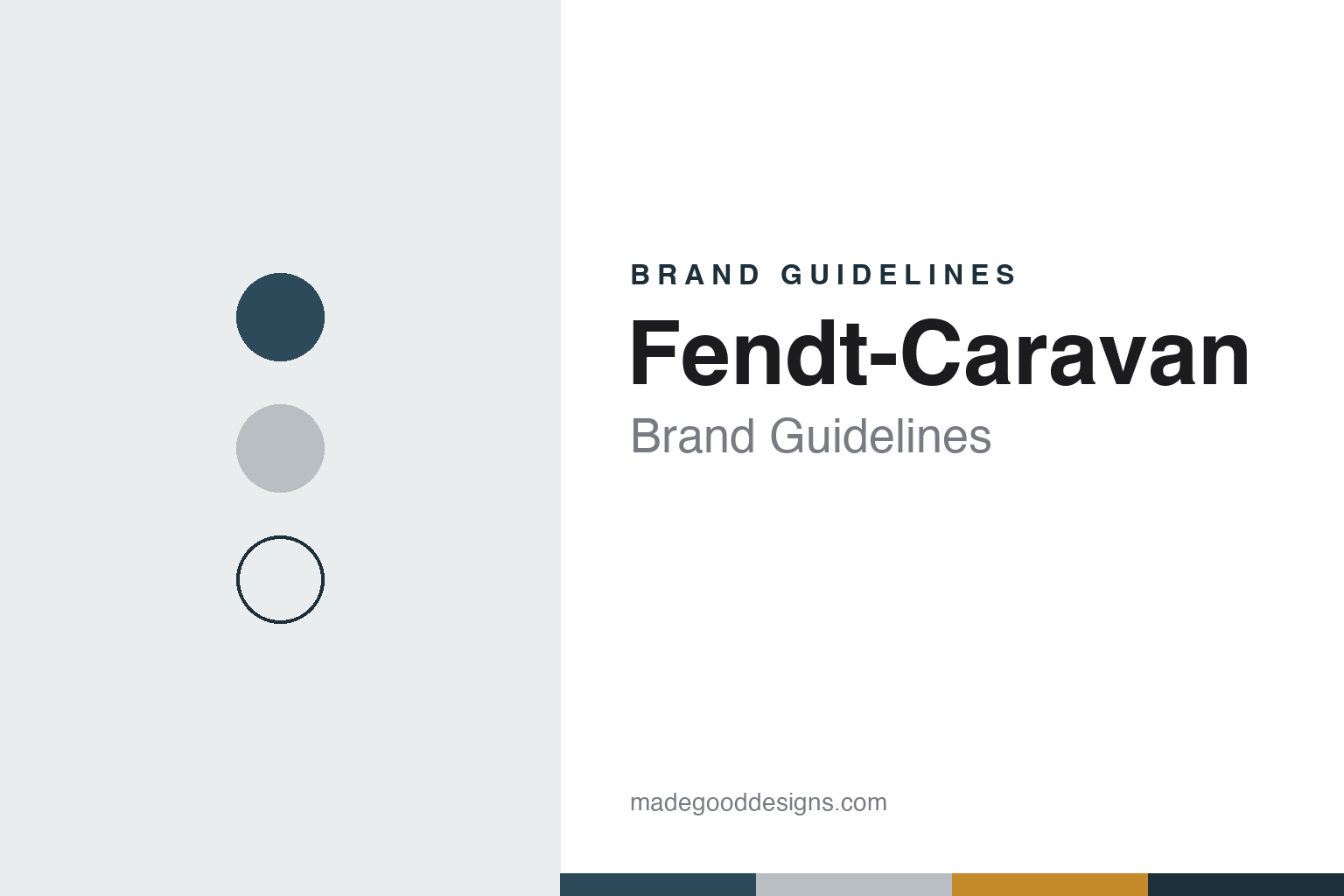
Fendt-Caravan Brand Guidelines
The Bavarian caravan maker that kept the Fendt name when the tractors went elsewhere.
Aa
Two constants: a dusk slate and hammered aluminium palette and a plain semi-condensed sans register. Abstract homage — not a Fendt-Caravan product or mark; no caravan, logo or badge is reproduced.
A Works at Bäumenheim
A caravan line that came with a farm-machinery factory.
Fendt-Caravan is not the tractor company. It builds caravans at Mertingen, north of Augsburg in Bavaria, and belongs to Hobby, the caravan maker of Fockbek in Schleswig-Holstein. The Fendt tractors of Marktoberdorf belong to the American group AGCO. The two share a name because they were once one family business, and AUTO ZEITUNG dates the parting of the ways to 1997.
The caravans came with a factory. On 1 September 1970, German Wikipedia says, the Fendt brothers took over Lely-Dechentreiter, a farm-machinery factory at Asbach-Bäumenheim, and carried on the caravan building already under way there. Wikibooks’ tractor encyclopedia traces the works to the workshop Josef Dechentreiter took over in 1896 and describes threshing machines as its main trade; the Dutch maker Lely bought most of the shares in 1963, and caravans were started under Lely to keep the plant busy. Fendt-Caravan says years of patent litigation involving the owner had left the firm in trouble, and that the takeover saved about 1,000 jobs. Its own timeline starts in 1970.
The site has a darker earlier history. In the summer of 1944 a subcamp of the Dachau concentration camp was set up on the Dechentreiter grounds. More than 500 prisoners were forced to make wing parts for the Messerschmitt Me 262 jet in twelve-hour shifts, according to the local history society, the Heimatfreunde Asbach-Bäumenheim, and German Wikipedia, which says the floor space was requisitioned. Prisoners died there of exhaustion, malnutrition and disease, and others in an Allied air raid on 19 March 1945; the camp was cleared in April 1945. The society records that a memorial threshold was laid in the village on 25 June 2022.
Colour
From the “Nasenbär” to the Diamant.
In 1975 came the Große Fahrt, or “grand tour,” an alcove model the company says was also called the “Nasenbär,” the German word for a coati. The company’s timeline adds a 1982 change it calls a first among series makers, moving the gas cylinder box into the front of the caravan, and the addition of motorhomes in 1988 with the 560 KH alcove model.
Several model names drew on stones and metals. When ownership changed in 1998, the company says, Karat became Saphir and Joker became Platin; the Topas followed in 2002, the Diamant VIP in 2004 and the Opal in 2012. The Bianco line arrived in 2007 and the Tendenza in 2010. AUTO ZEITUNG, in a brand profile published in November 2025, lists four current ranges, the entry-level Apero, the family Bianco, the Tendenza and the top Diamant, with more than 30 floor plans between them, plus a lighter sub-brand, Next, added in February 2025.
Motorhomes came and went. The range was dropped in 1998, and the company says it returned in 2006 with semi-integrated models built by Giottiline in Italy. From 2008 they were built at Hobby in Fockbek, and AUTO ZEITUNG says they stayed in the range until the middle of the 2010s. The magazine now describes Fendt-Caravan as a maker of caravans only.
Construction is part of how the brand is described. German Wikipedia says Fendt-Caravan builds with a timber frame and hammered aluminium sheet, with glass-fibre front and rear sections, and that most other makers had moved to timber-free bodies with glass-fibre skins from the 2010s. It also says the company places all its models in the upper price segment.
The company’s own list of honours is long and mostly drawn from the trade: repeated places in the “Caravans of the Year” readers’ vote of the magazine Caravaning, the “König Kunde” award of Camping, Cars & Caravans, and the European Innovation Award in 2016 and 2021. It also lists a German Brand Award in 2020 for what it calls the vitalisation of a traditional brand.
Typography
Design and documentation.
Motorhome makers tend to sell a picture before they sell a vehicle: a white van on a pitch by the sea, doors open, with the road implied behind it. The colour itself has a history in the category. Chausson says it was the first maker to “dare” white bodywork, on its 1984 overcabs.
The second image is more technical. Layout is what buyers compare, so makers lean on plans, cut-away views and model numbers that stand for a floor plan. Chausson’s 2027 catalogue, for instance, explains a lounge feature by listing the numbered models that have it, and Rapido’s vans run from V55 to V68. Rapido’s website offers a comparison tool and 360-degree views of its models, and Chausson’s invites buyers to compare its ranges by the way they want to travel.
The third setting is the dealer forecourt. Chausson says it reaches more than 15 European countries through specialist distributors, and Trigano, its parent, created the Libertium dealership network in 2023 and says it has 70 sales outlets. Rapido’s history shows how early this mattered: Le Journal des Entreprises counts ten dealers in the brand’s first years of rigid caravans.
The category’s annual stage is the Caravan Salon in Düsseldorf. The fair calls itself the world’s leading trade fair for mobile travel, and reports 259,000 visitors in 2026, with 834 exhibitors from 41 countries in 15 halls and on the outdoor grounds. It says those visitors covered more than 250,000 square metres of motorhomes, caravans, roof-top tents and equipment, which puts whole vehicles, not just pictures of them, in front of the public. The next edition runs from 27 August to 5 September 2027.
Aa
A plain, slightly narrow sans. (Specimen set in Barlow Semi Condensed, a sans STAND-IN; NOT the Fendt-Caravan logo.)
Fendt-Caravan
A Hobby company on its own Bavarian site.
The break came in two steps. AGCO bought the Fendt group in 1997, and on 1 January 1998 the caravan business became a wholly owned subsidiary of Hobby-Wohnwagenwerk, German Wikipedia says. Fendt-Caravan’s own account credits Harald Striewski, Hobby’s founder, with the takeover.
The move to Mertingen followed. The company dates the ground-breaking to 15 October 1999, the move to 23 July 2001 and the start of production in the new factory to 27 August 2001. It gives the 100,000th caravan as 21 November 2001, the 200,000th as 2015 and the 250,000th as 2019, and it added a third production line in 2018. German Wikipedia notes that the site reaches into the neighbouring municipality of Asbach-Bäumenheim. The company names ISO 9001:2015 and ISO 14001:2015 certification for its business.
The holding structure changed in 2021. A release dated 27 August 2021 says the family’s shares in the group were being placed into two new foundations, a family foundation and a charitable one, so that Hobby and Fendt-Caravan would stay independent. It says the operating companies would be unaffected and describes the group as the market leader in newly registered caravans in Germany and Europe; that is the group’s own statement.
For a design guide, Fendt-Caravan shows how a name can stay in use after the company behind it divides: the word Fendt now sits on tractors from one group and on caravans from another. Compare Hobby, its parent, and Tabbert, another long-running German caravan name. For this guide we use a dusk slate and a hammered aluminium grey with a sans, an unofficial interpretation; no product or logo is reproduced.
Explore & save
Keep Fendt-Caravan’s identity on hand — save it to a board in the Made Good inspiration library.
Fendt-Caravan identity set
Pin the Fendt-Caravan dusk slate and hammered aluminium palette and the plain semi-condensed sans register to your own board.