MCR Safety Brand Guidelines
Gloves, glasses and garments from a Memphis glove importer of 1974.
Aa
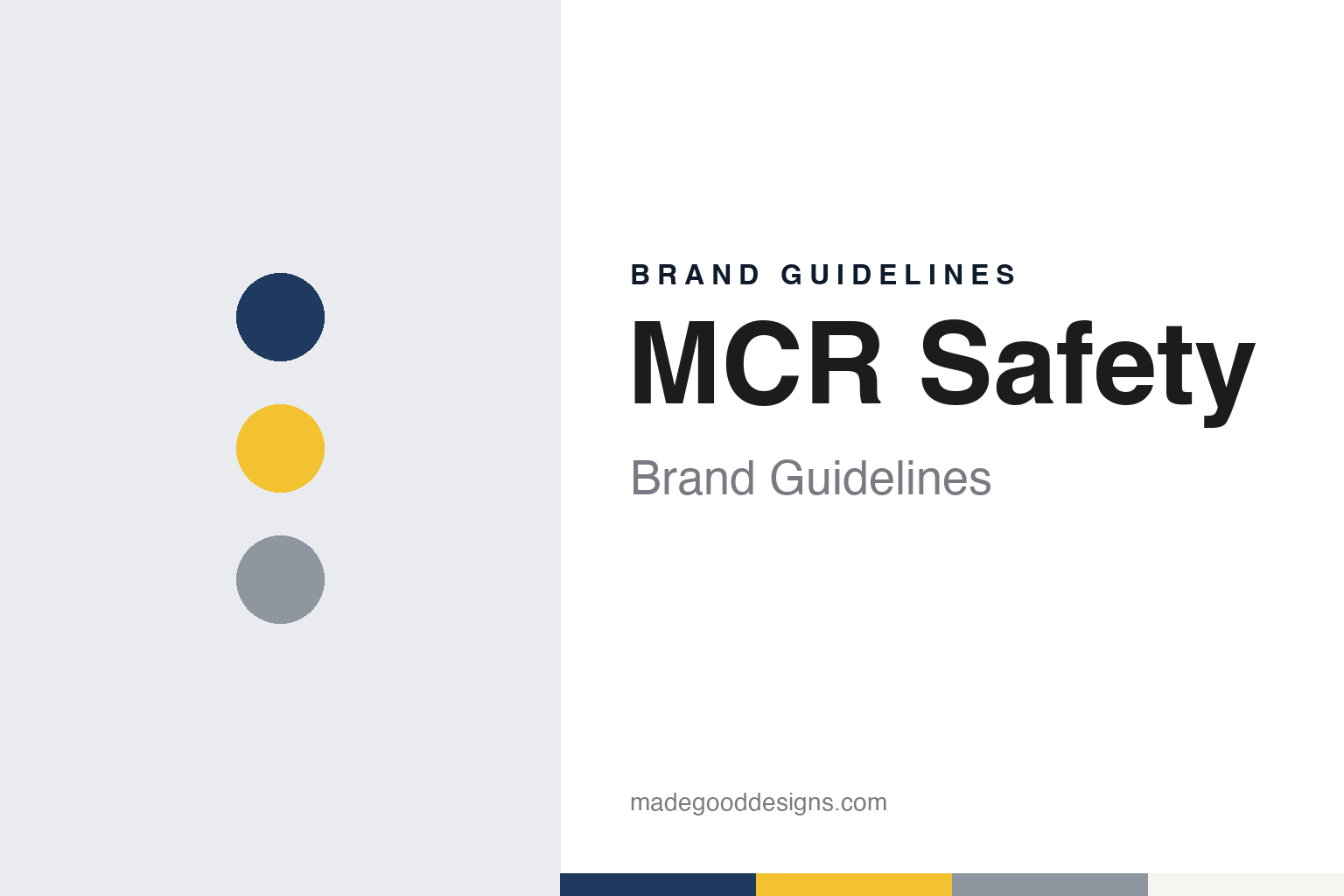
Two constants: a navy, yellow and grey palette and a condensed sans register. Abstract homage — not an MCR Safety product or mark; no glove, mascot or logo is reproduced.
Memphis Glove
A glove importer, two more companies and one name.
MCR Safety traces its roots to 1974, when Hilliard Crews founded the Memphis Glove Company as an importer of industrial gloves, according to his profile at the Society of Entrepreneurs, a Memphis business group that inducted him in 2007. After several years of that business, the profile says, he co-founded two more companies with his brothers: Crews Safety Glasses and a clothing business the profile calls River City Rainwear and the company today calls River City Garments. In 1984, it adds, he formed Shelby Specialty Gloves to concentrate on gloves for firefighters.
The businesses were held together by a holding company, Shelby Group International. The same profile says the group came to run factories in Arkansas, Mexico and China, with distribution centres in Piperton, Tennessee, and in California, and that it was named three times on Inc. magazine’s list of the fastest-growing privately owned companies in the United States. In 1983 Crews received an Executive of the Year award sponsored by the Memphis Business Journal and the University of Memphis, the profile says; it now lists him as the group’s retired chairman.
The MCR Safety name came later. The company’s own account says MCR Safety “originated by merging three leading industrial PPE companies in 2004”: Memphis Gloves, Crews Glasses and River City Garments, which it describes as all committed to hard-working safety gear and good service. A company blog post of February 2026 tells the same story in looser terms, saying the business began “supplying quality work gloves” and later grew into glasses, protective garments and respiratory equipment.
The company still describes itself through that early structure. It says it has “more than 50 years” behind it, and that it has led for that time “in gloves, glasses and garments” — the same three trades its founding companies covered.
Colour
More than 5,000 products and a guardian called Max.
MCR Safety says its range now runs to more than 5,000 products: work gloves, safety glasses and goggles, face shields, protective clothing, welding gear, chemical-protection items and flame-resistant clothing. Its premium lines carry names of their own, among them ARX, NXG and Hypermax, and its catalogue names materials from outside suppliers, including D3O, Dyneema and Kevlar.
On where its products are made, the company makes two claims. It says that “MCR Safety manufactures PPE directly in North America,” and, further down the same page, that it directly produces “most of the PPE supplied,” drawing on other sources of supply for the rest. When the British distribution group Bunzl announced its purchase in August 2020, it described MCR Safety as distributing “largely own brand” protective equipment — principally gloves, eye protection and workwear — from a main US facility in Memphis and another in Arkansas, with operations in Mexico, Canada, the UK, the Netherlands, Colombia and Costa Rica. The company also says its product-testing laboratory is accredited to the ISO/IEC 17025 standard.
The identity is built around a mascot. The company calls its logo icon Max, “the ultimate protector,” a guardian it says is “always on guard,” and ties him to its slogan, “We Protect People.” It explains the character through three roles: manufacturer, advocate for safety and “Xperts in the Field,” spelling the last with an X. Its leadership, the company says, works with industry bodies including the ISEA, the National Safety Council and the American Society of Safety Professionals on guidelines and standards.
The company sets out its strategy in three words, “Integrity, Credibility, Accountability,” and lists four guiding principles: branding, engagement, innovation and sustainability. The first of these is to “establish a recognized brand image across our portfolio of personal protection,” and its goal, it says, is “exceptional loyalty” from customers, employees and suppliers alike.
Typography
Work gear and its documentation.
Personal protective equipment is sold on sight as much as on specification, and the makers in this guide present themselves in a shared visual language. The strongest signal is colour: fluorescent yellow and orange, the tones of high-visibility vests, jackets and rainwear, appear across catalogues, packaging and trade-show stands, usually set against a dark navy, charcoal or black.
Photography does much of the work. Catalogues and websites show safety glasses, earmuffs and hard hats on workers rather than on a white background alone: a welder behind a visor, a road crew in reflective stripes, a warehouse picker in cut-resistant gloves. Construction sites, factory floors and utility work are the usual settings, and many makers add a second, outdoor register for shooters, hunters and anglers, with camouflage, sunglasses styling and range photography.
Product pages lean on order. Gloves are shown in grids by coating, cuff and size; glasses in rows by lens tint; earplugs and earmuffs by type. Standards and ratings are printed as part of the design, in badges and code numbers, and ranges are often organised by the hazard or the trade they are sold for rather than by style alone.
The trade meets at fairs. A+A in Düsseldorf, the international trade fair for safety and health at work, gathers makers and distributors from around the world, and in the United States the National Safety Council’s Safety Congress & Expo serves a similar role. Many makers also sell through distributor networks and buying groups, so brochures, counter displays and sell sheets carry as much of the identity as the logo itself. This guide sets out what can be checked about each brand — who founded it, who owns it and where it is based — and attributes claims to the company where they rest on its own word.
Aa
A condensed sans for a work-gear brand. (Specimen set in Barlow Condensed, a sans STAND-IN; NOT the MCR Safety logo.)
MCR Safety
From a Memphis holding company to a six-brand group.
In August 2020 MCR Safety changed hands. On 24 August that year Bunzl plc, the London-listed distribution group, announced that it had agreed to acquire MCR Safety, “based in Memphis, Tennessee,” and expected to complete the deal at the end of the month. Its chief executive, Frank van Zanten, called MCR “a high quality business with a strong leadership team and well established portfolio of own brand products.” The Society of Entrepreneurs profile of Hilliard Crews says the Shelby Group was acquired by Bunzl in 2020.
In 2026 the company reorganised its brands. A company blog post of 27 February 2026 announced MCR Safety Group, bringing six brands together: MCR Safety, Tingley, Cordova Safety and Shelby, with ALTA and GISA. MCR Safety, which concentrates on eye, hand and arm protection, is described as the group’s flagship. Tingley, the rubber-footwear and rainwear maker the company dates to 1896 and to its founder Charles O. Tingley, will keep operating under its own name, BIC Magazine reported on 31 March 2026. The same blog post describes ALTA as a maker of knee and elbow pads founded in 1978, Cordova Safety Products as founded in 1994, and GISA, or Guantes Internacionales, as a glove maker with a long record in Mexico’s industrial market.
The group’s website now gives its home as Collierville, Tennessee, and runs separate pages for MCR Safety’s operations in Brazil, Europe and Mexico.
For a design guide, MCR Safety shows how a company assembled from three businesses can carry one name and one mascot across a growing family of brands. Compare Superior Glove, another glove maker, and Ansell. For this guide we use a deep navy, a safety yellow and a steel grey with a condensed sans, an unofficial interpretation; no product or logo is reproduced.
Explore & save
Keep MCR Safety’s identity on hand — save it to a board in the Made Good inspiration library.
MCR Safety identity set
Pin the MCR Safety navy, yellow and grey palette and the condensed sans register to your own board.