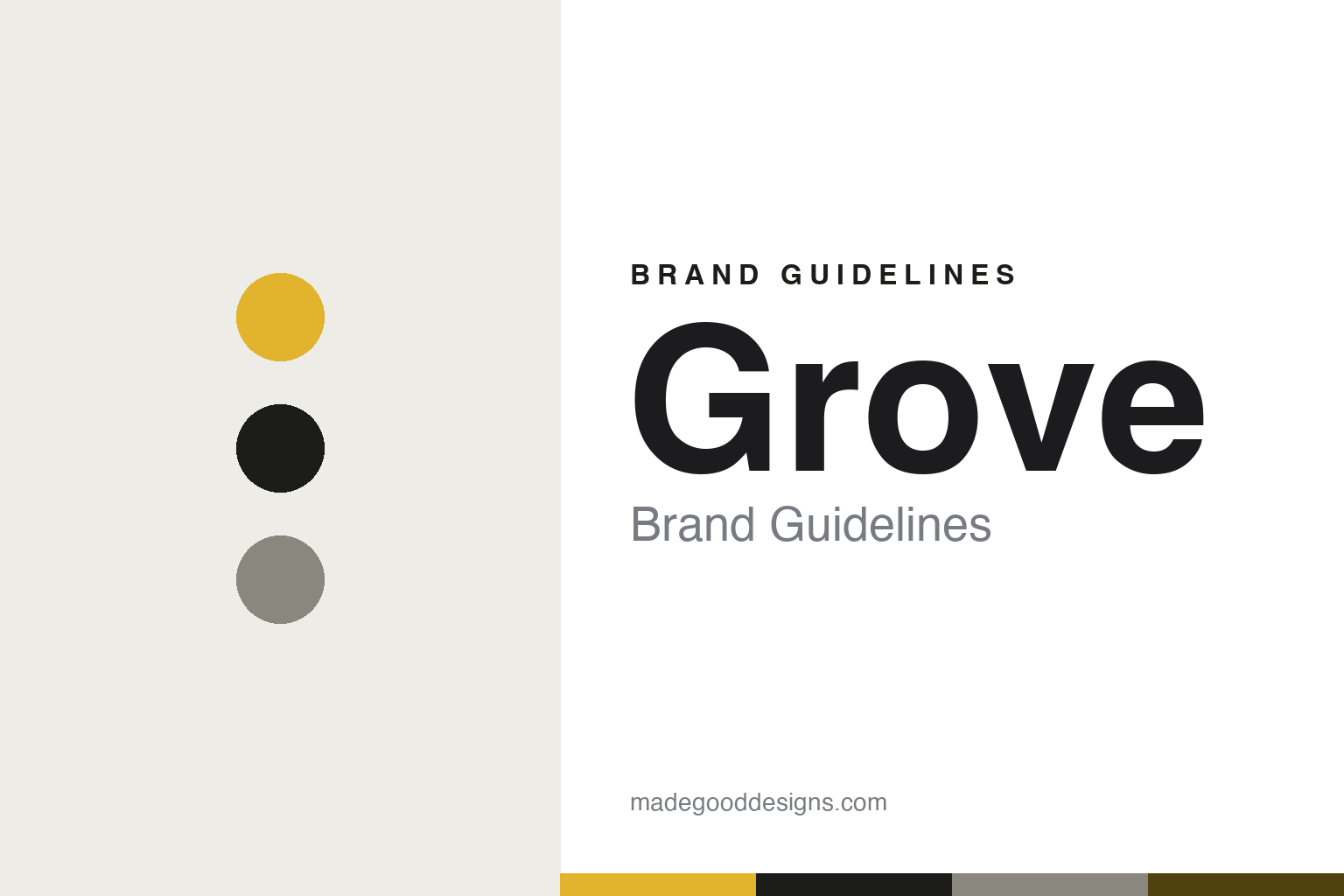
Grove Brand Guidelines
A 1947 Shady Grove farm-wagon garage turned mobile crane maker.
Aa
Two constants: a yellow, charcoal and grey palette and a condensed sans register. Abstract homage — not a Grove product or mark; no crane, logo or nameplate is reproduced.
Shady Grove
Farm wagons, a garage and a crane built for the works.
Grove began in 1947 in a garage in Shady Grove, Pennsylvania. Rental Equipment Register reported in April 2022, as the brand marked its 75th anniversary, that the brothers John and Dwight Grove and Wayne Nicarry were building farm wagons when they decided they needed a faster way to move raw materials around their own works. John Grove designed a simple rubber-tyred crane, and that machine became the first Grove mobile crane.
The crane turned the business around. Over time, Rental Equipment Register wrote, Grove moved from farm equipment to cranes, and it credited Grove with making the first mobile hydraulic industrial cranes. A Dutch crane-history site says customers took an interest in the small crane built for the factory, that the company had more than 1,000 employees by 1967, and that it was sold that year to the Walter Kidde company.
The founding name did not stay with only one company. John L. Grove went on to found a second business: in 1969, English Wikipedia says, he and two partners bought a small metal fabrication firm in McConnellsburg, Pennsylvania, and in 1970 they sold the first JLG aerial work platform. That company makes access equipment rather than cranes and has a separate history from Grove’s.
Colour
A German factory and a yellow livery.
Grove crossed the Atlantic in 1995, when it took over the mobile crane business of the German group Krupp, with its factory at Wilhelmshaven, Cranes Today reported in June 2000. Krupp’s all-terrain cranes carried on under the GMK designation; the 250-tonne GMK 6250 of 1998 was the first GMK model after the takeover, the magazine said. By 2000 the company traded as Grove Worldwide, Shady Grove was assembling GMK cranes from kits shipped from Wilhelmshaven, and engineers on both sides were working on new booms.
The magazine described a company tidying itself up. Jeff Bust, chief executive from June 1998, said Grove had cut its rough-terrain cab designs from twelve or thirteen to one. Booms designed in Shady Grove were going onto the new RT 700 series of large rough-terrain cranes, newer GMK models used a U-shaped MegaForm boom and a Twin-Lock pinning system, and production of the two-axle all-terrain cranes had been handed to GRC in Italy, which had built the small Krupp cranes. Grove also had a site at Cergy-Pontoise, outside Paris, where it held an open day for 300 French customers that year.
The same report described a change of look. Around 2000 Grove introduced a new bright yellow colour scheme and logo. European buyers who had been wary of the brand told the magazine they were now considering its all-terrain cranes, and the owner of one of the largest fleets in France said he took the new look as a sign that the company cared about its product and its image. The company line, the magazine wrote, was that the new look stood for a genuine revival. The 100-tonne GMK 5100 was the first GMK crane delivered in the new colours.
Today the company says Grove builds rough-terrain, all-terrain, truck-mounted, industrial and military cranes, as well as the GHC series of telescoping crawler cranes, and that its all-terrain cranes are made at the Wilhelmshaven factory. Its rough-terrain cranes run from 30 to 150 tonnes of rated capacity.
Typography
How crane makers present themselves.
Crane makers present very large machines largely through pictures. Their catalogues and websites lean on a small set of pictures: a tower crane standing over an unfinished skyline, a mobile crane with its telescopic boom fully extended, a crawler crane lifting a turbine section on a wind farm, or a loader crane folded neatly behind a truck cab. The machine itself becomes the logo at a distance, so the paint matters as much as the nameplate.
That is why colour does so much work in this category. Booms and jibs are painted in strong, flat tones, often yellow, red or white, with the maker’s name lettered large along the steel so it can be read from the street. Some makers go as far as naming their colours and applying them across a whole fleet, so that a crane on a distant site can be placed before its lettering can be read.
Closer in, the presentation shifts to the operator. Cab interiors, joysticks, load-moment displays and remote controls appear in brochures alongside outrigger layouts and load charts, with lettering that has to work on a decal, in a manual and on a small screen.
Trade fairs are the other stage. bauma in Munich, ConExpo-Con/Agg in Las Vegas, bauma CONEXPO INDIA and national shows in China and Japan are where new cranes are unveiled, often fully rigged on outdoor stands, and where companies announce acquisitions and new models. This guide sets out what can be checked about each maker — who founded it, who owns it and where its cranes are built — and marks clearly what rests only on the company’s own word.
Aa
A condensed sans — a yellow boom, a short name. (Specimen set in Barlow Condensed, a sans STAND-IN; NOT the Grove logo.)
Grove
From Grove Worldwide to a Manitowoc brand.
The early 2000s brought a new owner. The International Directory of Company Histories says Grove had just emerged from bankruptcy when Manitowoc bought it in August 2002. The two companies had signed a merger agreement on 18 March 2002. On 31 July 2002 the US Department of Justice sued to block the deal, because Grove, through its National Crane subsidiary in Waverly, Nebraska, and Manitowoc were two of the three main makers of medium- and heavy-lift boom trucks in North America. The department’s announcement described Grove, still based in Shady Grove, as a producer of all types of mobile cranes, including hydraulic truck-mounted, all-terrain and rough-terrain cranes, with National Crane building boom trucks in its own Nebraska factory. On the same day it filed a proposed consent decree requiring Manitowoc to sell either its own or Grove’s boom-truck business. Manitowoc sold its own boom-truck unit, which went to Quantum Heavy Equipment in early 2003, the same reference says.
Inside Manitowoc, Grove sits beside the French tower crane brand Potain, bought a year earlier. Potain’s chief executive, Jean-Yves Bouffault, told Cranes Today in 2004 that “Grove is every bit a German company,” while Potain was every bit a French one. In 2022 the brand marked its 75th anniversary with a tribute at the Bauma trade fair in Munich, Rental Equipment Register reported.
For a design guide, Grove shows how a colour change can be used to announce a turnaround. Compare Manitowoc, the group that owns it, and Tadano, another maker of mobile cranes. For this guide we use a strong yellow, a charcoal and a warm grey with a condensed sans, an unofficial interpretation; no product or logo is reproduced.
Explore & save
Keep Grove’s identity on hand — save it to a board in the Made Good inspiration library.
Grove identity set
Pin the Grove yellow, charcoal and grey palette and the condensed sans register to your own board.