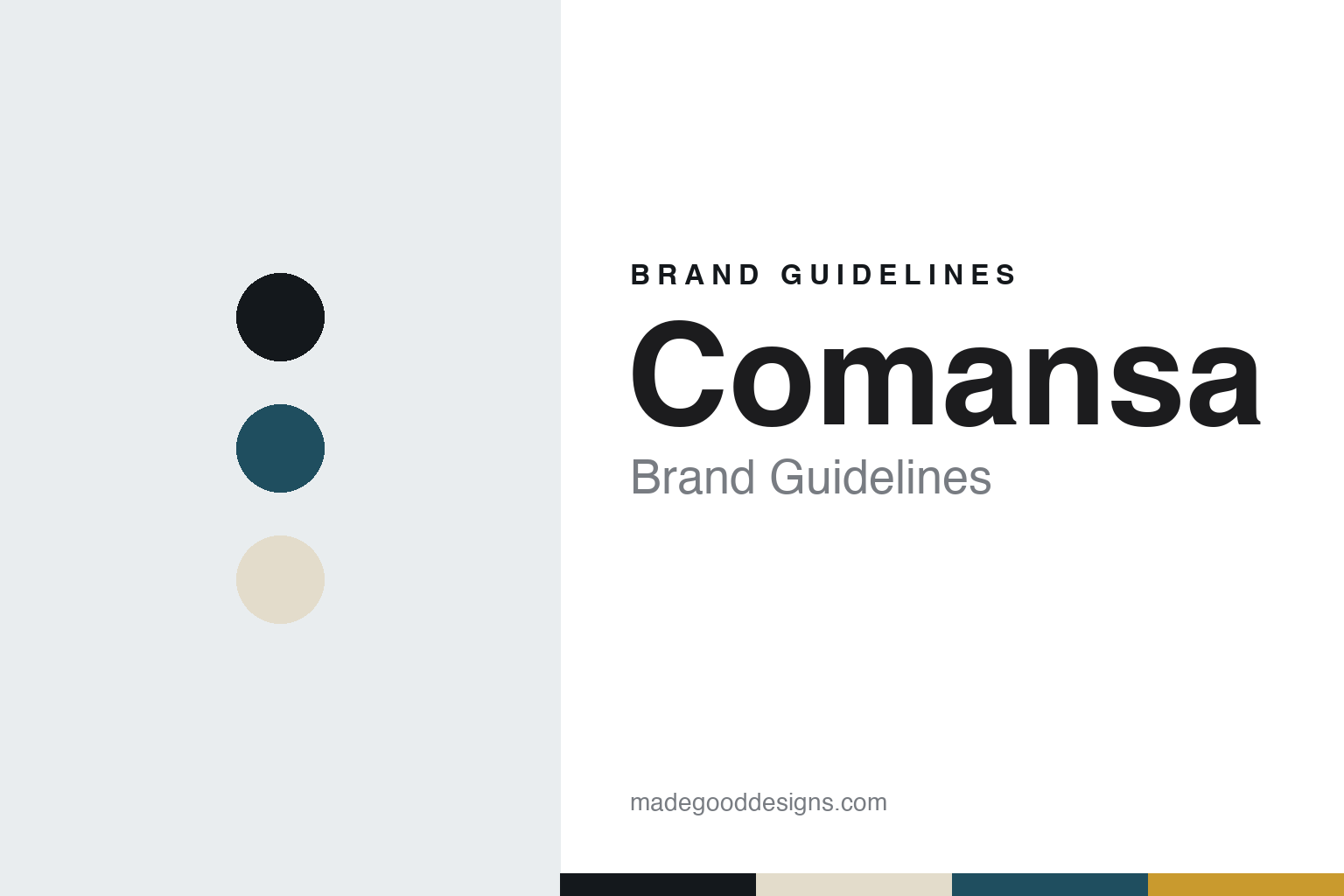
Comansa Brand Guidelines
A Navarre tower-crane maker that built its range on the flat-top.
Aa
Two constants: a teal, black and ochre palette and an engineering grotesque register. Abstract homage — not a Comansa product or mark; no crane, logo or nameplate is reproduced.
IMAUSA
Construction tools, then a licensed tower crane.
Comansa comes from Huarte, in Navarre, in northern Spain. The company says it began in 1962 as IMAUSA, a maker of construction tools, and at its 60th-anniversary event in 2022 it described its founders as a group of friends from Navarre who set out together into industry. Its headquarters have been in Huarte ever since, the company says.
Tower cranes came four years later. According to the company’s own timeline, it built its first tower crane in 1966 under a licence from Soteco, put the Comansa name on a crane for the first time in 1968, and in 1975 took the name Construcciones Metálicas Comansa S.A..
The turning point in its own account came in 1983, when Comansa acquired the rights to the Linden 8000 system and began applying it across its range. Linden was a Swedish design: in April 2013 the Spanish trade publication Interempresas described a Swedish Linden 8000-series crane at the Paducah-McCracken County riverport in Kentucky as the first flat-top crane in the United States, from the 1970s. Comansa says its flat-top cranes have no pendant lines, which it says makes them easier to assemble and suits projects that use several cranes at once.
Comansa says the Linden design was “revolutionary in the 1970s” and that it was a forerunner of the modular flat-top crane, a concept it says the rest of the industry later adopted. For many years the cranes were sold under the name Linden Comansa; that is how KHL and Interempresas named the maker in their reports from 2011 and 2013.
Colour
Flat-tops, luffers and the Cube cab.
The range is built from interchangeable parts. In July 2011 KHL reported that Linden Comansa had renewed its whole line of luffing-jib cranes in just over a year: the LCL 190 was shown at Bauma 2010, the LCL 280 and LCL 310 followed in March 2011, and the LCL 165, whose prototype was being tested at Huarte, was due that September. The new models replaced the LCL-200 and LCL-250, made since 1997, and most jib and tower sections were interchangeable across the series, the report said. The LCL 165 was to come in 8-tonne and 12-tonne versions with a jib of up to 50 metres, and with the company’s Effi-Plus system for raising hoist speed with light loads.
Bauma, the construction-machinery fair in Munich, which Interempresas called the most important in the sector, recurs in that record. At Bauma 2013, Interempresas reported, a delegation travelled from the Huarte factory, the Chinese and American subsidiaries were present, and Linden Comansa America announced the sale of a 30 LC 1450 flat-top to the Paducah riverport, to replace the old Linden 8000 crane. A 16 LC 260 shown on the stand had been bought by BKL Baukran Logistik, the German dealer that exhibited alongside Comansa, and an LCL 165 luffer was bound for Bangkok, where six of the maker’s luffing-jib cranes were already working. In August 2022 the same publication reported that Comansa would show the LCH300, its first hydraulic luffing-jib crane, at Bauma 2022, with a reach of up to 60 metres and the company’s Cube cab, which Interempresas described as award-winning.
On its website Comansa divides the range into flat-top cranes, with maximum loads it gives as 4 to 90 tonnes, and luffing-jib cranes, from 8 to 64 tonnes, and says all its horizontal-jib cranes are flat-tops. It lists residential, commercial, infrastructure, industrial, mining, energy and shipyard work among its uses, and says it has more than 450 employees and dealers in over 70 countries.
Its motto, in capitals on the website, is “Committed to Lifting Evolution.”
Typography
Cranes and how they are shown.
Crane makers present very large machines largely through pictures. Their catalogues and websites lean on a small set of pictures: a tower crane standing over an unfinished skyline, a mobile crane with its telescopic boom fully extended, a crawler crane lifting a turbine section on a wind farm, or a loader crane folded neatly behind a truck cab. The machine itself becomes the logo at a distance, so the paint matters as much as the nameplate.
That is why colour does so much work in this category. Booms and jibs are painted in strong, flat tones, often yellow, red or white, with the maker’s name lettered large along the steel so it can be read from the street. Some makers go as far as naming their colours and applying them across a whole fleet, so that a crane on a distant site can be placed before its lettering can be read.
Closer in, the presentation shifts to the operator. Cab interiors, joysticks, load-moment displays and remote controls appear in brochures alongside outrigger layouts and load charts, with lettering that has to work on a decal, in a manual and on a small screen.
Trade fairs are the other stage. bauma in Munich, ConExpo-Con/Agg in Las Vegas, bauma CONEXPO INDIA and national shows in China and Japan are where new cranes are unveiled, often fully rigged on outdoor stands, and where companies announce acquisitions and new models. This guide sets out what can be checked about each maker — who founded it, who owns it and where its cranes are built — and marks clearly what rests only on the company’s own word.
Aa
An engineering grotesque — plain capitals for load charts and series names. (Specimen set in Archivo, a sans STAND-IN; NOT the Comansa logo.)
Comansa
Huarte, Hangzhou and one name.
Comansa makes its cranes in two places, according to the company. In 2005 it moved its headquarters and factory to new, larger premises in Huarte, which it says produce the entire LC range. In 2006 it began operating in China through a joint venture, with a factory in Hangzhou whose cranes were sold as Comansa JIE; in 2015 it took full ownership of the Chinese company and the JIE brand became Comansa CM. The Hangzhou plant, renovated and expanded in 2015, makes the CM cranes sold in Asia, South America, Africa and the Middle East, the company says.
Sales offices followed the cranes. The company dates its own operations in the United States to 2001 on one page of its website and 2002 on another; it serves the United States and Canada from Pineville, near Charlotte, North Carolina. It opened a French office in Palaiseau, south of Paris, in 2022 and an Australian subsidiary in Sydney in 2024, it says.
The name was simplified in 2018, when the company merged the Linden Comansa and Comansa CM brands into a single brand for the whole range: Comansa. Alberto Munárriz was chief executive when the company marked its 60th anniversary at the Huarte factory in November 2022, according to the company’s report of the event.
For a design guide, Comansa shows how a regional manufacturer can fold a licensed design, a Swedish system and a Chinese joint venture into one plain name. Compare Jaso, another Spanish tower-crane maker, and Potain, the French tower-crane name. For this guide we use a deep teal, near-black and ochre with a grotesque sans, an unofficial interpretation; no product or logo is reproduced.
Explore & save
Keep Comansa’s identity on hand — save it to a board in the Made Good inspiration library.
Comansa identity set
Pin the Comansa teal, black and ochre palette and the engineering grotesque register to your own board.