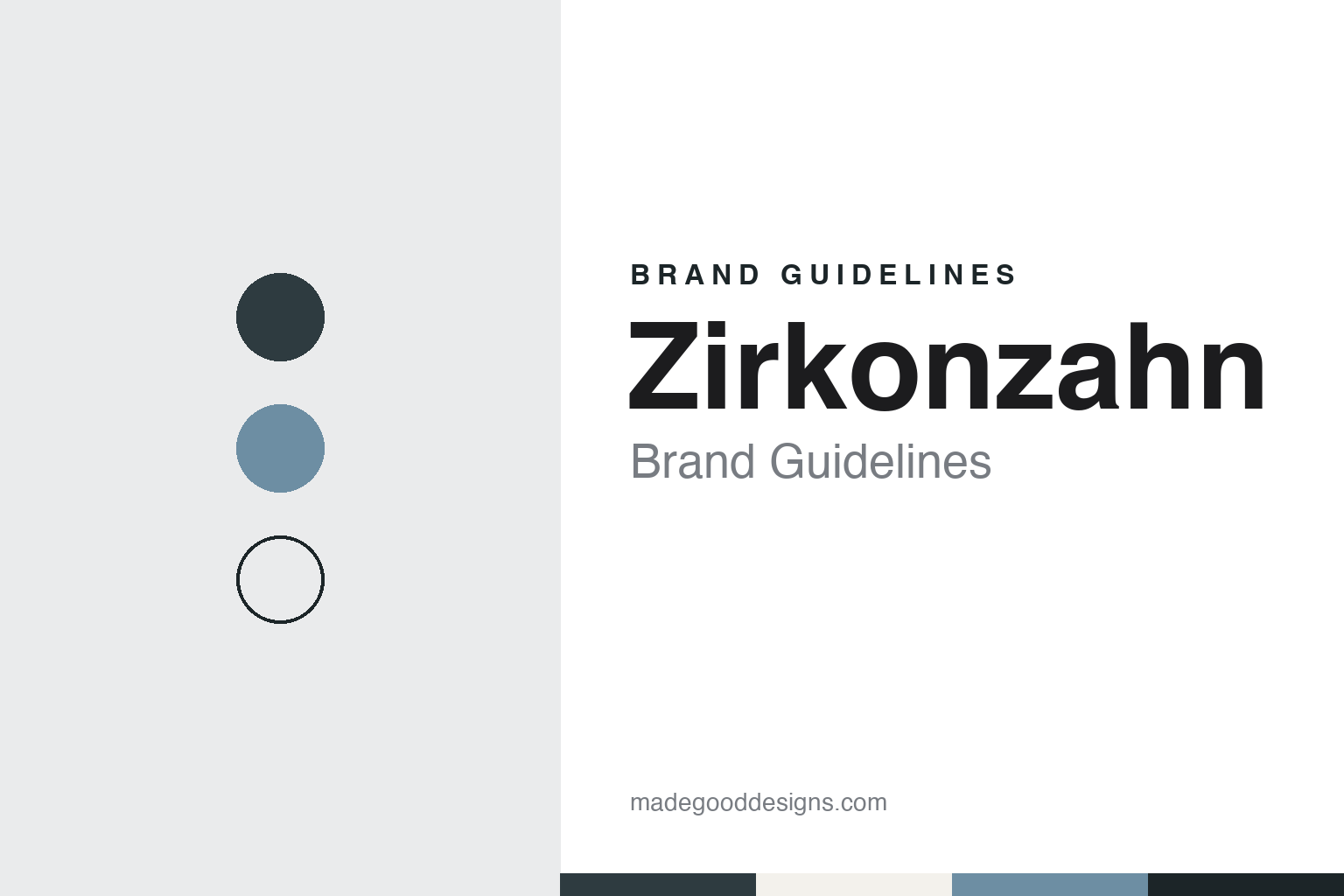
Zirkonzahn Brand Guidelines
The South Tyrol lab founded on a hand-powered milling machine.
Aa
Two constants: a Zirkonzahn alpine slate and glacier blue palette and an Alpine serif register. Abstract homage — not a Zirkonzahn product or mark; no machine, material, logo or wordmark is reproduced.
A basement in the Ahrntal
A dental technician’s hand-powered machine.
Zirkonzahn, a name that joins the German words for zircon and tooth, is a dental technology company in Gais, in the Aurina Valley, or Ahrntal, of South Tyrol in northern Italy. It was founded in 2003 by the dental technician Enrico Steger, the company says, a date repeated in a 2020 company profile in the Australian trade magazine eLABORATE. The company calls itself Zirkonzahn GmbH; a 2025 article in the customer magazine of the machine-tool group StarragTornos gives the Italian form, Zirkonzahn Srl.
The company tells its founding as a workshop story. Steger, it says, grew up in the Ahrntal, trained as a dental technician, worked in laboratories in several countries, particularly Germany, and came back to South Tyrol in his mid-twenties to set up his own laboratory in a basement. He passed ideas to other companies and lectured abroad, starting with an invitation to Japan.
When zirconia arrived as a new and costly material for dental work, processed then on expensive computer-controlled machines, Steger decided to build a manual milling machine instead, driven by the strength of the hands. The prototype began, the company says, as a simple wooden model and took about two years to become a machine ready for sale: the Zirkograph. He presented it on a tour of Central Europe in 2004, and by the company’s account some 700 people had pre-registered half a year later. The company says Steger feared people would laugh at a hand-operated machine in a computer-controlled industry, so he showed the finished results first and only then the device he had built himself. The motto it attaches to the story is “Move the world with your hands.”
The company credits the machine’s success to simplicity and low cost for the dental technician, and says it could mill both simple and highly complex work, including bridges of fourteen units. It says the business soon moved out of the basement, made its own improved drills and kept developing new products, and that its administrative office now works in twelve languages.
Colour
Everything made in the Alps.
From the Zirkograph, Zirkonzahn built a complete laboratory system. eLABORATE’s 2020 profile listed what it designs and produces in-house: zirconia under the Prettau name, resins and metals, patient-diagnostic tools, CAD/CAM systems, furnaces, colouring liquids, burs and implant-prosthetic components for more than 100 implant systems. The same profile called Steger the “father” of Prettau zirconia and of the Prettau Bridge, a monolithic full-arch bridge of 14 units.
The current range follows simple naming. On the company’s website the zirconia line runs from Prettau 2 Dispersive to Prettau 5; milling units are numbered from M1 to M6, scanners are the S300, S600 and S900 ARTI, and the software is sold as modules with dotted names such as Zirkonzahn.Scan and Zirkonzahn.Implant-Planner. The StarragTornos article also named the PlaneSystem, a diagnostic system for capturing information about a patient’s jaw for the design of dentures.
Production stays in the Alps. The company says its entire production and head office remain in South Tyrol, where it makes its milling system, dust extractor, furnace and dyeing liquids and sinters its zirconia blanks. The 2025 StarragTornos article, written by a supplier, put the workforce at around 350 employees, mainly at several sites in the Puster Valley, and reported that the company runs a fleet of 27 Tornos machines to make parts such as titanium bases. “We combine all processes under one roof, from the development of the tools to the production of the parts,” Steger told the magazine. eLABORATE had counted almost 300 employees in 2020, describing growth from a one-person business.
Typography
Design and documentation.
Dental implant and digital-dentistry companies sell to a narrow, expert audience, and their pictures show it. The typical product image is a small titanium screw shot on a white or pale grey ground, often beside its abutment and the driver that seats it, and lit to show the thread and the surface. Packaging tends to follow the same order: clean white boxes, colour codes for sizes, and the product line’s name set larger than the company’s.
Digital dentistry adds a second set of images. Intraoral scanners appear as slim wands next to a laptop or a cart, and the screen matters as much as the hardware: a coloured three-dimensional render of an arch, a planned implant position inside a CT slice, or a crown being shaped in design software. Milling machines and printers are shown with the blocks and discs they cut, and finished work is usually photographed as a single milled crown or bridge on a neutral surface.
The third subject is the clinician. Implant makers run training courses, symposia and hands-on sessions, and their brochures and press releases often show lecture halls and dentists at practice models rather than patients. Trade fairs carry much of that presentation: IDS, the International Dental Show in Cologne, and the congresses of the European Association for Osseointegration are where companies set up large stands, launch product lines and gather speakers.
The result is a category that looks clinical and orderly, with white space, steel greys and one or two accent colours carrying most of the identity. The companies in this guide include implant makers from South Korea, Europe, Brazil and the United States, alongside firms in intraoral scanners, lasers and CAD/CAM software. Each guide sets out who founded the company, who owns it now and what it says about where its products are made, separating documented facts from the company’s own claims.
Aa
An alpine serif — a name joining zircon and tooth. (Specimen set in Spectral, a serif STAND-IN; NOT the Zirkonzahn logo.)
Zirkonzahn
“Move the world with your hands.”
Teaching is part of the brand. Zirkonzahn runs its own course programme, “Die Zirkonzahn Schule,” which eLABORATE named in 2020 as one of the company’s signature offerings, together with its Zirkonzahn.Support service. Its website lists education centres including one in Brunico, in South Tyrol, and one at Neuler in Germany, and a research laboratory, Dental Laboratory Steger in Brunico, which the company says develops materials, working methods and course concepts, documents cases in its own photo studio and trains future dental technicians.
The company says it exports to more than 100 countries and has 15 branches worldwide. eLABORATE reported in 2020 that Steger runs the business together with his son, Julian Steger, also a master dental technician. The company also says Steger takes part himself in packaging design, the decoration of its offices and its website, and that he wanted the headquarters architecture to express order, cleanliness and discipline alongside creativity, with linear offices in glass.
For a design guide, Zirkonzahn shows how a brand can be built around a place and a founding object: an Alpine valley and a milling machine worked by hand. Compare exocad, the Darmstadt dental CAD software maker, and 3Shape, another digital-dentistry name. For this guide we use an alpine slate, a zirconia white and a glacier blue with a serif, an unofficial interpretation; no product or logo is reproduced.
Explore & save
Keep Zirkonzahn’s identity on hand — save it to a board in the Made Good inspiration library.
Zirkonzahn identity set
Pin the Zirkonzahn alpine slate and glacier blue palette and the Alpine serif register to your own board.