Lidea Brand Guidelines
The 2020 merger of two south-west French seed companies under one new name.
Aa
Two constants: a maize-leaf green and sunflower-yellow palette and a clean contemporary sans register. Abstract homage — not a Lidea product or mark; no seed bag, logo or variety label is reproduced.
Two seed houses
Euralis and Caussade, side by side.
Lidea is a young name built on two older seed businesses from the south-west of France. It came into being on 1 September 2020, when the combination of Euralis Semences and Caussade Semences Group took effect, as Seed World reported that day and the farm magazine Réussir confirmed on 7 September 2020. Announcing the new company, AFP described Euralis as based in the Pyrénées-Atlantiques and Caussade in the Tarn-et-Garonne.
The larger parent is Euralis, an agricultural and food cooperative group. French Wikipedia dates it to 1936, when a group of farmers in the south-west came together to sell their wheat as the wheat cooperative of the Adour basin, and places its head office at Lescar, near Pau. The same article says the cooperative built a maize seed research centre from 1960, began sunflower and soya research in the 1970s, launched the Soltis sunflower breeding programme in 1998, and took its seed business abroad from 1987, first to Germany and then, in 1993, to Seville.
The second parent, Caussade Semences Group, brought straw cereals among its crops, Réussir noted, alongside maize, sunflower and other species. Its chief executive since March 2019, Pierre Flye Sainte-Marie, became the first chief executive of Lidea; Seed World said he had earlier held senior European roles at Corteva and at Dow AgroSciences.
The new company was placed under a holding whose majority shareholder is Euralis, AFP reported, and Réussir wrote that Euralis had taken the majority of Lidea’s capital. Pierre Pagès, a vice-chairman of Euralis and a seed, maize and cereal farmer at Viella, became chairman of the board.
Colour
A name made from two names.
The name was chosen to sound new while keeping a link to the past. When the company was presented, Seed World wrote that Lidea had been picked as a modern, international brand in which each letter comes from at least one of the two original brands, and that it was meant to be easy to say and remember. Réussir gave the French pronunciation as “Lidéa.”
At its launch the company described itself in figures. Seed World and Réussir both reported more than 2,000 employees, eight seed production plants in France, Romania, Ukraine and Spain, four of them in France, 17 research stations across Europe and about 45,000 hectares of seed production in five countries. The crops named were maize, sunflower, rapeseed, straw cereals, forage crops, soya, sorghum and pulses, with cover crops also mentioned. AFP reported that maize and sunflower made up the largest share of sales.
The two leaders explained the logic in plain terms. Pierre Pagès told Réussir in September 2020 that it mattered to farmers to have a multi-species company able to offer them as wide a range of solutions as possible. Pierre Flye Sainte-Marie said the company was set up to supply all European markets and that the combination gave it the critical size to keep investing in research and development and to strengthen its brands. Speaking to AFP the same week, he described the aim simply as growth, noting that each parent already made most of its sales across greater Europe, from Spain eastwards, so the merger changed the depth of its presence rather than the territory.
The brands took a season to settle. For the 2020–2021 season, Réussir reported, the parent companies’ brands stayed in use — among them Euralis Semences, France Canada Semences, Codisem and Caussade Semences. In March 2021 the same magazine reported that, in France, Lidea would sell through two commercial brands instead of four. The Lidea brand would cover every species the company breeds, starting with rapeseed and the variety Capello, which Lidea described as the leading rapeseed variety in France. Caussade Semences Pro would offer a range built for distributors, including maize, sorghum and sunflower, and base seed of soya and straw cereals from which distributors could produce their own commercial seed. A further name, Actisem, was kept for that year.
Typography
Seed, field and fair.
Grass, forage and field seed companies sell something that looks almost the same in every bag, so much of their identity sits in where the seed ends up. Their pictures tend to come from three places: the finished turf of a football stadium or golf course, the cattle or sheep grazing a pasture, and the breeding plots where new varieties are tested in long rows before they reach a farmer. The Danish encyclopedia Lex, for example, illustrates its entry on DLF with a stadium pitch in Paris and a golf tournament in Arizona.
The seed bag itself often carries the brand. Bags stacked on pallets in a warehouse or a dealer’s yard are a common sight in the trade, and some companies make the bag the signature: Barenbrug says its grass seed is sold in yellow bags, and a 2020 release from its New Zealand business described the new name going onto those bags.
Many of these firms are owned by farmers or families rather than by listed groups, and they say so. DLF is held by a cooperative of Danish seed growers, according to Lex, while Barenbrug describes four generations of family ownership. Founding dates, anniversaries and long histories of mergers are therefore part of how such companies present themselves.
The trade also meets in person. Field days, demonstration plots and agricultural fairs such as Agritechnica in Germany and Farm Progress in the United States are where breeders show varieties to farmers, dealers and contractors. This guide sets out what can be checked about each company, who founded it, who owns it and what it sells, and marks clearly what rests only on the company’s own word.
Aa
A clean contemporary sans for a name coined in 2020. (Specimen set in DM Sans, a sans STAND-IN; NOT the Lidea logo.)
Lidea
The seeds arm of a cooperative.
Lidea now sits inside the Euralis group. Its own news pages describe its training programme as aligned with the priorities of Euralis’ Seeds Division, and they name Olivier Paul, who joined the Euralis group in 2015, as having joined Lidea in 2021 as managing director.
Euralis presents Lidea on its own site as a commercial trademark offering farmers more than 60 species and more than 500 varieties of maize, sunflower, small grains, rapeseed, soya, sorghum, fodder and cover crops. It lists research partnerships with Eurosorgho, Innolea, Soltis and GIE Grass, mentions more than twenty years of work in molecular genetics, and says Lidea ranks among the top ten field-crop seed producers worldwide, with about 2,000 employees. Those are the parent group’s own descriptions.
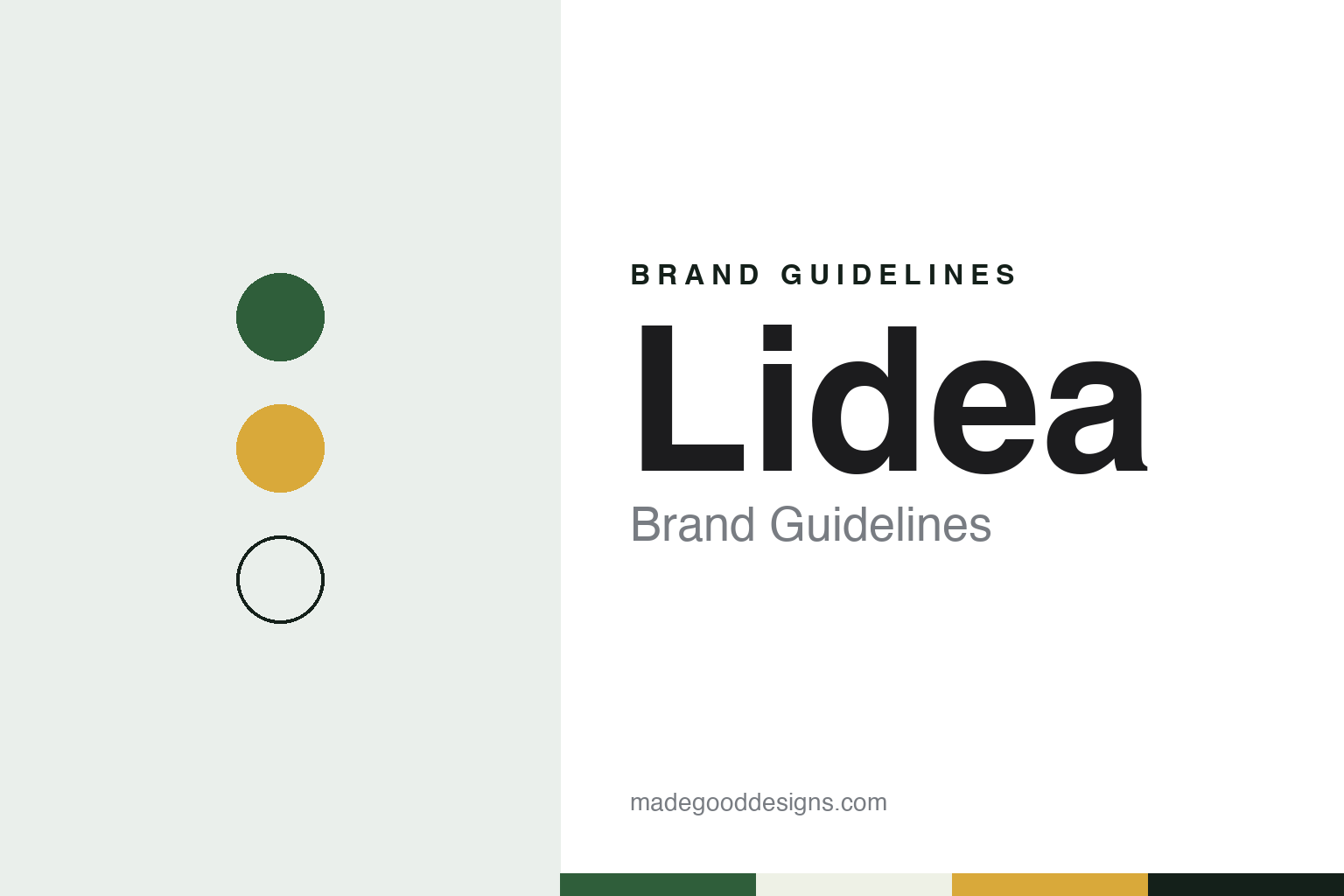
For a design guide, Lidea shows how a merger can be given a single coined name that keeps traces of both parents in its letters while the older brands stay on in a narrower role. Compare RAGT, another seed group from the south of France, and Limagrain, the French cooperative-owned seed group. For this guide we use a maize-leaf green, a pale stubble tone and a sunflower yellow with a sans, an unofficial interpretation; no product or logo is reproduced.
Explore & save
Keep Lidea’s identity on hand — save it to a board in the Made Good inspiration library.
Lidea identity set
Pin the Lidea green and sunflower-yellow palette and the clean contemporary sans register to your own board.