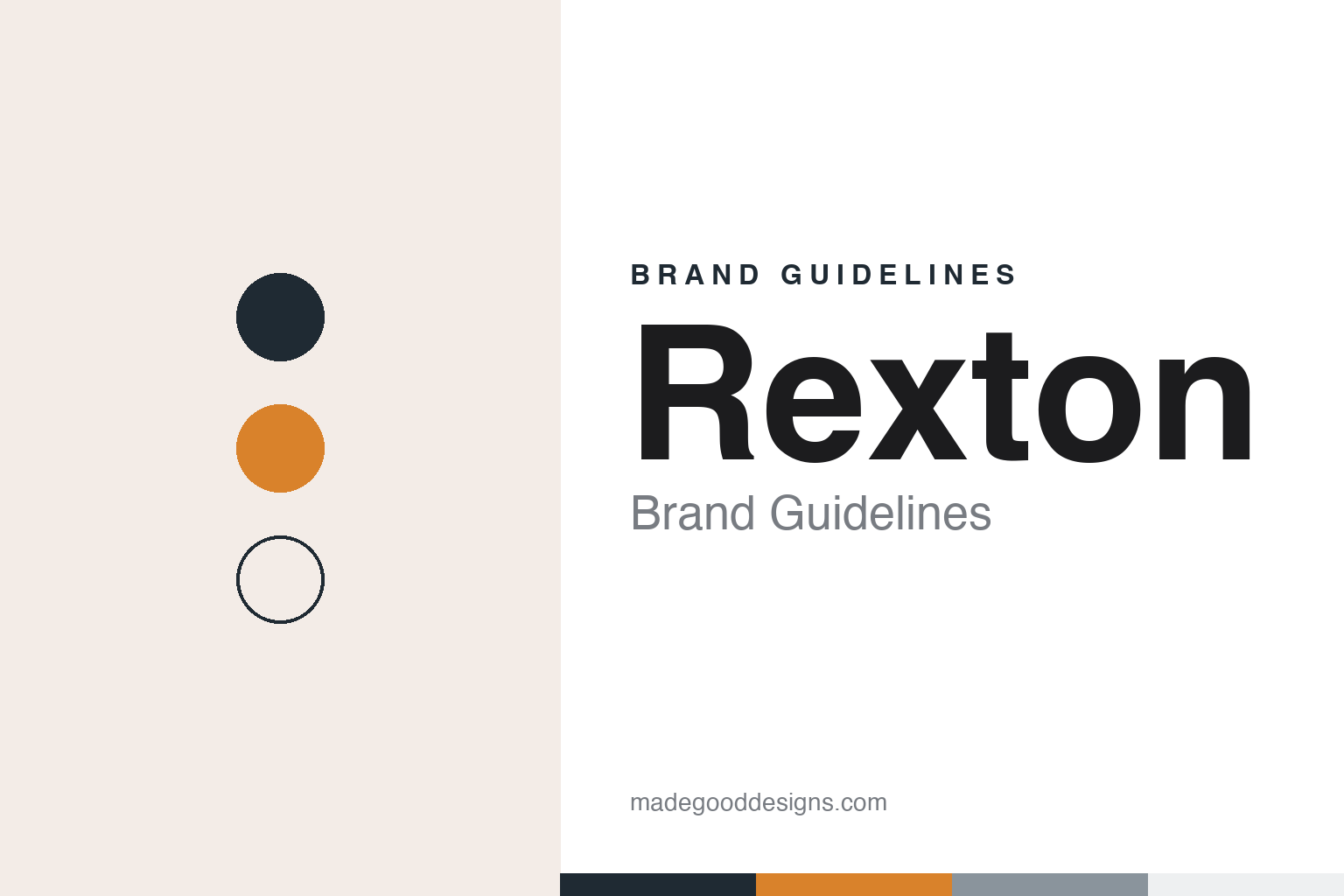
Rexton Brand Guidelines
A 1955 Zurich start, Siemens and WS Audiology.
Aa
Two constants: a slate, amber and steel palette and a workwear sans register. Abstract homage — not a Rexton product or mark; no hearing aid, logo or packaging is reproduced.
Zurich, 1955
A Swiss trader who began making his own aids.
Rexton began in Switzerland in 1955. German Wikipedia describes it as a Swiss hearing-aid group with seats in Zurich’s Albisrieden district and in Zug, founded by Paul Bommer. He started by trading in hearing aids and, the same article says, moved into making them in 1957; from the 1960s Rexton hearing aids were produced in Albisrieden. The brand still dates itself to that year: a 2020 Rexton press release published by HearingTracker opens its company note with “Since 1955.”
In 1962, German Wikipedia says, Bommer presented the Rexton Perle at the Basel Mustermesse, the Swiss trade fair: an in-the-ear hearing aid with a transistor amplifier, battery, microphone, receiver and volume control, weighing five grams. A Swiss patent for a miniature in-ear hearing aid insert, filed in 1985 in the name of Rexton Holding AG, lists Bommer among its inventors.
The business spread beyond Switzerland. German Wikipedia records a branch in Singapore in the 1970s, sales in Japan under the Sony label and distribution in Ecuador from 1977, and says Rexton was counted among the largest suppliers in the industry by 1986. It also credits Bommer with helping lay the groundwork for professional training of hearing-aid acousticians, the specialists who fit the devices.
Colour
Siemens, Sivantos, then WS Audiology.
Rexton did not stay independent. German Wikipedia says Bommer sold the Rexton group to Siemens in 1986; HearingTracker, on its Rexton brand page, gives the acquisition by Siemens Hearing Instruments as 1994. Either way, German Wikipedia says the Rexton name was kept on as a brand.
That business changed hands in the following decades. Siemens sold its audiology unit to the Swedish investor EQT — German Wikipedia dates the sale to 2014, English Wikipedia to 2015 — and the business was renamed the Sivantos group, which German Wikipedia says sold hearing aids under the Signia, Siemens, Audio Service, A&M and Rexton names. On 1 March 2019 Sivantos, based in Singapore, combined with Widex of Lynge, Denmark, to form WS Audiology, which English Wikipedia describes as headquartered in both Lynge and Singapore. Rexton’s website now carries a WS Audiology copyright line, and a 2024 report in HearingTracker placed it in the group alongside the Signia and Widex hearing-aid brands and the HearUSA and HearCANADA care networks. English Wikipedia lists Rexton among more than a dozen names the group sells under, from Signia and Widex to the online service hear.com.
HearingTracker gives its US headquarters as Minneapolis; the 2020 release came from Plymouth, Minnesota, and the 2024 announcement from Iselin, New Jersey. The same HearingTracker page credits Rexton engineers with a patented hybrid of 1995, a completely-in-canal receiver joined by a wire to a behind-the-ear processor, which it calls the first patented receiver-in-canal system, and says Rexton later sold that patent to Sebotek.
Typography
Design and documentation.
Hearing-aid makers sell a product that is meant to be hard to see, and much of their imagery works around that. Devices are shown balanced on a fingertip to make their size clear, or in close-ups of the ear, where a behind-the-ear case and its thin tube or wire are the only visible trace. The Bern newspaper Der Bund noted in 2012 that hearing aids, unlike glasses, still had an image problem, and that makers were trying both to shrink them and to give them designed housings in a choice of colours.
Colour tends to follow the body rather than fashion. Many ranges come in skin tones, greys and silvers meant to blend with hair and skin, with brighter shells offered as options. Around the device sit the settings of professional care: the audiology booth, the fitting session and, more recently, the phone app used to stream sound or adjust a program.
The industry is concentrated and old. In 2007 Germany’s competition authority, the Bundeskartellamt, named Siemens, Phonak and Oticon as the main producers in the German market, with GN ReSound and Widex as the next-largest. Several of today’s brands began inside telephone and telegraph companies: Bernafon at a Swiss telephone maker in 1946, and GN Hearing’s forerunner Danavox in a Danish group that started with telegraph cables. Most are now part of a few groups that each run several brands side by side.
The trade meets at its own congresses. In Germany the annual EUHA congress of hearing-aid acousticians is where makers show new ranges to the trade; in the United States the American Academy of Audiology’s convention, long known as AudiologyNOW!, plays a similar role. This guide sets out what can be checked about each brand — who founded it, who owns it and where its products are made — and marks clearly what rests on the company’s own word.
Aa
A sturdy workwear sans for a brand that talks about reliability. (Specimen set in Archivo, a sans STAND-IN; NOT the Rexton logo.)
Rexton
Rely on Rexton.
Rexton’s present-day voice is built around one phrase. Its website leads with “Rely on Rexton” and a stated mission “to deliver proven hearing technology in the most reliable way,” and it calls its hearing aids “Lifeproof,” a name it uses for products it says are built to be tough. Those are the company’s own words, and they set the tone for its photography and copy.
The website spells the promise out in four headings — proven technology, durable construction, ease of use and a dependable company — and says Rexton has supported wearers and hearing care professionals for “nearly 70 years.” Its Lifeproof page lists the tests it says its hearing aids go through, including drop, push, rain, UV and vibration tests, along with checks against sweat, heat and common creams and lotions, and it names an ATEX certification for its BiCore models. The page speaks directly to readers who work out, work in harsh environments or operate machinery, in short question-and-answer lines.
The current look dates from October 2020. Alongside a platform called Motion Core, with models including the M-Core SR, M-Core R-Li and the M-Core iX, which the release described as a completely-in-canal option with same-day fitting, Rexton announced a new brand identity. Its general manager said the new branding used “bold colors and powerful imagery,” and the release said the pictures focused on everyday workers such as nurses, firefighters and teachers. The same release quoted her saying that “the hardworking women and men of this country” wanted easy-to-use, affordable hearing solutions for work, play and home.
In March 2024 HearingTracker reported the launch of Reach, a family the company described as building on its earlier BiCore technology, starting with the Reach R-Li T, a rechargeable receiver-in-canal model with wireless streaming, and quoted its marketing vice-president naming restaurants, construction sites and medical facilities among the places it was meant for.
For a design guide, Rexton shows how a brand can keep its founding date while changing owners several times, and lean on a single promise of reliability. Compare Widex, its sister brand inside WS Audiology, and Hansaton, another hearing-aid name with roots in the German-speaking market. For this guide we use slate, amber and a steel grey with a sans, an unofficial interpretation; no product or logo is reproduced.
Explore & save
Keep Rexton’s identity on hand — save it to a board in the Made Good inspiration library.
Rexton identity set
Pin the Rexton slate, amber and steel palette and the workwear sans register to your own board.