Shurtape Brand Guidelines
The Hickory mill’s tape spin-off that bought Duck and FrogTape.
Aa
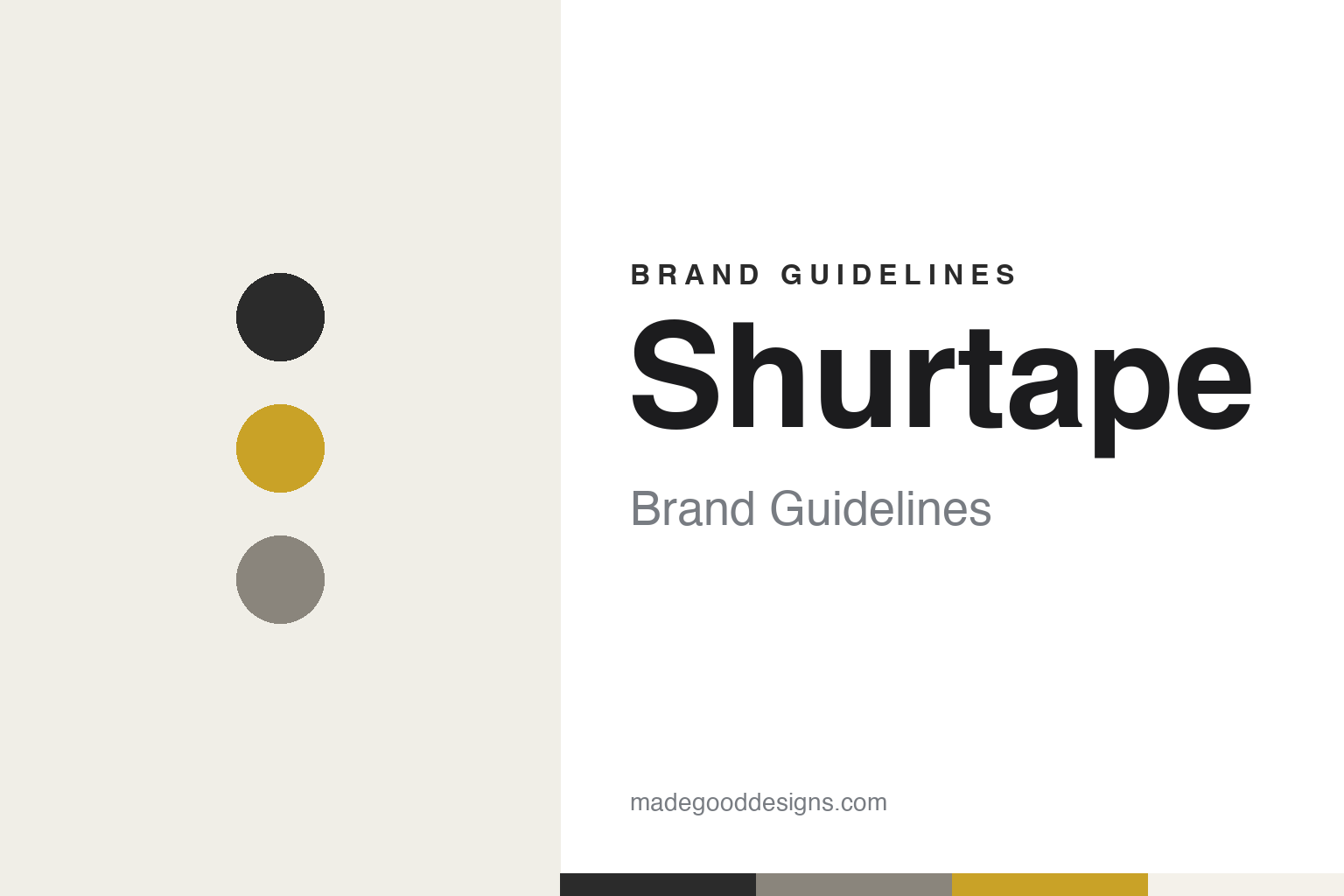
Two constants: a charcoal, warm grey and mustard palette and a condensed sans register. Abstract homage — not a Shurtape product or mark; no roll, logo or pack is reproduced.
Shuford Mills
A North Carolina textile mill that took up tape.
Shurtape grew out of a textile business. English Wikipedia says Shuford Mills was founded in North Carolina in 1880 by Abel Alexander Shuford, placing its start at Granite Falls, and that the Shuford family has been in business in Hickory since that year. The company itself describes a history that runs from spinning cotton, yarn and twine to making tape, and its industrial website speaks of 145 years of work.
Tape came in 1955. That year Shuford Mills launched a tape division focused on masking tape, according to Wikipedia; it began as a small section of the main factory in Hickory and later got a factory of its own. Shurtape’s industrial website also dates its tape portfolio “since 1955.” The history of the Duck brand, published by Shurtape, says Shuford Mills was already making packaging tape when it decided to add duct tape in 1972.
In 1996 the tape side was split off as a separate company, Shurtape Technologies, LLC, Wikipedia says, with the tape maker and the remaining textile business placed under a holding company, STM Industries. A plant in nearby Hudson followed in 1997, an expansion in Hickory and a converting site in Singapore in 2000, and a distribution centre in Catawba in 2004, the year Shurtape bought Permacel’s arts and entertainment tape division.
Colour
Duck, FrogTape and the brands it bought.
The biggest change came in 2009, the year Wikipedia gives for Shurtape’s purchase of the Duck business from Henkel. Reliable Plant reported that on 2 June Henkel announced the sale of its Duck, Painter’s Mate Green and Easy Liner businesses in the United States and Canada to Shurtape, including certain worldwide rights to the brands and Henkel’s facility in Avon, Ohio. Shurtape had been a long-term supplier to Henkel, and its president and chief executive, Jim Shuford, called the deal the formalisation of a 40-year relationship. The consumer brands became a new subsidiary, ShurTech Brands, based in Avon; the Duck website now calls that business Shurtape’s Consumer & Craftsman Group.
More brands followed. Wikipedia says Shurtape bought FrogTape, the painter’s tape, in 2010. In February 2017 it bought Syntac Coated Products of New Hartford, Connecticut, which was renamed Shurtape Specialty Coating, Packaging Gateway reported; the chief executive quoted then was Stephen Shuford. The renamed business stayed at its plant in New Hartford and added a new site in Sarasota, Florida, the magazine said, and around 50 Syntac employees joined Shurtape. Wikipedia adds that Shurtape Specialty Coating and the medical-adhesives business Shurmed now form its Engineered Solutions Group, and that in December 2018 the company announced plans for a new distribution and manufacturing centre in Catawba.
The Duck brand came with a long history of its own. Shurtape’s Duck website traces it to the Melvin A. Anderson Company, a small industrial tape distributor founded in 1950 and renamed Manco in 1971, which moved to a green pack colour in 1978 and created the Duck and Duck Tape trademarks in 1980, the site says.
Today the company lists brands including Duck, FrogTape, Shurtape and T-Rex. Its industrial range under the Shurtape name covers masking, cloth and duct tapes, HVAC tapes, flashing tapes, paper tapes and packaging tapes, including hot-melt and water-activated carton-sealing tapes, along with tape applicators and case-sealing machines.
Typography
How tape and strapping makers present themselves.
The makers in this guide sell much of their range to people who use tape and strapping at work: warehouse teams sealing cartons, packers securing pallets, contractors masking a wall or sealing a duct. Their catalogues tend to be organised around jobs and materials. Shurtape’s industrial website, for example, sorts its range by trade — construction, HVAC, packaging, marine — while IPG lists pressure-sensitive and water-activated tapes, stretch and shrink films and packaging machinery side by side.
That gives the category a recognisable set of pictures for a designer to study: rolls of tape on their cardboard cores, often stacked by colour or width; cartons running through a case sealer at the end of a packing line; steel or plastic strapping drawn tight around a loaded pallet with a hand tool or a machine; and close-ups of an adhesive face or a cut edge. Some makers, Shurtape among them, give their trade tapes short codes of letters and numbers rather than names.
The trade also meets in person. PMMI’s Pack Expo shows in the United States, interpack in Düsseldorf and FachPack in Nuremberg, which held its 2025 edition in September, gather makers of packaging materials, tapes, strapping and the machines that apply them together, and a maker’s stand there is one of the places its identity is seen at full size.
This guide sets out what can be checked about each brand — who founded it, who owns it now, and what it says about where its products are made — and marks clearly what rests only on the company’s own word. The colours and typefaces shown are our own unofficial interpretation, not any maker’s official palette.
Aa
A condensed sans for coded trade tapes. (Specimen set in Barlow Condensed, a sans STAND-IN; NOT the Shurtape logo.)
Family-owned
Still run by the Shuford family from Hickory.
Shurtape remains a private, family business. Wikipedia describes it as owned and operated by the Shuford family, with its corporate headquarters in Hickory, North Carolina, and with Shurtape and the textile business both held by STM Industries. As of 2017 it had around 1,500 employees and 13 manufacturing facilities, the encyclopedia says, and its industrial arm now presents itself online as Shurtape Industrial.
The company says it has facilities in the United States, Canada, the United Kingdom, Germany, Mexico, Peru, Denmark, Australasia, the United Arab Emirates and China. On where its tapes are made, its wording is careful: its industrial website says it makes “many” of its tapes in the United States, and its “Made in USA” page carries a note that those tapes use US and global materials.
The Shurtape name itself works as a trade brand. Its industrial website groups products by trade — construction, HVAC, packaging, auto aftermarket and marine — and gives most tapes a short code of letters and numbers, such as a “PC” prefix on many cloth duct tapes and an “HP” prefix on hot-melt packaging tapes, rather than a consumer name. The consumer-facing Duck and FrogTape names sit alongside it, and the industrial site also carries a “Duck Pro by Shurtape” line. The group’s company profile also names Kip and Pro Tapes among its brands.
For a design guide, Shurtape shows how one maker can run a trade brand of coded tapes next to consumer names it bought. Compare Intertape Polymer Group, another North American tape group, and 3M. For this guide we use a charcoal, a warm grey and a mustard yellow with a condensed sans, an unofficial interpretation; no product or logo is reproduced.
Explore & save
Keep Shurtape’s identity on hand — save it to a board in the Made Good inspiration library.
Shurtape identity set
Pin the Shurtape charcoal, warm grey and mustard palette and the condensed sans register to your own board.