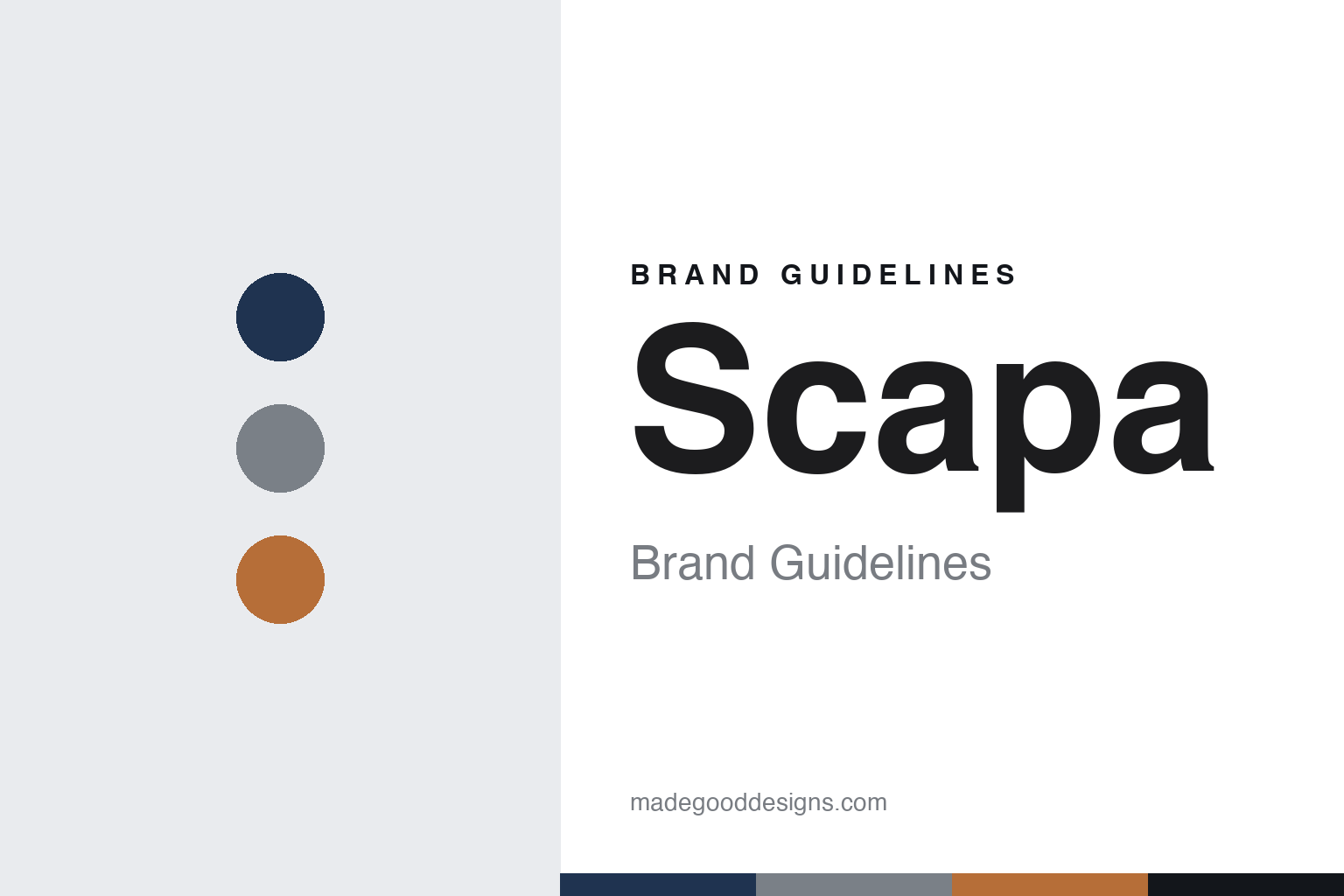
Scapa Brand Guidelines
From Blackburn dryer felts to cable tapes inside Mativ.
Aa
Two constants: a navy, grey and copper palette and an engineered sans register. Abstract homage — not a Scapa product or mark; no roll, logo or label is reproduced.
Scapa Dryers
A felt maker in Witton, Blackburn.
Scapa began as a textile business in Lancashire. The UK company register, Companies House, shows a company incorporated on 1 July 1927 as Scapa Dryers Limited. It kept that name until November 1970, when it became Scapa-Porritt Limited; in 1993 it was renamed Scapa Scandia, and in 1999 Scapa Blackburn Limited, the name it still holds as a non-trading company.
The firm was based at Witton, in Blackburn. In a 2020 look back at the business, the Lancashire Telegraph described Scapa Dryers as a company with an international reputation that “helped put Blackburn on the map.” It made specialist fabrics, including the press felts used on paper-making machines around the world, and it worked on a giant scale: the paper’s archive photographs show fabric being woven on 55-foot-wide looms, and the factory building across the road from Witton Park, the paper noted, has since been divided into separate units. The firm employed hundreds of people at its peak, the paper said, and several generations of local families worked there; it even ran its own social club in nearby Cherry Tree.
The Lancashire Telegraph pictures run from the late 1960s into the early 1990s — the laboratory at Scapa Dryers in 1970, a dryer felt being woven on one of the wide looms in 1976, a heat-setting machine at Scapa Porritt in 1992 — a record of the felt and fabric trade on which the Scapa name was built.
A holding company sat above the operating business. Companies House shows Scapa Group incorporated on 5 November 1964 and registered as a public limited company until April 2021. Both the group company and the old felt company are now registered at Ashton-under-Lyne, in Greater Manchester, where Scapa Industrial runs one of its plants.
Colour
Cable tapes, industrial tapes and contract manufacturing.
By the time it changed hands in 2021, the Scapa name stood for adhesive products rather than felts. The buyer’s own announcement described Scapa Group as a “UK-based innovation, design, and manufacturing solutions provider for healthcare and industrial markets,” and it pointed readers to two websites — one for Scapa Healthcare and one for Scapa Industrial. Those two names are how the brand is presented today.
Scapa Industrial describes itself as a maker of adhesive tapes for the automotive, cable, building and construction, and specialty markets, with production in North America, Europe and Asia, and says it is a member of Afera, the European adhesive tape association. Its capabilities page lists six plants: Ashton-under-Lyne in England, Valence in France, Ghislarengo in Italy, Renfrew in Canada, Windsor in Connecticut and Chennai in India. The Ashton site, it says, handles processes including calendering, hot-melt extrusion, PIB laminating and bitumen impregnation; each plant is listed with its own quality and environmental certifications.
Cable is the market with the longest story on the site. Scapa Industrial says cable makers have relied on its cable tapes and jointing components for more than 110 years, and describes ranges of water-blocking, semi-conducting and insulating tapes and yarns for telecom, power, mining, railway and subsea cables. It names the NorNed subsea power link between Norway and the Netherlands as one project its products are used on — its claim, not independently checked here.
Scapa Healthcare, the second business, presents itself as a contract development and manufacturing partner for healthcare and consumer companies, designing and making adhesive-based products for other brands. Its home page now carries the line that it is “part of MATIV.”
Typography
Rolls, pallets and trade fairs.
The makers in this guide sell much of their range to people who use tape and strapping at work: warehouse teams sealing cartons, packers securing pallets, contractors masking a wall or sealing a duct. Their catalogues tend to be organised around jobs and materials. Shurtape’s industrial website, for example, sorts its range by trade — construction, HVAC, packaging, marine — while IPG lists pressure-sensitive and water-activated tapes, stretch and shrink films and packaging machinery side by side.
That gives the category a recognisable set of pictures for a designer to study: rolls of tape on their cardboard cores, often stacked by colour or width; cartons running through a case sealer at the end of a packing line; steel or plastic strapping drawn tight around a loaded pallet with a hand tool or a machine; and close-ups of an adhesive face or a cut edge. Some makers, Shurtape among them, give their trade tapes short codes of letters and numbers rather than names.
The trade also meets in person. PMMI’s Pack Expo shows in the United States, interpack in Düsseldorf and FachPack in Nuremberg, which held its 2025 edition in September, gather makers of packaging materials, tapes, strapping and the machines that apply them together, and a maker’s stand there is one of the places its identity is seen at full size.
This guide sets out what can be checked about each brand — who founded it, who owns it now, and what it says about where its products are made — and marks clearly what rests only on the company’s own word. The colours and typefaces shown are our own unofficial interpretation, not any maker’s official palette.
Aa
An engineered sans for an industrial tape name. (Specimen set in IBM Plex Sans, a sans STAND-IN; NOT the Scapa logo.)
Scapa
From a public company to two brands inside Mativ.
Scapa’s independence ended in 2021. On 15 April 2021 the Georgia-based performance-materials company Schweitzer-Mauduit International, known as SWM, announced that it had finalised its acquisition of Scapa Group plc, saying the deal brought new coating and converting technologies into its business. Companies House records the change that followed: Scapa Group stopped being a public limited company on 28 April 2021 and has since been registered as a private company whose business is the activities of a head office.
A year later the owner itself changed. On 6 July 2022, SWM and Neenah, Inc. completed a merger of equals and the combined company began trading on the New York Stock Exchange as Mativ Holdings, based in Alpharetta, Georgia, according to Mativ’s announcement and a same-day report in the trade journal PaperAge. Mativ’s website now lists Scapa Industrial and Scapa Healthcare among its brands, alongside names such as Neenah papers and the Renfrew Pro hockey tape, and calls Scapa Industrial a “leading global manufacturer of bonding products and adhesive components” — its own description.
The Scapa name also carries legal history from its felt years. In the United States, Scapa’s dryer-felt business has faced asbestos product-liability litigation. In November 2005 Maryland’s Court of Special Appeals overturned a jury verdict against Scapa Dryer Fabrics, a Connecticut-based unit of Scapa Group, and sent the case back for a new trial, ruling that the company should have had more time to prepare its defence, the Associated Press reported in Insurance Journal. The case concerned dryer felts supplied to a paper mill in the 1960s and 1970s.
The web address follows the same path: the old Scapa group domain now forwards to the Scapa Industrial site, which describes the business as “a Mativ brand.”
For a design guide, Scapa shows how an industrial name can outlive its first trade: a felt maker’s brand that now sits on cable tapes and medical contract work under an American owner. Compare Advance Tapes, an independent English tape maker, and 3M, another company whose tapes grew out of a different first business. For this guide we use navy, grey and a copper tone with a sans, an unofficial interpretation; no product or logo is reproduced.
Explore & save
Keep Scapa’s identity on hand — save it to a board in the Made Good inspiration library.
Scapa identity set
Pin the Scapa navy, grey and copper palette and the engineered sans register to your own board.


