True Manufacturing Brand Guidelines
The Trulaske family’s Missouri refrigeration maker, from bottle coolers to kitchen reach-ins.
Aa
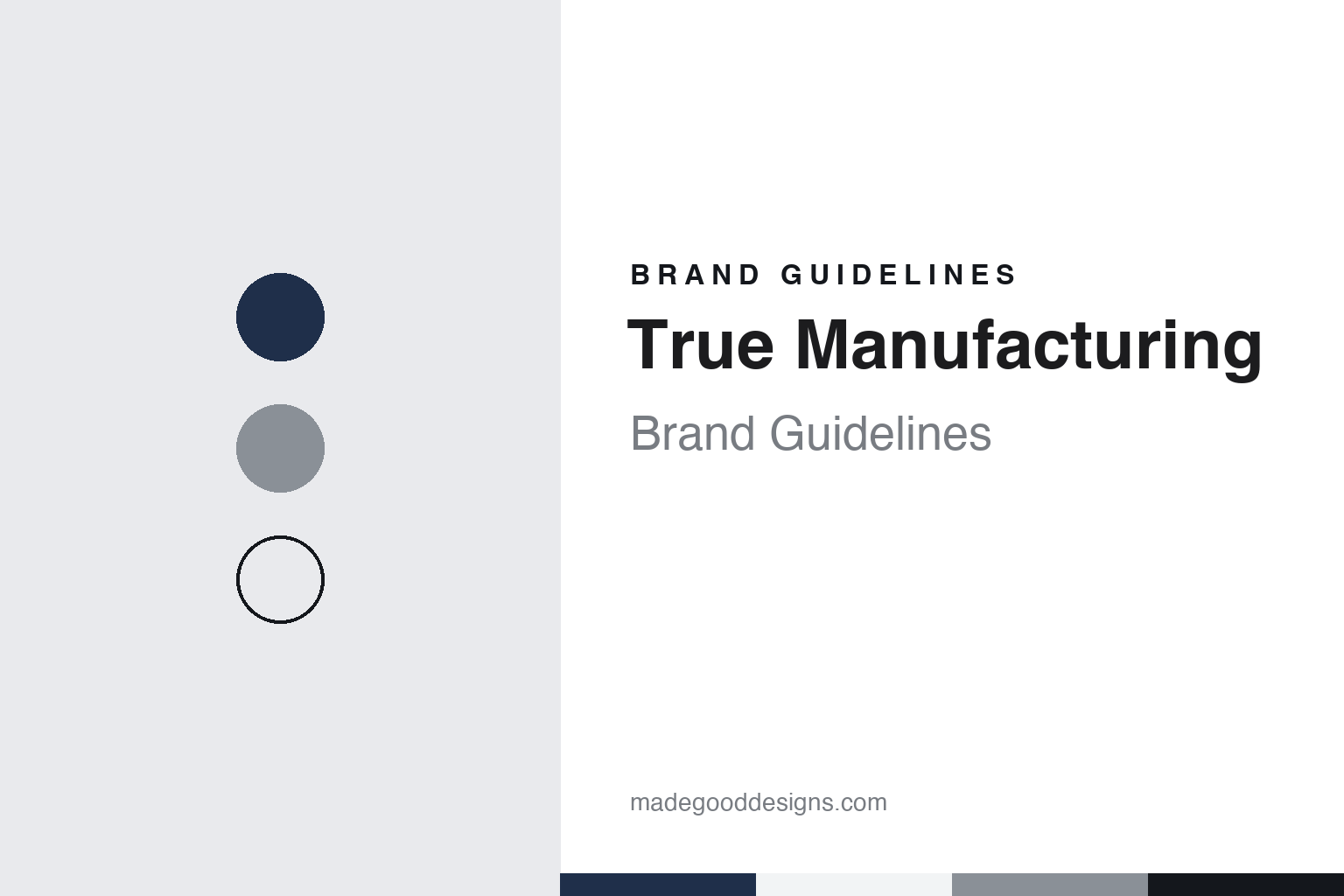
Two constants: a navy, steel and cold white palette and an industrial sans register. Abstract homage — not a True Manufacturing product or mark; no cabinet, logo or nameplate is reproduced.
A family idea
A war veteran’s savings and his father’s plan.
True Manufacturing began in Missouri in 1945. The company dates its “Passion for Cold” to that year, and a 2017 profile in the magazine of the Foodservice Consultants Society International (FCSI) tells the story. Bob (Robert J.) Trulaske, back from the Second World War, put his savings behind an idea of his father, Frank, a tool and die maker: to take electric refrigeration, then just arriving in homes, into restaurants and bars. With Bob’s brother Art, the family built some of its first commercial cabinets in the backyard of the family home in Wellston, Missouri, FCSI says; the company’s own timeline places the first upright freezer in a St. Louis garage.
That first batch was eleven upright freezers for meat storage. FCSI reports that they sold slowly until meat rationing was announced, when the rest went quickly and a backorder built up. The company’s anniversary page dates its first product, a 40-cubic-foot upright freezer, to 1946. The name was a family decision: Geraldine Trulaske, Bob’s wife, suggested dropping the “laske” from Trulaske, according to FCSI, and any echo of President Truman was a coincidence.
Bottlers came next. In 1948, FCSI says, a 7UP salesman noticed a True beverage cooler in a neighbourhood bar that worked without a block of ice, and 7UP placed its first order for True roll-top bottle coolers. Horizontal bottle coolers followed for 7UP and later for Coca-Cola and Pepsi, and production moved to a multi-storey warehouse on Pine Street in downtown St. Louis. In the 1950s, FCSI reports, Pepsi asked True for a vertical glass-door display refrigerator; True tested the prototypes in Puerto Rico’s heat and salt air, and the design opened sales across the Caribbean. The company’s timeline places its GDM upright glass door merchandisers in the 1960s, while the FCSI product list dates the first GDM to 1957.
Colour
From bottlers to restaurant kitchens.
The move into restaurant kitchens came in the early 1970s. FCSI says Bob Trulaske gave his elder son, Robert Trulaske Jr., the job of building a foodservice line of refrigerators and freezers for restaurant and hotel kitchens, and that father and son showed it at the National Restaurant Association show in 1972, where buyers still saw True as a maker of coolers for Coke and Pepsi. The line grew anyway. The FCSI product list runs from the T-Series reach-in in 1982 to undercounters and worktops in 1985, sandwich and salad prep units in 1988, pizza prep tables in 1990 and curved glass display cases in 2003; the company names the T-Series reach-in and the sandwich/salad prep table as the two core models of its foodservice business in the 1980s.
Today the range covers reach-in refrigerators and freezers, food prep tables, undercounters and worktops, glass-door and open-air merchandisers, milk coolers, bar refrigeration and heated cabinets, according to the company’s website, alongside a residential line, scientific refrigeration and True Ice, its own commercial ice machines and bins, which it showed at the NAFEM show in 2025. The anniversary page says True offered close to 800 models by 2006; FCSI counted more than 900 types of refrigerators and freezers in 2017. A powder-coating facility, opened in the 2010s, lets buyers order cabinets in custom colours, the company says, and its website presents this as a design option for bars, bakeries and shops.
Refrigerants are part of the record. FCSI reported in 2017 that True had been one of the first American makers to move to R290, a purified propane refrigerant, a step that helped it win business with McDonald’s in the United States, and that True was among the companies that petitioned the Environmental Protection Agency to allow its use. The company says it released a pilot hydrocarbon model, the GDM-19T-HC, in the 2010s.
Typography
How cold is sold.
Commercial refrigeration is a trade that sells itself through equipment people rarely notice. In restaurant kitchens it appears as rows of stainless steel reach-in refrigerators and freezers, undercounter units and prep tables, built to be cleaned, opened hundreds of times a day and serviced on site. Its makers present those cabinets plainly: model numbers, door counts, capacities and finishes, with the brand name on a small badge or kick plate.
In shops the same makers face the customer. Glass-door merchandisers, open-air cases and curved glass display counters hold drinks, dairy and prepared food at the point of sale, and many carry the colours of a bottler or a grocer rather than the maker’s own. Ice machines sit between the two worlds: a machine that turns water into cubes, flakes or nuggets, usually above a bin, in a bar, hotel corridor or hospital kitchen.
The industry meets at trade fairs. The NAFEM Show in the United States, organised by the North American Association of Food Equipment Manufacturers, HOST in Milan and HostelCo in Barcelona are among the places where makers show new cabinets and ice machines to dealers, consultants and chain buyers. Restaurant association shows have played the same role for decades: True Manufacturing, for one, first showed its foodservice line at the National Restaurant Association show in 1972, according to a 2017 profile in the FCSI magazine.
Ownership varies widely across the names in this guide: some remain family companies, some are listed groups such as Japan’s Hoshizaki, and others now sit inside larger equipment groups. This guide sets out what can be checked about each brand — who founded it, who owns it and where it says its products are made — and marks clearly what rests only on the company’s own word.
Aa
An industrial sans — the register of stainless cabinets and bottle coolers. (Specimen set in Archivo, a sans STAND-IN; NOT the True Manufacturing logo.)
True Manufacturing
Family-owned and built in Missouri, the company says.
True has stayed in the family. The company calls itself “family-owned since day one” and “family-owned and operated for over four generations.” In 2017 FCSI described Steve Trulaske, Bob’s younger son, as the third-generation owner; he had joined in the 1980s to build the international business, following leads through Coca-Cola and other customers into Spain, Korea and Canada. At the time FCSI listed True offices in Germany, the UK, Chile, Mexico and Sydney, with exports to 100 countries from its manufacturing base in St. Louis.
Where the products are made is central to how True presents itself. FCSI wrote in 2017 that every one of its products was made in the United States. The company today says each unit is “designed and engineered with pride – in the USA” and built in its “Missouri-based manufacturing facilities.” Its headquarters is in O’Fallon, Missouri, where, FCSI reports, True opened a 638,000-square-foot office and warehouse building in 1998.
In May 2024 the US Consumer Product Safety Commission announced a recall of about 29,200 True commercial refrigerators fitted with a Secop compressor and sold between January 2018 and June 2020. The notice cited fourteen reports of fires with property damage and no injuries, and the remedy was a free repair to the compressor’s starting components; True had announced a voluntary retrofit in March 2024.
For a design guide, True Manufacturing shows how a supplier to bottlers became a kitchen brand while keeping its family name and its factories in Missouri. Compare Hussmann, another St. Louis refrigeration name, and Hoshizaki. For this guide we use a deep navy, a brushed steel grey and a cold white with a sans, an unofficial interpretation; no product or logo is reproduced.
Explore & save
Keep True Manufacturing’s identity on hand — save it to a board in the Made Good inspiration library.
True Manufacturing identity set
Pin the True Manufacturing navy, steel and cold white palette and the industrial sans register to your own board.